Anambra Receives N11.6bn Ecology Funds, Spends N1.18bn As Erosion Swallows Roads, Homes

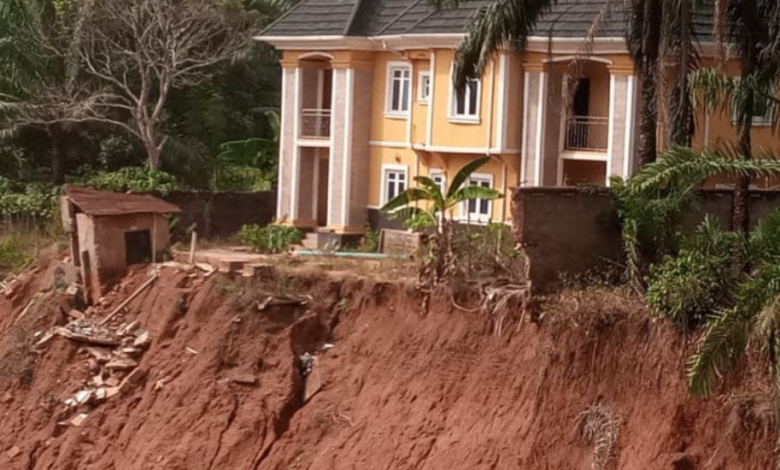
Anambra State and its 21 Local Government Areas (LGAs) received over N11.623bn in ecological fund allocations between 2023 and June 2026, but erosion and flooding continue to destroy roads, houses and farmlands across the state.
The state government received N6.371bn, while its 21 LGAs shared N5.251bn, according to an analysis of monthly Federation Account Allocation Committee (FAAC) records by THE WHISTLER.
Despite the federal allocations, Anambra’s financial records show that only N1.181bn was spent on erosion and flood control between 2023 and June 2026, representing 11.94 per cent of the cumulative N9.890bn appropriated for the purpose during the period.

Anambra, described by Governor Chukwuma Soludo as the nation’s erosion capital, has about 30 per cent of its landmass affected by gully erosion and flooding, attributed to its coarse and friable soil and human factors.
These factors, including waste dumps along drainage routes, structures on waterways and deforestation, have fuelled the state government’s call for self-regulation amid grievances from residents.
However, Soludo’s remarks that the state lacks the financial capacity to completely resolve the perennial problem have also raised questions about how available ecological resources are being deployed.
Between 2023 and June 2026, the Office of the Accountant-General of the Federation (OAGF) distributed cumulative Ecological Fund revenue of N6.371bn to the state government, comprising N1.269bn in 2023, N1.435bn in 2024, N2.290bn in 2025 and N1.377bn in the first half of 2026.
Likewise, a separate distribution to the 21 LGAs stood at N5.251bn, comprising N962.947m in 2023, N1.221bn in 2024, N1.916bn in 2025 and N1.152bn in the first half of 2026.
The allocations increased over the years. While the state’s allocation rose by 13.1 per cent in 2024 and 59.6 per cent in 2025, the LGA allocation increased by 26.8 per cent in 2024 and 57.0 per cent in 2025.
What The State Recorded
Some discrepancies, however, were identified between FAAC’s published disbursements and the state’s budget and financial records.
An analysis of the Anambra Accountant-General’s Report on the ‘State Share of Ecological Fund From FAAC’ revealed N10.287bn in cumulative Ecological Fund revenue between 2023 and June 2026.
The records listed under the ‘Other Statutory Transfers’ revenue section recognised only the state’s share of the revenue, not that of the LGAs.
THE WHISTLER‘s analysis revealed that while the monthly FAAC distribution records showed over N6.371bn in state Ecological Fund allocations, Anambra recognised N10.287bn in Ecological Fund revenue over the same period.
The state’s recognised revenue comprised N1.167bn in 2023, N4.552bn in 2024, N3.287bn in 2025 and N1.281bn in the first half of 2026.

The analysis showed that the state recorded significantly higher Ecological Fund revenue in 2024 and 2025 than the corresponding FAAC allocations. The cumulative difference stands at N3.916bn.
Notably, the disparity should not automatically be regarded as a surplus in FAAC disbursements or compared on a cash-for-cash basis, as the two sets of records could reflect different accounting periods, adjustments or recognition bases.
THE WHISTLER also identified differences in the state’s reported 2024 figure.
While Anambra’s 2024 Q4 Budget Implementation Report (BIR) recorded N4.253bn in Ecological Fund revenue, the 2025 Accountant-General’s audited statement, published in July 2026, gave the 2024 comparative figure as N4.5519bn.
The difference raises a reconciliation question between the two state records, although the available documents do not, by themselves, establish the reason for the variation.
Anambra Ecology Fund Budget Performance
Beyond federal revenue allocations, there is also a need to evaluate spending on erosion and flood management across the state.
An analysis of Anambra State’s Q4 BIRs and Accountant-General’s reports showed that, out of N32.516bn budgeted as Ecological Fund revenue between 2023 and June 2026, the state’s financial records recognised N10.287bn in Ecological Fund revenue over the same period.
The breakdown showed that the state budgeted N810.280m in 2023, N4.306bn in 2024, N12.399bn in 2025 and N15bn for 2026. Its recorded revenue stood at N1.167bn in 2023, N4.552bn in 2024, N3.287bn in 2025 and N1.281bn in the first half of 2026.
Cumulatively, Anambra recorded 31.64 per cent revenue performance, leaving N22.229bn, or 68.36 per cent of the budgeted Ecological Fund revenue, unrealised during the period.
Further evaluation of Anambra State’s approved budgets and Budget Implementation Reports on Erosion and Flood Control identified a cumulative appropriation of N9.890bn between 2023 and June 2026, with only N1.181bn spent over the period.
A breakdown of the budget and expenditure showed N1.182bn and N348.153m in 2023, N1.375bn and N248.767m in 2024, N2.213bn and N448.182m in 2025, and N5.120bn and N135.705m in the first half of 2026, respectively.
The year-on-year expenditure performance stood at 29.45 per cent in 2023, 18.09 per cent in 2024, 20.25 per cent in 2025 and 2.65 per cent in the first half of 2026, reflecting 11.94 per cent implementation of the cumulative Erosion and Flood Control budget during the period under review.
While residents continue to demand accountability, THE WHISTLER‘s analysis revealed that N8.709bn, or 88.06 per cent of the cumulative Erosion and Flood Control budget, had not been spent during the period under review.
What Happened At LGA Level
At the LGA level, Ecological Fund allocations are only one part of the picture. In 2023, the National Emergency Management Agency (NEMA) identified 19 Anambra LGAs as high- or moderate-flood-risk areas.
By 2024, a flood-impact assessment in the state reported that 21,083 of the 54,422 people affected had been displaced, including 10,272 households.
The assessment was conducted by the International Organisation for Migration (IOM), through its Displacement Tracking Matrix (DTM), in collaboration with NEMA, the Anambra State Emergency Management Agency (SEMA) and the Nigerian Red Cross Society (NRCS).
Recent flooding and erosion incidents have continued to affect communities across several LGAs, including Idemili North, Ekwusigo, Njikoka, Awka South, Onitsha South, Onitsha North and Ogbaru.
This is happening despite more than N5.251bn in Ecological Fund revenue being allocated to the 21 LGAs between 2023 and June 2026.
An analysis of 11 LGAs selected for this investigation showed allocations ranging from about N202m to N339m during the period.
The analysis identified four LGAs with the highest allocations: Idemili North (N339.138m), Aguata (N325.774m), Anaocha (N266.396m) and Nnewi South (N251.964m) between June 2023 and June 2026.
Where Did The LGA Money Go?
Accountability at this level proved complicated, as various attempts to engage authorities on the subject reportedly met with refusals because of the issue’s sensitivity and concerns about job security.
However, THE WHISTLER gathered from sources familiar with the matter that although LGAs acknowledge receiving monthly FAAC allocations, Ecological Fund receipts are not specifically labelled.
“If you ask me whether LGA in Anambra State receives FAAC, the answer is yes. If you further ask me if we receive ecology funds, the answer is no or maybe because although it is inclusive, it is not specified.
“When we receive monthly FAAC, 60 per cent of the funds is usually contributed by each LGA into a common pool account, where salaries and pension of public school teachers and health care workers across the state are paid from.
“In addition, 20 per cent is set aside for security; you understand that is non-negotiable due to security peculiarities in the state. It is the 20 per cent left that we use in operating and managing the affairs at the LGA level,” a senior government official, who pleaded anonymity, revealed.
The official said the arrangement dates back to previous administrations and was designed to address disparities in salary payments among councils.
Previous administrations had considered a consolidated account into which each LGA contributed its share to ensure uniformity in salary payments across the state.
Meanwhile, the Mayor of Idemili North LGA, Standley Nkwoka, told THE WHISTLER that even the cumulative allocation of N5.251bn to all 21 LGAs could not resolve the erosion problem in his jurisdiction.
Idemili North has the highest Ecological Fund allocation from FAAC among the 21 LGAs.
According to Nkwoka, “Only one flood site in Idemili North cost us nothing less than N9bn. We currently have a third phase of flood site expected to cost the state about N15bn, so tell me what can the N339.138m you quoted do for us? Even the entire allocation can’t solve Anambra’s erosion crisis.”
The mayor, who served as an environmental consultant to former governor Peter Obi, noted that waste management and self-regulation by residents were among the approaches to managing and controlling environmental challenges across the state.
“In Idemili North, we take sanitation seriously. Drainages are cleaned daily, and waste from various households are taken by the waste management routinely. Anyone caught indiscriminately dumping waste anywhere is fined N250,000, and it is non-negotiable.
“I have also suggested that people should build catchment pit structures in their homes. It is a bio-engineering strategy to channel the rain into one channel, preventing it from going into the street. This is the most effective way to manage erosion and flood in Anambra,” he said.