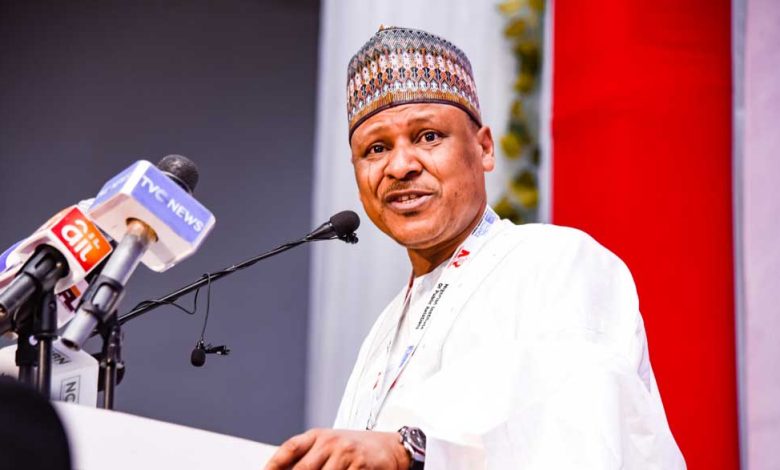
The Federal Government has accused middlemen and hoarders of creating artificial food scarcity in the country by buying off commodities from farmers and storing them in sealed warehouses for later sale at exorbitant prices.
The Minister of Information, Mohammed Idris who stated this at a media briefing on the state of affairs in the country on Monday, said government had observed a situation where middlemen were buying off commodities from farmers and storing them, and later selling them to enterprises.
“We had a situation in this country where some hoarders, you know, taking advantage of the situation, were buying off these commodities, putting them in warehouses, and even sealing the warehouses. In some instances, in Kano, I recall, that security agencies had to go there and force some of these warehouses open,” the Minister said.
He questioned the sense of patriotism of those behind the act explaining that the government can take decisions and create enablers to make food available, affordable and locatable, but added that it was ultimately the collective responsibility of Nigerians to support what government is doing.
He stressed that no one should see a situation where people are unable to buy commodities not because they are not available but because middlemen are making it very difficult for marketers to access them and for ultimate consumers to get them.
He assured that the administration is anticipating the challenge and remains up and doing, adding that the Minister of Agriculture and Food Security is always opening up reserves, putting them in fragmented silos and bringing them out when needed.
Speaking on the recent fuel pricing concerns, the Minister said the foreign pricing of fuel is not just a natural matter, noting that fuel is an international commodity.
“If you follow what is happening in the Middle East now, you will have noticed that price of fuel has not gone up only in Nigeria. It has gone up in so many other places,” he said.
He clarified that there is no return to subsidy, stating that what the Nigerian National Petroleum Company Limited (NNPCL) did was to look at its profit margin and decide to forego some of it.
“What the NNPC has done is they have looked at it and said, okay, we are making this much profit. Why can’t we forego some of the profit that we are making so that Nigerians will have, you know, some form of cushion?” he explained.
He described the action as entirely within NNPC’s mandate to ensure energy security.
“President Bola Tinubu is a listening president. He cannot just sit and see that countrymen are facing the pressure that they have not seen coming and they will not do anything about it,” he said.
On the economy, the Minister dismissed attempts to politicize World Bank reports. “Whenever World Bank reports say something that is very favourable, you know, they will say, my statistics will go chop. But when there seems to be something that indicates otherwise, then we hold on those statistics as if they actually matter.”
He cited growth figures, stating, “Our economy grew by 4.2 percent in the first half of 2026, compared with 3.9 percent, you know, in the corresponding period last year, and 3.5 percent in 2024.”
On labour issues, the Minister said government will continue to engage organized labour and recalled that during the N70,000 minimum wage negotiation, the President suggested moving the review period from every five years to every three years.
In his opening remarks before the question and answer session, the Minister had said government is taking bold decisions to address long-standing structural weaknesses, restore stability and lay a stronger foundation for sustained growth.
“We are taking bold decisions to address long-standing structural weaknesses, restore stability and lay a stronger foundation for sustained growth that we all need as a nation. These decisions are producing measurable results and we are increasingly seeing the transition from economic reform to economic opportunity,” he said.
He acknowledged that many households continue to face cost of living pressures and said the President remains focused not only on stabilising the economy but also on making the benefits of recovery visible in the lives of people, with stronger indicators translating into more jobs, more productive businesses, more affordable essential services and greater purchasing power.
He said the macroeconomic numbers have turned the corner, with the economy on course to grow by more than 4 percent in 2026, current account surplus of $12bn in the first half of 2026 from $8.6bn in the first half of 2025, and inflation falling from about 27 percent in January 2025 to around 15 percent today.
According to him, oil theft is down and production is up, bringing more revenue to all three tiers of government, while external reserves exceeded $54bn in September, the highest level in almost two decades, and the foreign exchange market has stabilised.
He added that in 2025, Nigeria earned more than $6bn from non-oil exports, the highest in history, with much of the money going to local businesses in agriculture, mining, petrochemicals, manufacturing and logistics.
He said every road project is money flowing to contractors, suppliers, engineers, artisans, transporters and food vendors, noting that the four legacy projects alone cover about 3,000 kilometres across all six geopolitical zones, alongside hundreds of other projects including the recently approved approximately N1.5trn highway project in Niger State.
He also listed other interventions, including the commissioning of additional cancer treatment centres bringing the number to ten, the Presidential Compressed Natural Gas initiative which has attracted about $2.5bn in private investment with over 120,000 vehicles converted, the Nigerian Education Loan Fund(NELFUND) which has supported more than 1.6 million students with over $192bn in fees and about $250bn in government funding and commitments for CNG, and the 3 Million Technical Talent Programme for young Nigerians.