Visually Impaired Nigerians Demand Equal Rights, Accessible Infrastructure, Financial Inclusion

Firdaus Obiremi
Persons with visual impairments have called on governments, financial institutions and other stakeholders to dismantle discriminatory barriers and provide accessible infrastructure, employment opportunities and equal access to essential services.
They also urged authorities to move beyond temporary financial handouts and charity-based interventions towards sustainable policies that guarantee the independence, dignity and economic empowerment of persons with disabilities.
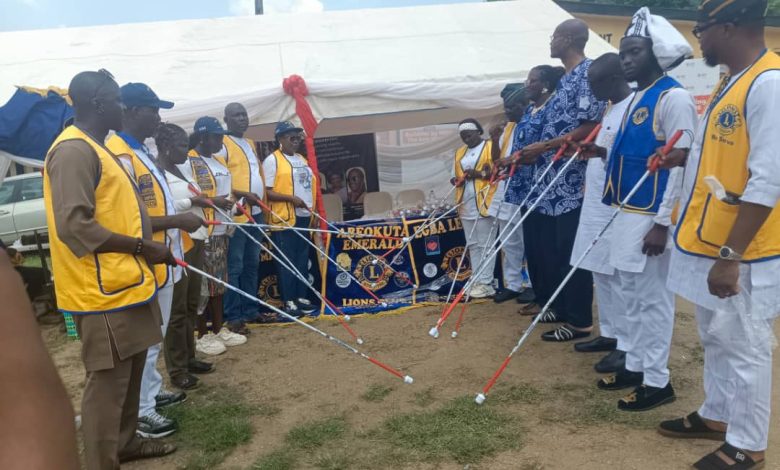
The stakeholders made the call on Friday in Abeokuta, Ogun State, during the 2026 International White Cane Safety Day and Empowerment Programme organised by the Nigerian Association of the Blind, Abeokuta South Chapter.
The programme, themed, “Knights of the Blind in the Modern Era: Championing Mobility, Digital Financial Access, and Livelihood Inclusion for Persons with Visual Impairments,” brought together members of the association, legal practitioners, disability rights advocates, Lions Club International and other stakeholders.
Speaking at the event, the Chairperson of the NAB Abeokuta South Chapter, Mrs Oluwatomisi Adeyefa Olatayo, said persons with visual impairments wanted equal opportunities to participate in society rather than being treated as objects of pity.
Olatayo stressed that persons with disabilities should be included in decision-making processes and given the necessary support to pursue education, employment and other livelihood opportunities.
“We want to live in a society free from discrimination and stigma, where we are free to live as humanly as possible,” she said.
She urged members of the public to replace sympathy-driven interventions with genuine support for disability rights, insisting that persons with visual impairments deserved opportunities to become self-reliant.
“The Bible says to love your neighbour as yourself. Love us genuinely; do not pity us. We want the opportunity to thrive, not charity or peanuts. Disability rights are human rights,” she added.
Olatayo acknowledged the contributions of Lions Club International, the Beyond Limits Initiative for Women and Girls with Disabilities, and the Joint National Association of Persons with Disabilities, Ogun State Chapter, to efforts aimed at improving the welfare of persons with disabilities.
Also speaking, the Director of Media and Communications of Junior Chamber International, Abeokuta, Mr Kareem Owolabi, who represented the member representing Abeokuta South I Constituency in the Ogun State House of Assembly, Hon. Lukman Atobatele, said disability should not determine an individual’s worth or limit their potential.
Owolabi argued that distributing money and relief materials without addressing the structural challenges confronting persons with disabilities would do little to secure their long-term independence.
He called for stronger legislation at the grassroots and state levels to protect the rights of persons with disabilities and ensure their access to public facilities, healthcare and economic opportunities.
Highlighting JCI Abeokuta’s humanitarian interventions, Owolabi said the organisation had facilitated the participation of 40 medical professionals from the United States in a medical outreach during which more than 135 free surgeries were performed, including 50 cataract procedures.
He added that guiding canes and crutches were also distributed as part of the intervention.
Owolabi called on lawmakers, community leaders, government agencies and non-governmental organisations to work together to improve infrastructure, expand medical outreach programmes and strengthen policies supporting persons with disabilities.
In his keynote address, a Solicitor of the Supreme Court of Nigeria and co-founder of Aiding the Blind in Nigeria, Barrister Olayinka Komolafe, said the major challenge confronting visually impaired Nigerians was not blindness itself but the institutional and environmental barriers that restricted their independence.
Referencing Helen Keller’s 1925 address to members of the Lions Club, in which she challenged them to become “knights of the blind in the crusade against darkness,” Komolafe said the modern-day struggle required society to confront discriminatory systems rather than view blindness as a personal limitation.
“The real darkness in Nigeria is not blindness—it is the systemic barriers that turn blindness into a disability,” he said.