Obasanjo Tackles Tinubu Over Borrowing, Says Debt Worse Than Leprosy, Destroys Generation

Toyyibat Qasim
Former President Olusegun Obasanjo has sharply criticised President Bola Tinubu’s borrowing policy, describing his assertion that borrowing is not leprosy as “absolute nonsense” and warning that mounting debts could destroy generations of Nigerians.
Obasanjo, who expressed concern over the country’s growing debt burden, argued that while leprosy destroys an individual, excessive borrowing places an enduring financial burden on entire generations.
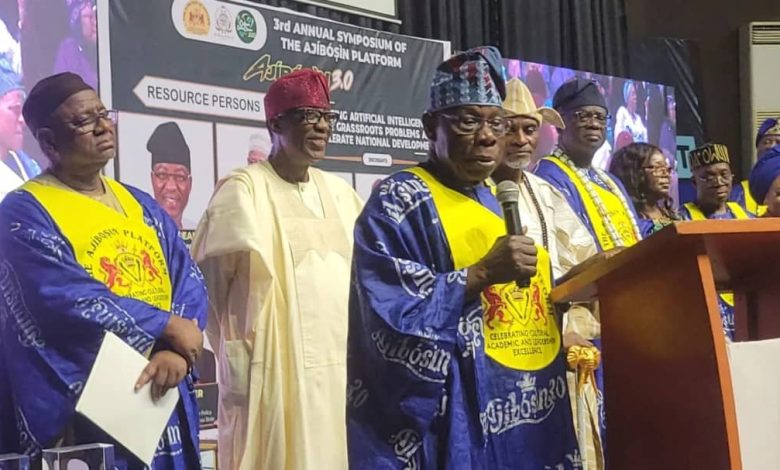
The former president made the remarks on Friday in Abeokuta, Ogun State, while speaking at the Ajibosin Platform, a public forum themed, “Leveraging Artificial Intelligence to Solve Grassroots Problems and Accelerate National Development.”
He was reacting to Tinubu’s earlier declaration that his administration would continue to borrow whenever necessary, insisting that borrowing should not be treated as a national taboo.
The President had made the statement in April during a meeting with Plateau State leaders at the State House, Abuja, led by Governor Caleb Mutfwang and the National Chairman of the All Progressives Congress, Nentawe Yilwatda.
Tinubu had said, “If we have to borrow, we borrow. Borrowing is not leprosy, we just have to work hard to be able to pay for it.”
But Obasanjo rejected the President’s argument, maintaining that the consequences of excessive borrowing extend beyond the present administration and could undermine the economic prospects of future generations.
“And for anybody to say debt is no leprosy, is absolute nonsense. Debt is worse than leprosy. Because leprosy destroys only one person. Debt destroys generations,” he said.
The former President’s criticism comes amid continuing public debate over Nigeria’s rising public debt, the cost of servicing existing loans and the growing pressure on government revenue.
Obasanjo also questioned the country’s economic performance over the years, using the dramatic depreciation of the naira against the United States dollar to illustrate what he described as Nigeria’s failure to achieve meaningful economic progress.
Recalling the exchange rate when he established his farm nearly five decades ago, he expressed concern that the country had moved from a position of relative currency strength to severe depreciation.
“When I started my farm, 47 years ago, naira to the dollar was one naira to $1.85. Forty-seven years ago. What has Nigeria done in 47 years that we now have 1,500 naira to the dollar? What have we done?” he queried.
Obasanjo further questioned the competence and capacity of Nigeria’s political leadership, asking whether those entrusted with governing the country possessed the knowledge and ability required to address its economic and developmental challenges.
“What do our leaders know? And what do they not know? And from what they know, what can they do for us?” he asked.
Beyond the country’s borrowing policy, the former President criticised Nigeria’s dependence on economic prescriptions from international financial institutions, particularly the World Bank and the International Monetary Fund.
He argued that policies promoted by the institutions should not automatically be considered suitable for Nigeria, insisting that the country’s economic challenges and development priorities required solutions that reflected its peculiar circumstances.
According to him, the institutions were established before Nigeria attained independence and were not necessarily structured to address the country’s specific economic realities.
“World Bank and IMF were not designed for us. They were not built by us. They were built before we became independent. And that’s the people who would determine what we do,” he said.
The former President also recalled Nigeria’s experience with agricultural policies, arguing that the country had previously been discouraged from providing certain forms of support to farmers despite the extensive agricultural subsidies available in developed economies.