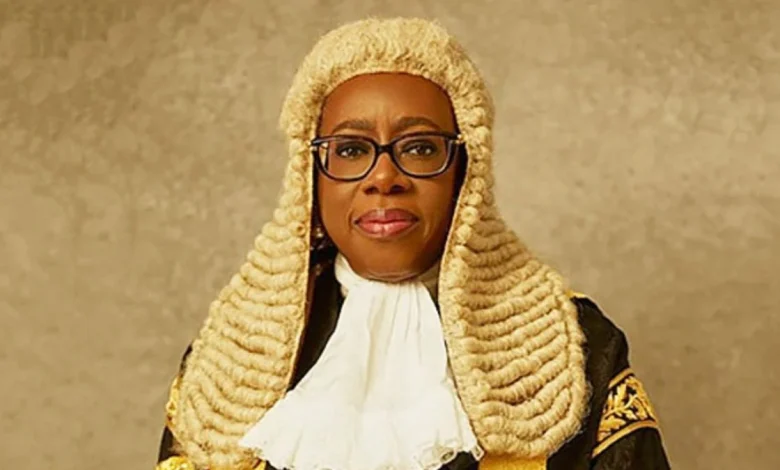
Chief Justice of Nigeria, Justice Kudirat Kekere-Ekun, has warned judges who may be appointed to serve on election petition tribunals ahead of the 2027 general elections to maintain strict impartiality and avoid conduct that could create the impression of political bias.
The CJN gave the warning on Wednesday during the flag-off ceremony for the 2026/2027 legal year of the National Industrial Court of Nigeria, NICN, in Abuja.
Kekere-Ekun said some judges of the National Industrial Court could be called upon to serve on election petition tribunals under the constitutional and legal framework governing the 2027 elections.
She said such assignments would place additional responsibilities on the judges because election disputes usually attract strong political interests and widespread public attention.
The CJN therefore urged the judges to remain conscious of their conduct, relationships and public engagements before, during and after their tribunal assignments.
She said their actions would be closely scrutinised, particularly as the country moves towards another general election.
“As we approach another electoral season, these responsibilities assume even greater importance.
“Some of Your Lordships may, in accordance with the applicable constitutional and legal framework, be called upon to serve as members of Election Petition Tribunals.
“In that capacity, Your Lordships will be called upon to decide politically sensitive disputes which attract considerable public attention.
“The nature of such assignments therefore demands an even greater degree of impartiality, restraint and detachment.
“Whether sitting in this Court or performing a Tribunal assignment, you must remain conscious that your conduct will be closely scrutinized.
“You must ensure that nothing in your associations, public engagements or other conduct creates a reasonable perception of political alignment or predisposition.
“The Bar must never become an instrument through which the judicial process is manipulated for partisan or strategic purposes.
“The proper forum is determined by law, not by the perceived likelihood of success before a particular Judge or court.
“There is also a need for restraint in public commentary. The right to criticise a judgment or judicial process does not extend to personal attacks on Judges, deliberate misrepresentation of proceedings or attempts to bring pressure to bear on the Court through public opinion.
“Where there are genuine concerns about judicial conduct, the appropriate institutional channels remain available and should be used,” the CJN added.
Election petition tribunals are expected to play an important role in resolving disputes that may arise from the conduct and outcome of the elections.
Their decisions can affect candidates, political parties and elected offices.
Kekere-Ekun’s comments also placed emphasis on the relationship between the judiciary and the legal profession.
She cautioned lawyers against filing similar cases before different courts simply because they believed a particular judge or court might be more likely to rule in their favour.
According to her, such practices could result in conflicting judgments and undermine confidence in the judicial system.
The CJN further warned lawyers against turning public commentary into a means of exerting pressure on judges.
She said lawyers had the right to criticise judicial decisions but must do so within the limits of professional responsibility and respect for the courts.
CJN Raises Concern Over AI-Generated Court Authorities
The Chief Justice also used the occasion to caution lawyers about the growing use of Artificial Intelligence in legal research and court processes.
While acknowledging that AI could assist lawyers in conducting research, she warned that information produced by such systems must not be accepted without proper verification.
She said AI-generated materials could contain fabricated cases, incorrect citations or quotations that never appeared in the judgments they were attributed to.
“An AI system may produce an answer that appears authoritative, complete with names of parties, citations, quotations and even a seemingly convincing account of the decision.
“That does not make the authority genuine. A non-existent case, an incorrectly stated decision or a quotation attributed to a judgment in which it does not appear has no place in a court process
“For counsel, the consequences can be serious,” the CJN warned.
She stressed that lawyers remained professionally responsible for the materials and authorities presented before the courts, regardless of whether the information was obtained manually or with the assistance of technology.
FG Pledges Support For Industrial Court
The Attorney-General of the Federation and Minister of Justice, Prince Lateef Fagbemi, SAN, also attended the ceremony and pledged the continued support of the Federal Government to the National Industrial Court.

Fagbemi’s position came as the court continued efforts to improve the speed and efficiency of labour justice delivery.
The President of the Nigerian Bar Association, Mrs Oyinkansola Badejo-Okusanya, SAN, also called for continued development of Nigerian labour jurisprudence.
She maintained that the country’s labour laws and judicial principles must respond to changing realities while remaining firmly based on the rule of law.
The legal year ceremony was preceded by the official commissioning of the new headquarters building of the National Industrial Court in Abuja.
The two-day 2026 legal year programme includes court activities, a public lecture and a Bar and Bench forum.
The ceremony marks the commencement of another legal year for the court.
Former Chief Justices of Nigeria, Justices Mahmud Mohammed and Walter Onnoghen, were among the dignitaries present at the event.
Also in attendance was the President of the Court of Appeal, Justice Monica Dongbam-Mensen, alongside Senior Advocates of Nigeria and other members of the legal profession.