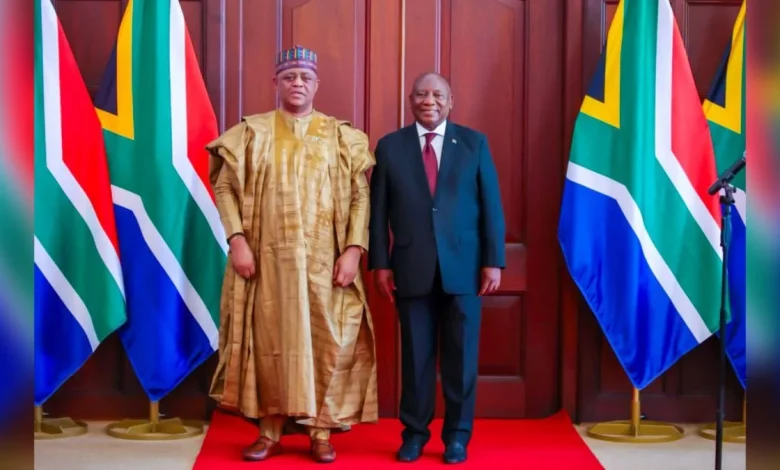
A former Minister of Youth and Sports Development, Solomon Dalung, has criticised Nigeria’s High Commissioner to South Africa, Femi Fani-Kayode, over his conduct amid the diplomatic disagreement between both countries.
Dalung argued that although Fani-Kayode had a responsibility to defend Nigerians against xenophobic attacks in South Africa, his actions must reflect the diplomatic judgment required of someone representing the country.
The African Democratic Congress (ADC) chieftain made the remarks in a Facebook post on Sunday, amid the controversy surrounding the alleged exclusion of Fani-Kayode’s speech from the livestream of a ceremony where he presented his credentials to South African President Cyril Ramaphosa.
He condemned the recurring xenophobic attacks, killings, destruction of businesses and hostility against Nigerians in South Africa, insisting that the government must take seriously its responsibility to protect citizens abroad.
However, Dalung maintained that speaking against injustice should not come at the expense of diplomatic tact, stressing that the effectiveness of an ambassador should be determined by the results he achieves rather than the controversies he generates.
He said, “The question, therefore, is not whether FFK should speak against xenophobia. Of course, he should. The question is whether his approach advances the safety of Nigerians in South Africa or unnecessarily complicates the diplomatic relationship through which that safety must be pursued.”
The former minister noted that diplomacy did not amount to cowardice or silence but required confronting difficult situations in ways that could produce meaningful outcomes.
He also cautioned against relying on Nigeria’s historical contributions to South Africa’s liberation struggle as justification for disregarding the country’s sovereignty and diplomatic sensitivities.
According to him, relations between both countries involve trade, investment, security and continental cooperation, making strategic engagement necessary, particularly amid existing tensions.
Dalung further argued that an ambassador’s responsibility was to strengthen bilateral relations, protect national interests and secure tangible benefits for citizens, rather than engage in personal confrontations or seek public recognition.
“An ambassador is not appointed to win arguments, settle personal scores or demand public applause. He is appointed to build relationships, protect national interests and secure tangible outcomes for the citizens whose interests he represents,” he stated.
He described the controversy as unfortunate, particularly at the beginning of Fani-Kayode’s ambassadorial assignment, when his priority should be rebuilding confidence and improving relations between Nigeria and South Africa.
Dalung also warned that Nigeria’s international reputation could suffer when individuals mistake personal aggression for national assertiveness or prioritise defending their public image over the country’s interests.
“A country’s ambassador carries the dignity of millions of citizens, not the ego of one individual,” he added.
His comments come amid an exchange of strong words between the Nigerian High Commission in Pretoria and South African presidential spokesperson Vincent Magwenya over Fani-Kayode’s complaint that his speech was excluded from the livestream of the diplomatic ceremony.
Fani-Kayode had alleged that he was the only one among 15 ambassadors who were given the opportunity to address the gathering whose speech was omitted from the broadcast during the presentation of credentials at the Sefako Makgatho Presidential Guest House in Pretoria.
He suggested that some elements in South Africa did not want to hear his message or see him, but maintained that he would remain in the country as long as he enjoyed the confidence of President Ramaphosa.
However, Magwenya rejected the allegation, explaining that the ceremony was broadcast by the South African Broadcasting Corporation (SABC), whose editorial decisions were independent of the presidency.
He also accused Fani-Kayode of misrepresenting the circumstances surrounding the broadcast.
The Nigerian High Commission subsequently responded by accusing Magwenya of attempting to worsen diplomatic tensions. It described him as a liar and a disgrace, arguing that his comments showed contempt for Nigeria and its newly accredited envoy.
The disagreement comes against the backdrop of renewed tensions between both countries following another wave of xenophobic violence in South Africa, which has been linked to the deaths of at least 12 Nigerians.
Dalung, however, insisted that the ultimate measure of Fani-Kayode’s performance should be his ability to secure the safety of Nigerians, resolve disputes and strengthen relations between the two countries.
He concluded that the true test of courage in diplomacy was not the ability to generate controversy but the capacity to protect national interests in the process.