“All The Payments Were Official And Approved” — Taraba Cashier Tells Court In Ex-Governor Ishaku’s Alleged ₦27bn Fraud Trial

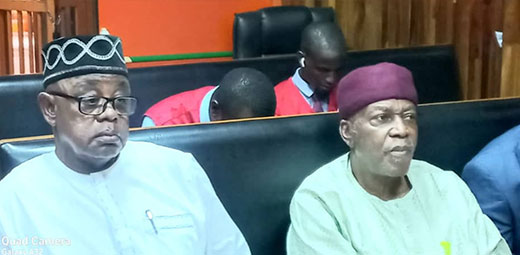
A cashier with the Taraba State Government, Taiwo Jones, has told the Federal Capital Territory High Court sitting in Maitama, Abuja, that all financial transfers he made during the administration of former Governor Darius Ishaku were official payments approved by his superiors.
Jones made the disclosure on Monday while continuing his testimony as the third prosecution witness in the alleged ₦27 billion fraud case instituted by the Economic and Financial Crimes Commission (EFCC) against Ishaku and Bello Yero, a former Permanent Secretary of the Taraba State Bureau for Local Government and Chieftaincy Affairs.
The anti-graft agency accused the former governor and Yero of diverting approximately ₦27 billion belonging to the Taraba State Government.
Both defendants have denied the allegations.
During his earlier testimony, which commenced in June, Jones explained how he received funds from local governments in Taraba State into the bank account of his company, P3 Cornerstone, for onward disbursement to various beneficiaries on the instructions of his superiors.
He also disclosed that some of the funds were transferred into two of his personal bank accounts.
However, under cross-examination by Ishaku’s counsel, Chris Umar, SAN, on Monday, the witness maintained that the transactions were carried out in his official capacity and with the approval of the relevant authorities.
Reading from a statement he made to the EFCC during its investigation, Jones said, “All the payments being done by myself and John Columba are official payments approved by the then-Permanent Secretary.”
At the prompting of the defence counsel, the witness read the statement three times, emphasising that the transactions were official payments.
Jones further confirmed that he transferred substantial sums of money to different beneficiaries but insisted that the transactions were carried out strictly on instructions.
Giving details of some of the payments, the witness confirmed that he transferred ₦7.5 million, ₦8 million, ₦2 million and another ₦8 million to Ibrahim Saleh on October 3, 2018.
He also disclosed that Saleh received four additional transfers of ₦5 million, ₦1 million, ₦6 million and another ₦1 million on March 1, 2019.
The witness further told the court that Prince Emmanuel, also known as Onwuzurike, received ₦10 million, ₦9 million, ₦5 million and another ₦10 million on August 9, 2019.
Emmanuel had previously testified as the second prosecution witness, explaining how funds were transferred into his account and subsequently withdrawn on the instructions of Yero.
Continuing his testimony, Jones said that on August 20, Saleh and Emmanuel received ₦7 million, while a cheque withdrawal of ₦8.7 million was also made.
When questioned about the total amount of money he transferred on the instructions of his superiors, the witness said he could not provide an exact figure because of the large volume of transactions involved.
He explained that the number of payments made during the period was too extensive for him to calculate the total from memory.
Jones also admitted that he never reported the transactions to the police or the EFCC while they were being carried out.
He maintained that there was no reason to make such a report because he did not consider the transactions suspicious or improper at the time.
According to him, the payments were approved by the then-Permanent Secretary, and he acted on instructions in carrying them out.
Following the conclusion of Monday’s proceedings, the trial judge, Justice Sylvanus Oriji, adjourned the matter until November 5, 2026, for continuation.
The testimony forms part of the prosecution’s case against Ishaku and Yero over allegations of the diversion of funds belonging to the Taraba State Government.
Two other prosecution witnesses, Dare Lawal and Prince Emmanuel, had earlier testified about their respective roles in receiving and disbursing funds during the former governor’s administration.
Lawal, the first prosecution witness, previously worked for Ishaku’s private business before becoming his personal assistant during his tenure as governor.
During his testimony, which lasted for much of the previous year, Lawal gave details of how he allegedly received millions of naira from different state government officials, including Yero, on behalf of the former governor.
He explained the circumstances surrounding several financial transactions that the prosecution linked to the alleged diversion of public funds.
Similarly, Emmanuel, who testified as the second prosecution witness in February, disclosed that he had a personal relationship with Yero.
He told the court that money was transferred into his bank account and subsequently withdrawn on Yero’s instructions.
The prosecution has relied on the testimonies of the witnesses to establish the movement and disbursement of funds allegedly diverted from Taraba State Government accounts.
However, Jones’ testimony under cross-examination introduced the defence’s position that the transactions were official payments authorised by the relevant government officials.
His statement that he found nothing wrong with the payments also formed part of the evidence elicited by Ishaku’s counsel in challenging the prosecution’s allegations.
The court has yet to determine whether the transactions were lawful government disbursements or constituted part of the alleged diversion of public funds.
Ishaku and Yero remain presumed innocent unless and until the charges against them are proved beyond reasonable doubt.
Post Title: “All The Payments Were Official And Approved” — Taraba Cashier Tells Court In Ex-Governor Ishaku’s Alleged ₦27bn Fraud Trial By Papers Nigeria.