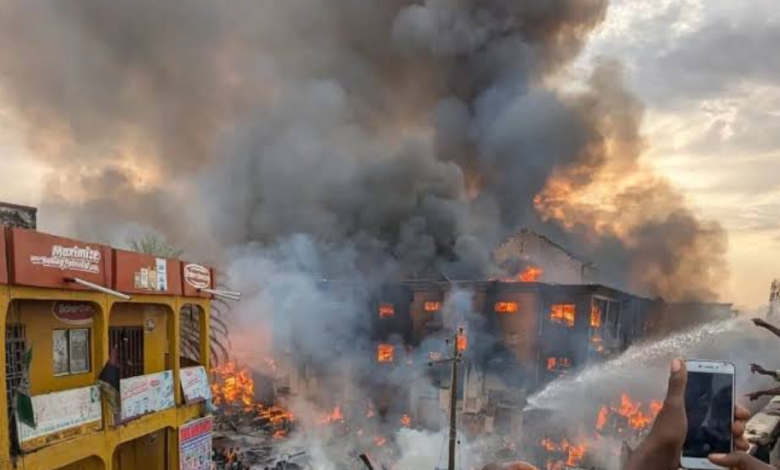
Kugbo Furniture Market in Abuja recorded three separate fire outbreaks between January and October 2026, making it the market with the highest number of reported fire incidents at a single location in THE WHISTLER’s review of market fires across Nigeria.
The market was hit on January 19, February 22 and October 2, with the outbreaks affecting furniture workshops, shops, adjoining residential buildings and traders’ goods.
Kugbo was not alone. Singa Market in Kano State and Bola-Ige International Market in Ibadan, Oyo State, also recorded multiple fire outbreaks within the review period.
A review by THE WHISTLER of published reports between January 1 and November 21, 2026, identified repeated fire outbreaks in markets and commercial centres across 12 states and the Federal Capital Territory (FCT), leaving traders to count losses running into billions of naira.
At the state level, Oyo recorded the highest number of reported incidents, with nine outbreaks in markets and commercial centres between February and October. Kano also recorded multiple market fires, including two at Singa Market. The FCT, however, recorded three separate outbreaks at Kugbo Furniture Market alone, making it the location with the highest number of repeated incidents in the review.
The findings are based on THE WHISTLER’s review of published reports and not a consolidated national fire-service database. The Oyo tally includes both traditional markets and commercial complexes, a distinction reflected in the breakdown below.
Federal Capital Territory
Kugbo Furniture Market, along the Abuja-Keffi Expressway, recorded three fire outbreaks during the period.
The first incident occurred on January 19, when fire razed parts of the market. The Federal Fire Service said firefighters and other emergency responders brought the blaze under control after several hours.
The service reported that property valued at N1.8bn was saved, while goods worth more than N2bn were exposed to the fire. The N1.8bn represented the value of property salvaged and should not be interpreted as the value of goods destroyed.
The market was hit again on February 22, when more than 15 shops and adjoining residential buildings were affected. Traders who spoke after the incident put their individual losses at N5.2m and more than N8.2m.
On October 2, another fire affected 21 shops and a vehicle at the market. The National Emergency Management Agency (NEMA) said no casualties were recorded, while the chairman of the Kugbo Wood Machinist Association, Godswill Ndukwe, estimated the value of destroyed goods at more than N500m.
The repeated outbreaks made Kugbo the market with the highest number of reported fire incidents at a single location in the review.
Beyond Kugbo, Karimo Market in the FCT was affected by a fire on February 15, which damaged several shops. NEMA said no fatalities were recorded.
On August 30, fire also affected Chida Plaza in Jabi, where businesses dealing in building materials and roofing supplies operated. An eyewitness estimated the value of some destroyed goods at more than N20m.
Another incident occurred on November 14 at Gwagwalada International Market. A post-incident assessment by the FCT Emergency Management Department identified 28 open stalls and two lock-up shops as affected, impacting about 45 traders.
One of the affected traders, Salome Israel, said she lost goods worth about N400,000, including yams, tomatoes and peppers. Other items reportedly destroyed included clothing, herbal medicines and beverages.
Oyo State
Oyo State recorded nine reported fire outbreaks in markets and commercial centres between February and October, the highest number among the states covered by the review.
The affected locations included Ogunpa Market, Bode Market, the Nigerian Railway Shopping Complex, Alhaji Moba Complex, Bola-Ige International Market, Bodija Foodstuffs Market, Oranyan Market and the NIPOST Shopping Complex in Dugbe.
The first incident occurred on February 9 at Ogunpa Market, where about 10 shops at Iya Maryam Adebara Complex were affected.
On June 6 into June 7, fire destroyed at least 16 shops at the NIPOST Shopping Complex in Dugbe, Ibadan, affecting businesses operating within the commercial premises.
On July 3, another outbreak destroyed several shops in the herbal section of Bode Market, leaving traders dealing in herbs and traditional products to count losses estimated at millions of naira.
On August 8, fire affected one of 17 prefabricated shops at Alhaji Moba Complex in the Gbagi area of Ibadan.
Bola-Ige International Market in New Gbagi was affected on August 17, when two lock-up shops were destroyed.
Five days later, on August 22, fire destroyed nine shops at the Nigerian Railway Shopping Complex around the Aleshinloye Market axis. One trader, Busari Olayemi, estimated his loss at N21m.
On August 24, fire ravaged parts of Oranyan Market, where eyewitnesses estimated that nearly 300 shops were affected. Traders dealing in gold, furniture, second-hand clothes and other merchandise were among those affected.
Bodija Foodstuffs Market recorded another outbreak on October 19, when 15 shops were razed and 25 others partially damaged in a row of 44 shops.
The latest incident in the nine-outbreak tally occurred on October 29 at Bola-Ige International Business Complex in New Gbagi, where eight shops were affected and goods and property worth millions of naira were reportedly destroyed.
The August and October incidents show that the Bola-Ige commercial location also experienced repeated outbreaks. However, the Oyo figure covers shopping complexes as well as traditional markets and should not be interpreted as nine fires in traditional markets alone.
Kano State
Kano State also recorded multiple market fires, including two outbreaks at Singa Market within 12 days in February.
The first incident occurred on February 2, destroying three large stores. On February 14, another fire affected a different section of the market.
The chairman of Singa Market, Junaid Zakari, estimated losses from the second incident at more than N5bn. He said more than 1,000 businesses were affected, while seven people were initially reported missing.
On February 11, a separate fire destroyed about 30 permanent shops and 55 temporary stalls at Kasuwar Yan Katako, a timber market in the Rijiyar Lemo area of Kano.
Another outbreak occurred on February 20 at Fatima Simra Multi-Purpose Market in the Dakata area, where at least 50 shops were destroyed. The affected businesses included small-scale operators involved in vegetable oil production and plastic and nylon recycling.
On October 31, fire destroyed 110 structures at Kofar Ruwa Timber Market in Kano metropolis. The Kano State Fire Service said 75 permanent buildings and 35 temporary structures were affected.
Two days later, on November 2, another fire affected Gezawa Market in Gezawa Local Government Area. The Kano State Fire Service said four containers and seven temporary shops were destroyed, with goods worth millions of naira lost.
The incidents placed Kano among the states with the highest number of reported market fires during the period.
Cross River State
In Cross River State, fire engulfed Akim Timber Market in Calabar on March 27, destroying more than 100 shops containing timber and other building materials.
The blaze started at about 8:45 p.m., after most traders had closed for the day. Police said no deaths or injuries were recorded.
The market was hit again on November 19, when another fire affected a building materials shop opposite Mammy Market. Goods worth millions of naira were reportedly destroyed.
The Cross River State Police Command said the fire was extinguished through a joint effort involving police personnel, the Federal Fire Service and members of the community.
Although preliminary accounts suggested a possible electrical spark associated with a lightning strike, the actual cause had not been established.
The two incidents, occurring about eight months apart, made Akim Timber Market another location where traders experienced repeated fires in 2026.
Anambra State
Anambra State recorded two reported market fires during the period.
On February 18, fire affected shops at the Nnewi Electronics Parts Market, destroying electrical appliances and electronic components worth millions of naira. No casualties were reported.
On March 20, fire swept through the plumbing and building materials section of Bridgehead Market in Onitsha.
The Anambra State Government estimated the value of destroyed goods at between N2bn and N3bn, while one trader reportedly lost goods worth about N4m.
In Ogun State, fire destroyed two shops belonging to bean traders at Panseke Market in Abeokuta on January 19.
About 180 bags of beans were reportedly lost, with the affected traders putting their losses at N13m.
Other States
On January 28, fire affected the livestock section of Owode Market in Offa, destroying at least 10 stalls.
The value of the losses was not officially established, although traders were reported to have lost goods worth millions of naira.
On February 24, fire destroyed shops, stalls and slaughter slabs at Fika Central Market, leaving traders with losses estimated at millions of naira.
The Yobe State Emergency Management Agency said outdated firefighting equipment hampered efforts to contain the outbreak.
On March 14, fire affected more than 10 shops at Terminus Market in Jos.
The affected businesses dealt in clothing, footwear and other merchandise. No deaths were reported.
On May 19, fire affected Akpan Andem Market in Uyo, destroying eight container shops and damaging eight lock-up stores.
Two traders separately put their losses at more than N12m and N6m.
The incident also raised concerns about emergency response after reports that a fire truck could not be deployed because the fire station lacked diesel. An official of the state fire service acknowledged the fuel shortage.
Lagos State recorded several market-area fire incidents during the period.
On July 21, fire affected Sabo Market in Ikorodu, destroying 17 of 32 containerised shops in a row. The fire service suspected an electrical surge, while no casualties were reported.
On November 4, a fire at Akanimodo Market in the Mile 12 area affected plastic recycling structures and workers’ accommodation. The Lagos State Emergency Management Agency attributed the outbreak to a gas explosion.
On November 15, fire destroyed about 10 shops at Oke Isalu Market in the Ikotun area. No casualties were reported, although traders lost goods worth millions of naira.
On August 12, fire affected Sabo Market in Ore, destroying shops and goods.
Governor Lucky Aiyedatiwa visited the market and ordered an investigation into the incident, while promising support for affected traders.
On October 1, fire affected several shops at Creek Road Market in Port Harcourt.
Traders lost goods worth millions of naira, while the local government chairman promised to set up a committee to assess the damage.
Traders Count Billions In Losses
The financial losses reported across the affected markets vary. While some estimates were provided by government authorities, others came from market leaders, traders and eyewitnesses. They do not constitute a consolidated or independently audited national loss figure.
The chairman of Singa Market put losses from the February outbreak at more than N5bn, while the Anambra State Government estimated losses at Bridgehead Market in Onitsha at between N2bn and N3bn.
At Kugbo Furniture Market, the association chairman estimated that more than N500m in goods was destroyed in the October fire. Other traders across the affected markets reported losses ranging from hundreds of thousands to millions of naira.
The figures also exclude property saved during firefighting operations. For instance, the N1.8bn reported by the Federal Fire Service at Kugbo in January represented the value of property salvaged, not goods destroyed.
For many traders, the destruction goes beyond the cost of replacing goods. It disrupts daily income, affects employees and places additional pressure on families and businesses that depend on the markets for their livelihoods.
Fire Prevention And Response
The repeated outbreaks have renewed concerns about fire prevention, market safety standards and the capacity of emergency responders to contain blazes before they spread.
During the 2026 National Fire Safety Week in Abuja on November 2, the Minister of Interior, Olubunmi Tunji-Ojo, said the Federal Government planned to transform the Federal Fire Service into a modern fire and rescue service.
The minister identified the existing Fire Service Act, which is more than 60 years old, as an obstacle to the proposed reform. He also called for stronger fire inspections, enforcement of safety codes and the deployment of trained fire marshals in communities.
He said the National Fire Academy in Sheda, Kwali, FCT, was 85 per cent complete and expected to be ready by the end of the year. The proposed reforms and facilities are intended to strengthen the country’s emergency response capacity.
Following the Gwagwalada Market fire, the FCT Emergency Management Department urged traders to switch off electrical appliances before leaving their shops, inspect electrical installations regularly and ensure that functional firefighting equipment was available.
The department also encouraged traders to consider insurance coverage as a way of reducing the financial impact of future incidents.
The Kano State Fire Service similarly urged traders to observe fire-safety precautions, particularly during the harmattan season, when dry and windy conditions can increase the risk of fires spreading.
For traders who have watched their shops and years of investment reduced to ashes, prevention remains as important as the emergency response that follows an outbreak.
Without safer market environments, functional firefighting equipment and prompt emergency intervention, businesses across the country remain exposed to the risk of losing their goods, investments and livelihoods to another fire.
ENDS