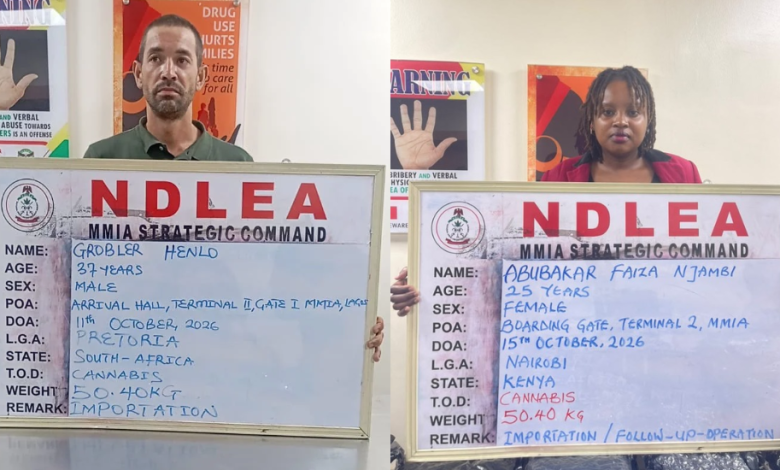
A South African professional golfer and a Kenyan private chef have been arrested in Lagos after allegedly accepting payments to smuggle 50.4 kilogrammes of a potent cannabis strain into Nigeria for an international drug trafficking syndicate.
The two foreign nationals, identified as 37-year-old Grobler Henlo and 25-year-old Abubakar Faiza Njambi, were reportedly recruited through intermediaries and promised thousands of dollars and rand to deliver the illicit consignment.
While Henlo allegedly agreed to a payment of 5,000 South African rand, Njambi was reportedly promised $8,000 for successfully delivering the drugs.
Their arrests at the Murtala Muhammed International Airport, Lagos, exposed an alleged trafficking arrangement involving exchanged luggage tags, tracking devices and hotel accommodation designed to conceal the identities of couriers and frustrate security checks.
According to a statement issued on Sunday by its Director of Media and Advocacy, Femi Babafemi, the National Drug Law Enforcement Agency (NDLEA), Henlo was arrested on October 11, 2026, shortly after arriving in Lagos from South Africa aboard a South African Airways flight.
A search of two travelling boxes in his possession uncovered 46 parcels of Loud weighing 50.40kg.
Investigators subsequently discovered that the boxes carried Njambi’s luggage tags, while she had collected two other boxes bearing Henlo’s tags from the airport conveyor belt and left the facility.
The agency described the arrangement as a deliberate attempt by the syndicate to ensure that each courier could deny ownership of the luggage if intercepted.
During interrogation, Henlo reportedly told investigators that a South African associate identified as Shanel recruited him and connected him with other members of the syndicate he had never met physically.
He said a driver picked him up from his residence, handed him four travelling boxes and took him to the airport, where he was instructed to meet Njambi and exchange luggage tags.
The golfer, who travelled business class while his alleged accomplice flew economy, reportedly said he was promised 5,000 South African rand after successfully delivering the consignment.
The NDLEA also discovered tracking devices installed on the boxes and Henlo’s mobile phone, suggesting that the syndicate monitored the movements of its couriers.
Njambi was subsequently arrested on October 15 at the airport’s departure boarding gate while attempting to board a South African Airways flight to Kenya.
Her arrest followed the discovery of her passport biodata page on Henlo’s phone, which prompted the agency to place her on its watchlist.
The Kenyan chef reportedly told investigators that a man recruited her through a friend in Kenya, who persuaded her to accept the $8,000 offer.
She said she travelled from Kenya to South Africa on October 4, stayed in a hotel for about a week and met Henlo at the airport on October 11, where they exchanged the four boxes before travelling to Lagos.
Upon arrival, she allegedly collected the two boxes bearing Henlo’s luggage tags before a driver transported her to a hotel in the Lekki area of Lagos.
The NDLEA said the claim tag for the boxes bearing her name was recovered from her hand luggage, while both suspects identified each other during an identification parade.
Their arrests came exactly one month before the agency arrested an American professional basketballer, Greene Da’monte Khiree, at the same airport on November 11 over the alleged importation of 33.95kg of Loud.
The agency said tracking devices were also discovered in the bags abandoned by the American basketballer, suggesting a similar method of monitoring couriers and drug consignments.
NDLEA Chairman, Brigadier-General Mohamed Buba Marwa (retd.), said the arrests showed that international drug cartels were increasingly exploiting the professional identities of sportsmen and other individuals to evade security scrutiny.
He warned that neither professional status nor international travel privileges would protect anyone involved in drug trafficking.
“The two cases show a trend in which international drug cartels now recruit sportsmen and other professionals as couriers, in the hope that their profiles will shield them from scrutiny,” Marwa said.
“The NDLEA has a clear message for such syndicates: no profession, passport or travel class will provide cover for drug trafficking through Nigeria’s ports of entry.”
Beyond the Lagos arrests, the agency reported several major seizures across the country, including 160 pieces of explosives allegedly being transported to Zamfara State and more than 4.6 tonnes of cannabis concealed beneath granite in a truck intercepted in Osun State.
In Ondo State, operatives also intercepted 1,045kg of cannabis allegedly being transported to Kano State, while a separate operation in Kaduna led to the recovery of hundreds of thousands of tramadol capsules.