Jonathan Raises Alarm Over Nigeria’s Democracy, Faults Leadership Recruitment, Weak Institutions

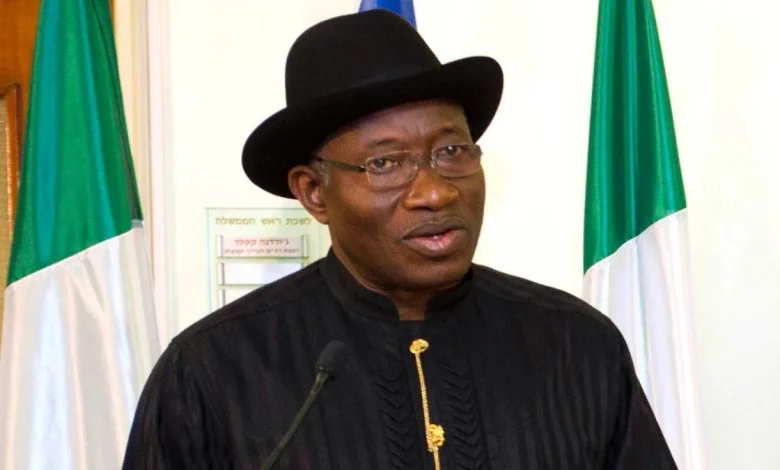
Daud Olatunji
Former President Goodluck Jonathan has called for comprehensive reforms of Nigeria’s democratic system, warning that the country may struggle to achieve meaningful development unless its political and institutional structures are fundamentally strengthened.
Jonathan made the call on Saturday while delivering his address as Chairman of the Occasion at the Herbert Macaulay Memorial Colloquium in Lagos, where he described Nigeria’s current democratic practice as opaque and lacking the institutional clarity required to drive sustainable national development.
The former President said Nigeria must review its democratic system to reflect core principles such as popular participation, the rule of law, separation of powers, respect for human rights, judicial independence and accountability.
He stressed the need to build a democracy anchored on strong institutions and supported by vibrant civil society organisations.
“We must review our opaque and amorphous democratic system and align it with the fundamental pillars of democracy.
“These include popular participation, the rule of law, separation of powers, respect for human rights, judicial independence, accountability, prudence and democratic governance,” he said.
Jonathan expressed concern that Nigeria’s democratic practice had failed to develop a clear institutional character, warning that the situation could undermine the country’s aspirations for progress.
“What we are practising today, as political scientists here may agree, is difficult to define and understand. It is an amorphous democracy that lacks clear institutional character.
“Until we move away from this opaque and amorphous democratic practice, we may find it difficult to make the progress we desire,” he added.
The former President also identified Nigeria’s political recruitment process as a major obstacle to national development, lamenting that leadership selection remained heavily influenced by religion, ethnicity, language and other considerations rather than competence and character.
He said the problem had persisted since the pre-independence era, limiting the emergence of capable leaders who could effectively address the country’s development challenges.
“Our political recruitment process has been problematic, even from the pre-independence era.
“We are still suffering from a system in which political leaders are often selected based on religion, language, ethnicity and other considerations rather than competence, character and capacity,” he said.
Jonathan illustrated the challenge with an example from a southern Nigerian state, where he said ethnic considerations could prevent qualified individuals from emerging as governor despite their competence.
He consequently urged Nigerians to abandon what he described as a primitive approach to political leadership recruitment and embrace a system that prioritises merit, capacity and integrity.
On education, Jonathan called for greater investment in functional educational institutions capable of driving technological advancement, innovation and knowledge creation.
He maintained that Nigeria could not achieve meaningful development without strengthening its educational system and equipping young people with the skills required to compete in an increasingly technology-driven world.
The former President clarified that his position was not a condemnation of Nigerian universities, noting that he obtained all his academic qualifications in the country.
“I did not have the opportunity of schooling abroad. I obtained all my degrees in Nigeria.