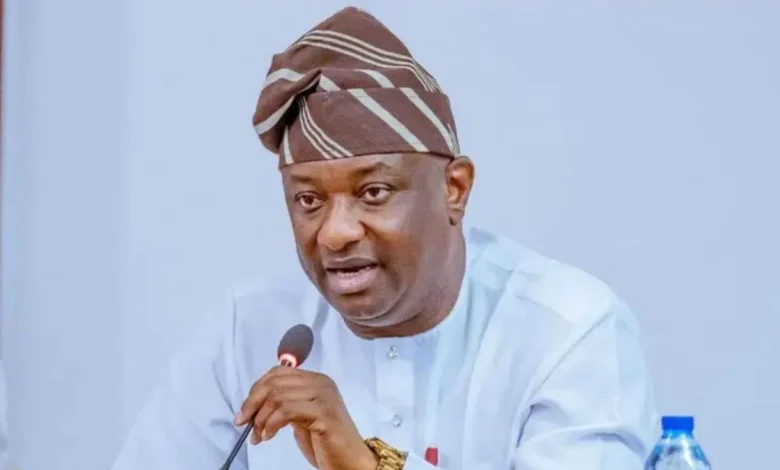
Minister of Aviation and Aerospace Development, Festus Keyamo, has issued a 48-hour ultimatum to former Bayelsa State Governor and National Leader of the Nigeria Democratic Congress (NDC), Senator Seriake Dickson, demanding clarification over the party’s position on the use of Nigeria’s former national anthem.
Keyamo wants Dickson to state whether the NDC officially supports the singing of the old national anthem, ‘Arise, O Compatriots’, following the controversy that erupted at the party’s town hall meeting in Lagos State.
The minister made his position known in a statement shared on his X handle on Saturday.
He questioned the decision by some NDC supporters to sing the former anthem at a political gathering despite the Federal Government’s restoration of ‘Nigeria, We Hail Thee’ as the country’s official national anthem.
According to Keyamo, the national anthem is more than a ceremonial song.
He described it as an important national symbol that reflects Nigeria’s history, values, identity and sovereignty.
He argued that the decision by a group to deliberately adopt an alternative anthem could raise concerns about national unity, particularly if the group’s leadership formally endorses the action.
The minister maintained that a national anthem is expected to unite citizens, regardless of their ethnic, religious or political differences.
He warned that rejecting the anthem prescribed by law could be interpreted as an attempt to establish a separate national identity.
“A national anthem is one of a country’s national symbols. It represents a country’s history, values and sovereignty. It is meant to unite citizens,” he wrote.
Keyamo further argued that the deliberate use of another anthem could have implications beyond the immediate political gathering.
“When a group of people decide to defy it and sing something different from what others are singing as prescribed by law, that group is preparing grounds to break away from the country. It is one of the ingredients of secession.
“And once the leader of such a group endorses the action, it means the group is then officially a secessionist movement.”
Following his argument, the minister directly challenged Dickson to clarify whether the incident reflected the official position of the NDC.
Keyamo referred to Dickson as his former classmate and friend.
He also acknowledged the former governor’s courage and leadership qualities while insisting that he expected him to address the controversy within 48 hours.
“I am therefore officially calling on the original ‘Countryman’, my classmate, my friend and a man of considerable courage from our school days, Senator Seriake Dickson, the official leader of the NDC, to within 48 hours speak up as to whether the NDC officially endorses a proscribed anthem as its own national symbol. The world is waiting,” he said.
The minister’s demand followed an incident at an NDC town hall meeting held in the Oregun area of Lagos State on Thursday.
During the gathering, some participants began singing Nigeria’s former national anthem, ‘Arise, O Compatriots’, instead of the current anthem, ‘Nigeria, We Hail Thee’.
The development attracted attention because Peter Obi, the NDC presidential candidate, was among those seen participating in the singing.
Obi was also seen making the two-finger gesture associated with the party during the gathering.
The incident subsequently generated political reactions, with questions raised about whether the singing represented a deliberate position of the party or an independent action by some supporters.
The NDC has, however, faced questions over the interpretation of the incident.
Funso Doherty, the party’s Lagos State governorship candidate, offered an explanation following the controversy.
He described the singing of the former anthem as a spontaneous reaction by some participants during an emotional moment at the event.
Doherty maintained that the current national anthem was also performed at the gathering.
He stressed that Nigeria has only one officially recognised national anthem and that the incident should not be interpreted as an attempt by the party to establish a different national identity.
Despite the explanation, Keyamo has maintained that Dickson, as the national leader of the NDC, must clearly state the party’s official position.
The controversy has also brought renewed attention to the Federal Government’s decision to restore Nigeria’s original national anthem in 2024.
Before the change, ‘Arise, O Compatriots’ had served as Nigeria’s national anthem for 46 years, having replaced ‘Nigeria, We Hail Thee’ in 1978.
The original anthem was first adopted when Nigeria gained independence from British colonial rule on October 1, 1960. Its restoration followed the passage of the National Anthem Bill by the National Assembly.
President Bola Tinubu signed the legislation into law on May 29, 2024, formally bringing back ‘Nigeria, We Hail Thee’ as the country’s national anthem.
The decision generated different reactions across the country. While supporters described the move as a return to Nigeria’s historical identity, critics questioned the timing of the change and argued that the government should give greater attention to economic hardship, insecurity and other pressing national challenges.
Keyamo also addressed the NDC controversy during an interview on Eagle 102.5 FM on Friday.
During the interview, he criticised Obi and other party members over their participation in the singing of the former anthem.
He accused them of showing disregard for Nigeria’s national symbols, the law and the office of the President.
The minister questioned whether individuals seeking to lead the country should participate in an action he considered disrespectful to established national institutions.
“For me, it is left for the Nigerian people to decide whether these human beings you have now seen disregarding national symbols, disrespecting the law and disrespecting the office of the President that they so crave are responsible enough to aspire to that office,” he said.
Keyamo went further to criticise Nigerians who might support the NDC despite the incident.
He described such support as irresponsible and suggested that the controversy could affect the party’s appeal among moderate voters.
However, the minister made an important admission during the same interview when he acknowledged that he was not aware of any specific punishment prescribed by law for singing the former national anthem.
“There’s no penalty that is prescribed by law. No penalty. The law just says this is our new national anthem and then you should think we should all abide by it. It becomes a crime when there’s a penalty attached to it,” he said.