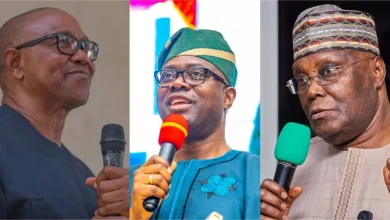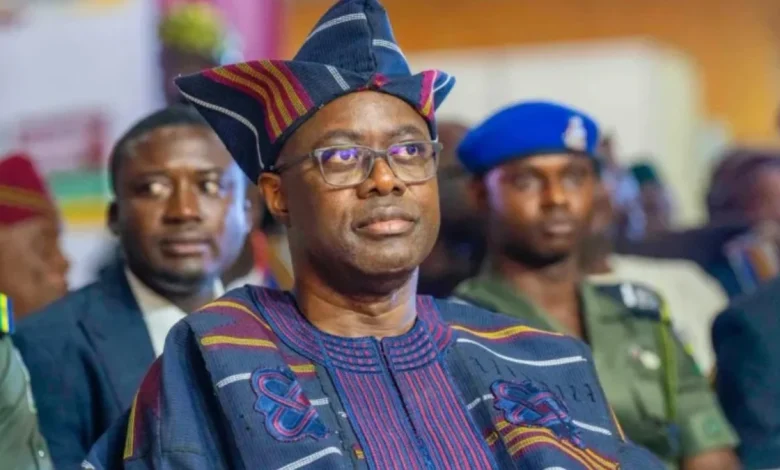
Oyo State Governor, Seyi Makinde, has questioned the political appeal of the proposed presidential ticket involving former Anambra State Governor, Peter Obi, and former Kano State Governor, Rabiu Musa Kwankwaso, arguing that a traditional alliance between the North and Southwest would provide greater stability for Nigeria.
Makinde made the remarks while explaining why Nigerians should consider a proposed Makinde-Daura ticket over the Obi-Kwankwaso combination ahead of the coming election.
The governor spoke during an interview on The Rooftop, a Nigerian talk show hosted by Kayode Okikiolu.
Makinde is the presidential candidate of the Allied People’s Movement (APM) while Obi is the candidate of the Nigerian Democratic Congress (NDC).
Responding to a question on why Nigerians should choose a Makinde-Dora ticket over an Obi-Kwankwaso ticket, Makinde said the historical relationship between the North and Southwest had played an important role in maintaining political stability in the country, particularly during periods of crisis.
According to him, the alliance between the two regions has historically provided a stabilising force in Nigeria’s political development.
“Well, apart from the traditional Southwest-North alliance, that alliance has always provided stability for Nigeria during times of crisis,” he said.
Makinde further recalled Nigeria’s first military coup in January 1966, arguing that the killings of prominent political and military figures from the Northern and Western regions demonstrated the historical sacrifices made by the two regions in the country’s quest for stability.
“If you go back to the first military coup in Nigeria, the people who were killed were largely from the North and Southwest because we have always been at the forefront of efforts to maintain stability in the country. That is what we have brought to the table,” the governor stated.
Nigeria’s first military coup took place on January 15, 1966, when a group of young military officers launched coordinated attacks that resulted in the deaths of several prominent political and military leaders, including Prime Minister Abubakar Tafawa Balewa, Northern Premier Ahmadu Bello and Western Region Premier Samuel Ladoke Akintola.
The coup ended Nigeria’s First Republic and paved the way for military rule under Major General Johnson Aguiyi-Ironsi.
Makinde also highlighted what he described as the youthful energy and achievements of his administration in Oyo State as other reasons Nigerians should consider his proposed political platform.
He said his administration had made its promises and commitments clear, insisting that the government could be held accountable for its performance.
“There is also the youthful energy, what we have achieved in Oyo State, and the fact that we have reduced all these promises to black and white, making ourselves accountable,” he added.
The governor also used the interview to explain his proposal for a transitional government of national unity, saying Nigeria needed a political arrangement capable of addressing the country’s socio-political challenges.
According to him, he was prepared to lead such a transition but would not seek to benefit from the political arrangement or remain in government after the process.
Makinde explained that removing himself from the benefits of the proposed transition would enable him to make impartial decisions without personal political interests influencing his judgment.
“Transitional in the sense that we know that we have to do something about our socio-political environment,” he said.
“I’m saying that I can lead it, but I will not be a beneficiary of the outcome, because if I’m looking at myself as benefiting from that outcome, it may cloud my judgment and also influence how I will take that decision.
“So, I’ve upfront removed myself and said, look, I will not be there now. I’m saying it for the record, even now,” Makinde stated.
The Oyo governor further explained that the proposed government of national unity was necessary because insecurity and other national challenges had spread across different parts of the country.
He argued that the problems confronting Nigeria were not restricted to any particular region and would require a collective approach to address them.