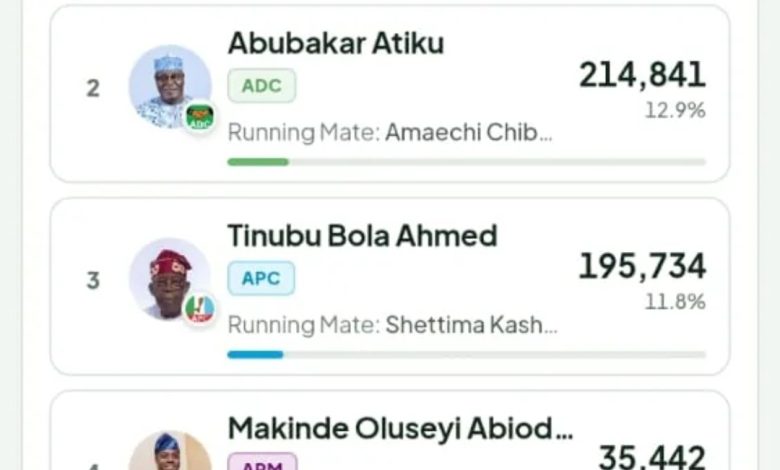
…Tinubu, Atiku Trail In Controversial Online Simulation Published By NEIS
…APC Describes Figures As Fictitious, Accuses Opposition of Manipulating Public Opinion
…Electoral Commission Warns Nigerians Against Treating Simulated Figures As Actual
Results
Daud Olatunji
Controversy has erupted over purported presidential rankings published by the Nigeria Election Intelligence System following the Independent National Electoral Commission’s mock accreditation and election exercise, with the commission and the All Progressives Congress dismissing the figures as fictitious.
The online platform had published simulated figures showing Peter Obi, presidential candidate of the Nigeria Democratic Congress, leading with 5.7 million votes, while President Bola Tinubu came second with 5.6 million votes and African Democratic Congress presidential candidate, Atiku Abubakar, placed third with 5.4 million votes.
The publication has generated political reactions, with the INEC distancing itself from the figures and insisting that its November 28 mock exercise did not feature real political parties or presidential candidates.
The controversy also took a new dimension on Sunday when the APC Presidential Campaign Council accused opposition elements of attempting to manipulate public opinion through what it described as fabricated election figures.
In a statement issued by its spokesperson, Dele Alake, the APC campaign council described the more than five million votes purportedly credited to Obi as “fictitious, fraudulent and intended to mislead Nigerians”.
Alake questioned how NEIS arrived at the figures when the ballot papers used during the mock exercise did not contain the names or logos of registered political parties.
He also challenged the platform to explain how it generated more than 17 million votes from an exercise that covered only about 10 per cent of the country’s polling units.
INEC had conducted the mock exercise in two polling units in each ward nationwide as part of its preparations for the 2027 general election.
With 8,809 wards and 176,846 polling units across the country, the exercise reportedly covered 17,618 polling units.
The commission had explained that the exercise was designed to test the effectiveness of its Bimodal Voter Accreditation System, as well as its technological processes and logistical arrangements ahead of the next general election.
The ballot papers reportedly carried dummy options, including AQUA, BLUE, COAL, CYAN and GOLD, rather than the names and logos of political parties or their candidates.
Reacting to the controversy, INEC disowned the purported results published by NEIS, describing the figures as false and misleading.
In a statement issued on Sunday by Adedayo Oketola, Chief Press Secretary to the INEC Chairman, Joash Amupitan, the commission said the website was neither affiliated with nor authorised by it.
“The Commission wishes to state categorically that the website is not affiliated with, authorised by or connected to INEC in any way, and that the figures it displays are false and misleading,” the statement read.
INEC maintained that the mock exercise did not feature actual political parties or candidates, explaining that pseudo names were generated solely for the dummy ballot papers used during the exercise.