Oshiomhole Dares Obi To Public Showdown, Offers To Showcase Edo Projects, Demands Account Of Anambra Record

Daud Olatunji
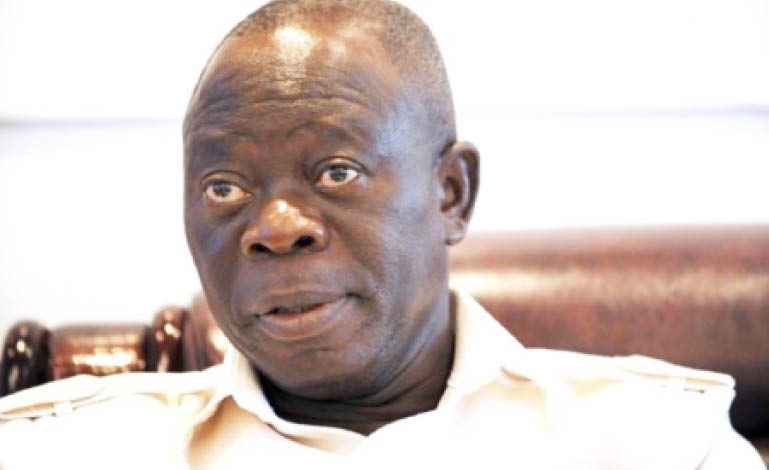
Former Edo State Governor, Adams Oshiomhole, has challenged former Anambra State Governor, Peter Obi, to a public inspection of their respective records in office, declaring that he is ready to take the Labour Party presidential candidate round Edo State to showcase projects executed during his administration.
Oshiomhole said Obi should first visit Edo State to assess his achievements before both politicians proceed to Anambra State, where the former governor would be expected to identify projects executed during his eight-year administration.
The former governor’s challenge comes amid the renewed political controversy over the performance of former state governors following President Bola Tinubu’s criticism of Obi’s record in tackling the persistent erosion menace in Anambra State.
Obi had announced plans to publish his achievements as governor daily over the next few days in response to Tinubu’s allegation that he failed to address the erosion crisis before leaving office.
However, Oshiomhole, who backed the President’s position, insisted that Obi’s record should be subjected to public scrutiny, particularly regarding the devastating effects of gully erosion on communities in Anambra.
He threw the challenge on Monday in Abuja at the launch of the A-Z of Education Reforms Scorecard by the Minister of Education, Dr Tunji Alausa.
Speaking at the event, Oshiomhole said he was prepared to personally conduct the inspection, insisting that Nigerians deserved concrete evidence of what their political leaders achieved while occupying public offices.
“I offer through the media. I will take you to Edo and I will show my landmark achievement. And then Peter will follow me. We will go to Anambra. Let him point to all those things,” he said.
Oshiomhole said the proposed inspection would also afford both politicians the opportunity to examine the erosion crisis in Anambra and hear directly from residents whose homes and communities had allegedly been devastated by the environmental challenge.
He maintained that the complaints of affected residents could not be ignored, arguing that the scale of the erosion problem raised questions about the performance of successive administrations in the state.
“When President Bola Ahmed Tinubu talks about his failure to fix erosion, we will go and see that this erosion were there and all the cries of the people. We will check it out. Give me station and see how the people were crying that their homes were being swept away,” he added.
The former Edo governor, however, extended his intervention beyond the political exchange, using the occasion to defend the Tinubu administration’s education policies, particularly the Nigerian Education Loan Fund (NELFUND).
Oshiomhole dismissed criticisms of the initiative by some political figures, insisting that the scheme represented an important intervention in addressing financial barriers to higher education.
He contrasted the policy with what he described as the privatisation approach associated with former Vice-President Atiku Abubakar, whom he accused of promoting private tertiary education while serving in government.
According to him, the Tinubu administration’s education reforms were not limited to student financing, as improved welfare and remuneration for university lecturers were equally important to restoring stability in the nation’s tertiary education system.
Oshiomhole argued that better conditions of service would encourage qualified Nigerians to remain in the university system instead of seeking more lucrative opportunities elsewhere.
Recalling his involvement in efforts to resolve the longstanding dispute between the Federal Government and the Academic Staff Union of Universities, Oshiomhole said successive administrations had failed to honour agreements with the union despite repeated industrial crises.
He disclosed that former President Umaru Musa Yar’Adua appointed him in 2009 to mediate between ASUU and the Federal Government, adding that improved remuneration remained essential to preventing avoidable strikes and strengthening public universities.