
President Bola Tinubu has finalised a Five-Year Strategic Defence Operations Plan aimed at ending insurgency, banditry, kidnapping and other security challenges affecting different parts of Nigeria.
The plan will introduce major changes to the country’s security architecture, with increased military manpower, improved intelligence gathering, modern technology and better coordination among security agencies forming part of the proposed strategy.
Politics Nigeria reports that the All Progressives Congress Presidential Campaign Council (APC PCC) disclosed this in a statement issued on Sunday in Abuja by its spokesperson, Dele Alake.
According to the council, the framework is designed to address Nigeria’s 17-year battle against insurgency and other forms of insecurity.
It will also provide a long-term direction for military operations, defence spending, personnel development and the acquisition of necessary equipment.
Alake said the administration was determined to move beyond conventional military operations by adopting a system that combines intelligence gathering, technology, prevention and sustained security offensives.
He stated that the initiative would reposition the country’s security structure towards a more coordinated and effective approach to tackling threats across the country.
“President Bola Tinubu is determined to end the 17-year scourge of insecurity ravaging parts of Nigeria through a comprehensive Five-Year Strategic Defence Operations Plan designed to strengthen the country’s security architecture, improve military effectiveness, and ensure a coordinated response to emerging threats,” Alake stated.
The campaign council also highlighted what it described as achievements recorded by the Tinubu administration in the fight against terrorism and banditry over the past three years.
According to Alake, military operations during the period resulted in the elimination of more than 15,000 Boko Haram terrorists and bandits.
He further claimed that over 130,000 Boko Haram fighters and their dependents had surrendered through Operation Safe Corridor, the Federal Government’s rehabilitation programme for repentant insurgents.
The programme is designed to process and rehabilitate individuals who abandon insurgent groups, with the objective of supporting their reintegration into society.
The APC PCC explained that the figures reflected the administration’s approach of combining military offensives with non-military interventions to address insecurity.
Beyond the reported military operations, the council disclosed that Tinubu had approved several structural changes within the Nigerian Army to improve its operational strength and response to security threats.
One of the measures is the establishment of four new Army divisions alongside the restructuring of existing military formations.
The administration has also approved the establishment of two additional Army depots in Osogbo, Osun State, and Amasiri-Edda, Ebonyi State.
Each of the facilities is designed to accommodate 6,000 recruits at a time.
This will provide a combined training capacity of 12,000 soldiers and increase the number of personnel available for future military operations.
Alake disclosed that the Osogbo Army depot had already commenced operations, with 5,210 recruits currently undergoing training.
The expansion of military training facilities comes amid the need to strengthen manpower across security formations and improve the ability of troops to respond to attacks in vulnerable communities.
In another major development, the APC PCC spokesperson said Tinubu had approved the recruitment of an additional 28,000 soldiers into the Nigerian Army.
The President has also authorised the recruitment of 50,000 additional officers into the Nigeria Police Force.
With the two recruitment figures combined, the administration is planning to bring an additional 78,000 personnel into the Army and Police Force.
The council said the manpower expansion would address existing personnel shortages and improve the deployment of security operatives to areas experiencing persistent attacks, kidnapping and other criminal activities.
On the welfare of military personnel, Alake disclosed that the administration was also investing in accommodation and operational infrastructure to improve the living and working conditions of troops.
He specifically mentioned the construction of a 700-unit military barracks in Ikere-Ekiti, Ekiti State.
The project is expected to provide accommodation for military personnel and strengthen the infrastructure supporting security operations in the area.
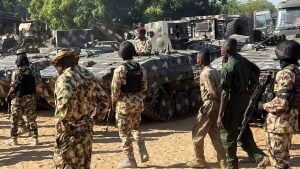
Alake maintained that providing suitable accommodation and improving working conditions remained important parts of efforts to strengthen the country’s defence capabilities.
“These measures reflect the administration’s determination to address manpower and infrastructure gaps, improve the capacity of security agencies, and ensure personnel are adequately trained, equipped, and deployed to areas facing security challenges,” the statement read.
The APC PCC also explained that the new five-year framework would influence how the government allocates resources to the defence sector.
Under the proposed arrangement, security spending would be guided by identified threats, operational requirements and national priorities rather than unnecessary expenditure.
Alake said the objective was to eliminate waste in the defence sector while ensuring that security agencies had access to the equipment, training and infrastructure required to carry out their responsibilities.