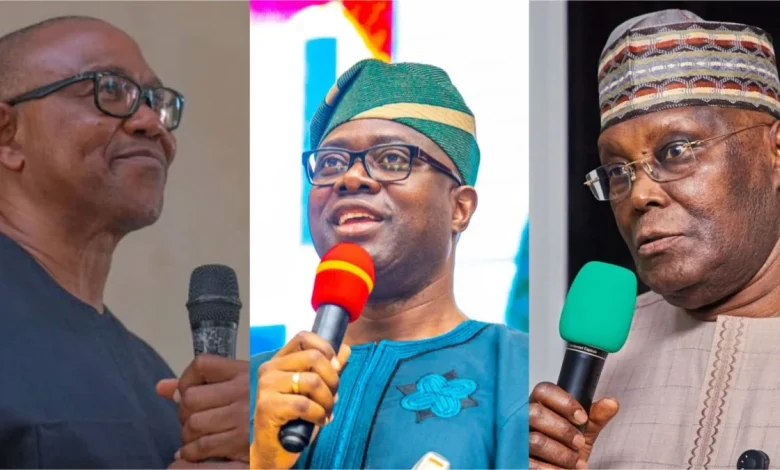
Oyo State Governor Seyi Makinde has revealed why the five aggrieved governors of the Peoples Democratic Party (PDP), popularly known as the G5, refused to support former Vice-President Atiku Abubakar or join forces with Labour Party presidential candidate Peter Obi during the 2023 general election.
Makinde said the decision followed disagreements over the PDP’s zoning arrangement and concerns about the concentration of political power in the hands of northern leaders ahead of the election.
The governor explained that the G5 governors were uncomfortable with the party’s decision to leave its presidential ticket open after eight years of President Muhammadu Buhari’s administration, which was led by a northerner.
He maintained that the group had pushed for the presidency to move to the South in the interest of fairness and political balance.
However, Atiku eventually emerged as the PDP’s presidential candidate after defeating other contenders at the party’s presidential primary.
Makinde made the disclosure during an interview on the WithChude Podcast, where he provided details of the discussions, disagreements and political calculations that influenced the G5’s decision to withdraw support from Atiku.
The group comprised Makinde, former Rivers State Governor Nyesom Wike, former Benue State Governor Samuel Ortom, former Abia State Governor Okezie Ikpeazu and former Enugu State Governor Ifeanyi Ugwuanyi.
The five governors had openly opposed Atiku’s candidacy and demanded the resignation of the PDP National Chairman, Senator Iyorchia Ayu, who was also from the North.
According to Makinde, he was among those who strongly advocated for the PDP to zone its presidential ticket to the South following Buhari’s eight-year tenure.
“If you look at 2023, we had an issue in the PDP. I was at the forefront of zoning the presidency to the South in the PDP, such that after eight years of President Buhari, who’s from the North, you can have a southern president,” he said.
He explained that the party’s failure to enforce its zoning arrangement created the conditions that eventually led to the emergence of Atiku, despite the governors’ position that the presidential ticket should go to the South.
Makinde said the G5 subsequently held discussions with Atiku and presented several conditions they believed would address their concerns about political representation and the future structure of the party.
One of their major objections concerned the positions occupied by key northern politicians within the PDP’s leadership and presidential campaign.
At the time, Atiku was the presidential candidate, Ayu remained the party’s national chairman, while former Sokoto State Governor Aminu Tambuwal was appointed Director-General of the presidential campaign.
Makinde argued that the arrangement gave three northern politicians considerable influence over the party’s presidential campaign and the decisions that could shape the next administration.
He said the governors wanted a political structure that would give the South a meaningful role in decision-making rather than simply expecting southern politicians to support the party without adequate representation.
“Now you are the candidate of the party, there are certain things we want you to do. First is, you cannot be the candidate from the North-East. The national chairman of the party is Senator Ayu from the North-Central, and you’re appointing Governor Tambuwal as the DG of the campaign.
“I mean, it’s the three of you that will sit and decide most things. And when you transition to government, it’s almost the same thing. So, what do we have to use to campaign for our own people in the South? So we couldn’t have an alignment,” he said.
The governor said the disagreement eventually pushed the G5 to consider political alternatives outside the PDP, particularly as the group was determined to secure certain commitments on how the country would be governed after the election.
He stressed that their decision was not based solely on who would win the presidential election but also on what they believed the next administration should represent.
Makinde disclosed that the governors approached both Peter Obi and Bola Tinubu, who was then the presidential candidate of the All Progressives Congress (APC), to discuss their expectations for the country.
He said the discussions centred on the possibility of establishing a government of national unity that would accommodate different interests and ensure that Nigerians from all parts of the country had a sense of belonging.
The governor explained that the group wanted assurances that the next government would not concentrate opportunities and political appointments in the hands of a few individuals or a particular section of the country.
“So, we decided. Are there other options available to us? Yes, we started thinking about governance beyond the 2023 election. If you have to break rank across party lines, then you have to really go deep into governance, into what will happen after the election itself,” Makinde said.
He disclosed that the G5 had a discussion with Obi during which they presented their expectations for a more inclusive government.
However, despite describing the meeting as positive, Makinde said the governors were not convinced that the former Anambra State governor would implement the proposals if elected president.
According to him, the group wanted more than political assurances during the campaign. They wanted to understand how their proposed arrangement would translate into actual governance after the election.
“We approached Peter Obi. We approached Asiwaju, and we said, ‘Look, beyond this election, it will be a government of national unity. Nobody should be a slave in their own country. A Nigeria that will work for not just the privileged few, but everybody.’
“Those things were brought to the forefront, and then Peter Obi, we had a good discussion, but we didn’t get the feel that this will happen,” he said.
Makinde said the governors subsequently held discussions with Tinubu and presented the same proposals, including the formation of a government of national unity and the need to prioritise national competence.
He claimed that Tinubu accepted their proposals, giving the G5 the assurance they wanted regarding the direction of the proposed administration.
“So, when we now approached the president, and we brought this before him, he accepted government of national unity, all of those things we have put together, national competence, and things like that,” he said.
The governor explained that Tinubu’s response influenced their eventual decision to support the APC presidential candidate instead of Atiku or Obi.
He also acknowledged that the G5 had taken a significant political risk by openly challenging the leadership and presidential candidate of their own party.
According to Makinde, the governors understood that breaking ranks with the PDP could have serious political consequences, particularly if the alternative arrangement they eventually supported failed to meet their expectations.
He said they therefore had to be careful about the direction they chose after deciding not to support their party’s presidential candidate.