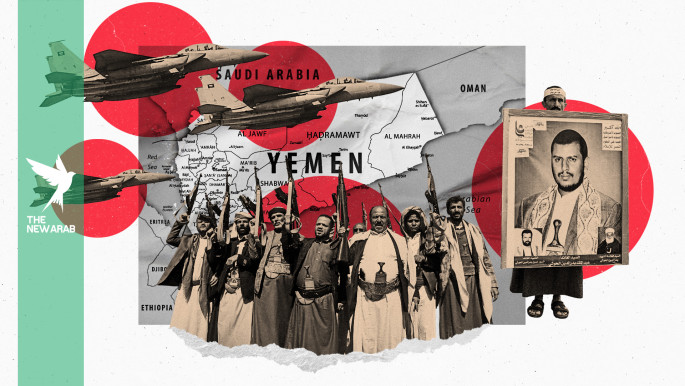
July has seen the 30 March 2022 ceasefire between Saudi Arabia and the Houthis put to its greatest test yet, with both sides exchanging fire for the first time in four years.
The standoff came as the Houthis and Iran actively sought to cross a major red line by reestablishing direct flights from Tehran to the Houthi-controlled Yemeni capital Sanaa for the first time since 2015.
Sanaa standoff
The standoff started on 3 July when an Iranian Mahan Air flight flying directly from Tehran landed in Sanaa to pick up a Houthi delegation attending the funeral of the late Iranian Supreme Leader Ayatollah Ali Khamenei.
The plane came without the approval of Yemen’s internationally recognised government, nor its backer, Saudi Arabia. The Houthis promptly accused Saudi Arabia of attempting to prevent it from landing, claiming they fired air defence missiles to force Saudi warplanes to back off, and threatened to target Saudi airports in response.
The Saudi-led coalition warned the following day that it would retaliate with “unprecedented determination and force” against any such attacks. The Mahan Air flight returned to Tehran.
Ten days later, another aircraft flying from Tehran entered Yemeni airspace. This time, Saudi Arabia acted, with fighter jets launching missiles at the runway in Sanaa airport before the Iranian airliner could land.
The plane landed at Yemen’s Hodeidah International Airport, which the Houthis also control, a few hours later. The Houthis responded by launching missiles and drones at Saudi Arabia’s Abha International Airport, which the kingdom said it intercepted.
The Saudi strike on Sanaa was the first recorded since 27 February 2022. Saudi-led warplanes previously bombed the runway of that international airport in April 2015 to prevent another Iranian airliner from landing there.
Mohammed Al-Basha, founder of the US-based Risk Advisory Basha Report, noted that the Houthis had been preparing the airports in Sanaa, Hodeidah, and Saada for several days ahead of the 13 July Iranian flight. Such preparations were a “strong indication” that the Houthis expected either a Saudi or Israeli strike.
“I expect we will see more direct flights between Tehran and Sanaa,” Al-Basha told The New Arab. “I do not think that will be sustainable over the long term.”
“If those flights continue, there is a real possibility that the airstrips and airport infrastructure in Houthi-controlled northern Yemen could be heavily damaged or destroyed,” he said.
Presently, the “main path to de-escalation” is running through Oman’s capital Muscat, which is hosting senior Houthi negotiators and UN Special Envoy for Yemen, Hans Grundberg.
“Oman is communicating with Saudi Arabia, and the UN is in contact with both sides in an effort to reduce tensions,” Al-Basha said.
Fatima Abo Alasrar, author of the Ideology Machine, a publication on authoritarian information systems, described the 13 July events as one of the most consequential Saudi-Houthi confrontations, given that it unfolded at an “exceptionally fragile moment” in the region.
“Iran is openly backing direct flights to Sanaa while bypassing restrictions on Yemeni airspace that were designed to disrupt Houthi supply networks and maintain oversight of access into Houthi-controlled territory,” Alasrar told The New Arab.
“Tehran appears intent on establishing a recurring air link that could facilitate the movement of personnel, and most likely finance and other cargo.”
Iranian leverage
Ryan Bohl, a senior Middle East and North Africa analyst at the risk intelligence company RANE, similarly described it as a “very serious confrontation”.
Nevertheless, he doubts Iran can establish any feasible air corridor unless it reaches a “diplomatic understanding” with the US, Israel, and Saudi Arabia, since any of these powers can intercept any attempts to do so.
“The question is whether or not Iran is going to try to push that line given their clear intention to use Bab al-Mandeb as another piece of leverage against the US,” Bohl told The New Arab.
“If Iran pushes it, we may see a quick unravelling of the ceasefire, as Saudi Arabia would not want such a clear link established. But in terms of the actual ceasefire, Saudi Arabia’s intent remains the same: prop up the IRG (Internationally Recognised Government), stay aloof from the conflict, keep the stalemate,” he added.
“What isn’t clear is if Iran and its new leadership feel compelled to force Saudi Arabia out of that by trying to arm the Houthis at new levels,” Bohl said.
In another sign of possible escalation, Houthi military spokesperson Yahya Saree on Monday declared a “maritime embargo against the criminal Saudi enemy, based on the equation of ‘an eye for an eye’” in response to “an unjust and oppressive siege” by Saudi Arabia on Yemen.
Al-Basha believes the “key issue” is that the Houthis are using the threat of resuming flights from Tehran to Sanaa to increase pressure during negotiations.
“Their goal is to secure full control over Sanaa airport, including the authority to approve arrivals and departures without oversight from Yemen’s internationally recognised government or the Saudi-led coalition,” he said. “That is a difficult demand because it would effectively give the Houthis control over Yemen Airways as well.”
There are only three operational aircraft left in that fleet after Israeli airstrikes destroyed or damaged the rest.
“The internationally recognised government is concerned that if those aircraft begin operating under Houthi control, they could become targets again,” Al-Basha said. “That concern is understandable, which is why there is significant hesitation.”
Riyadh opposes the restoration of these direct flights because they could be used to transport military equipment.
“An Airbus A340 has enough cargo capacity to carry a substantial number of weapons, including potentially thousands of man-portable air defence systems, making these flights a serious security concern,” Al-Basha said.
Strike capabilities
In the latter stages of the 2015-22 Saudi-Houthi war, the Yemen-based group proved increasingly capable of hitting targets deeper inside Saudi Arabia with Iranian-designed ballistic missiles and drones. RANE’s Bohl believes they’ve retained their capability of striking “more or less all” of that large kingdom.
“The scale would be a question, given the Houthis have used up some of their arsenal against Israel and can’t rebuild like Iran can,” he said. “They too seem to be reactive and responsive to Iran, and so the type of strikes would depend on Iran’s intent towards Saudi Arabia; is it supply destruction or merely more disruption?”
“For that matter, does Iran want the Houthis to attack the UAE as well?” he added. “Those are questions that are yet to be answered.”
During the 13 July strike, it appears Saudi Arabia used air-launched Storm Shadow cruise missiles to hit the airport at a standoff range, possibly to evade Houthi air defences like those the group claimed to have fired on 3 July. During America’s large-scale Operation Rough Rider air campaign against the group in 2025, Houthi air defences almost hit US F-16 and even fifth-generation F-35 stealth fighters.
“I think the Saudis are aware they are more at risk than the Americans – their air force is less advanced, and so the desire to use long-range systems is high to prevent a possible shoot-down,” Bohl said.
“But long-range strike capabilities are also a way of signalling deterrence to the Houthis as well, putting the Saudis into a category similar to the Israelis and Americans in their ability to fire from well outside Yemen’s borders.”
Then there is the question of Saudi air defences against the Houthis. While the kingdom has some cutting-edge American systems, including the Patriot PAC-3 and the recently acquired THAAD, its interceptor inventories were undoubtedly strained during the recent Iran war.
Bohl assesses that Saudi air defences can “manage recurrent, sporadic attacks” by the Houthis, but some attacks will still come through, especially if they are launched simultaneously alongside Iranian attacks.
Such a scenario would put an additional strain on the kingdom’s defences and increase the likelihood of Iranian and Houthis’ munitions making it to their targets. Iran launched its first direct attack against Saudi Arabia in months on Saturday.
That attack came mere days after Tehran reportedly asked its Houthi ally to close the vital Bab al-Mandeb strait if the US fulfils President Donald Trump’s threat to hit Iran’s power infrastructure.
“We do know that there has been rushing of air defences to the region from the US, but what we don’t know is the quantity; that matters immensely as to when Saudi Arabia decides to ‘ration’ munitions and thereby allow some strikes to preserve munitions for more advanced attacks,” Bohl said.
Evading escalation
While tensions have reached a high point, that doesn’t mean renewed war is inevitable. Al-Basha pointed to Saudi Arabia’s decision to allow the Iranian aircraft on 13 July to land and depart from Hodeidah without striking that airport as an indicator that Riyadh seeks to avoid escalation.
Similarly, the Houthis’ decision to only target Abha rather than larger airports like Jeddah and even Riyadh suggests they too want to contain the confrontation.
“That said, the crisis is far from resolved,” Al-Basha said. “While negotiations continue in Muscat and through other back channels, both sides appear to be preparing for the possibility of a broader conflict.”
“I do not think a full-scale war is imminent,” he added. “There could still be another round of limited strikes, but for now, that is my assessment.”
Ideology Machine author Alasrar outlined how, from the Saudi perspective, allowing any air corridor from Iran to Houthi-controlled areas in Yemen would “fundamentally alter the strategic landscape” in that country.
Saudi Arabia’s subsequent decision to hit the runway at Sanaa therefore suggests it’s prepared to risk renewed escalation to prevent any “new logistics corridor from taking root”.
“The Houthis remain dangerous, but their ability to generate sustained military assault will depend in part on whether Iran can continue replenishing critical components and technical support,” she said.
“The past years have seen interception of their supply chain that has effectively choked off the movement, which has been increasingly choosing limited escalations that it was not able to sustain.”
Paul Iddon is a freelance journalist based in Erbil, Iraqi Kurdistan, who writes about Middle East affairs
Follow him on X: @pauliddon
Edited by Charlie Hoyle