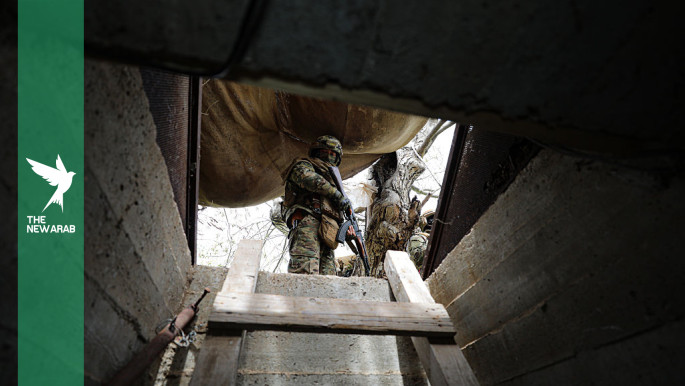
Syrian troops uncover a network of tunnels near the Lebanon border on 1 April 2026. [Getty]
Syrian authorities are stepping up efforts to combat arms smuggling across the country’s border with Lebanon, following the seizure of more than 200 grenades hidden inside a vehicle bound for Lebanon.
The latest operation came just days after Damascus said it had foiled an attempt to smuggle long-range missiles, anti-tank guided missiles and drones allegedly destined for Hezbollah.
The repeated seizures have raised questions over why Damascus is tightening its grip on the border, and whether the campaign is driven solely by domestic security concerns or also reflects Syria’s efforts to improve ties with the international community, particularly following President Ahmed al-Sharaa’s meeting with US President Donald Trump.
Firas Faham, a researcher specialising in security and political affairs, told The New Arab that the heightened security measures along the Syrian-Lebanese border “did not emerge overnight” and began following the fall of Bashar al-Assad’s government.
He said the new authorities have made security a priority in the area to combat the smuggling networks established by Iranian-backed militias.
According to Faham, Damascus has pursued two parallel objectives since taking power: dismantling armed cells that could threaten stability and sending a message to the international community that Syria is no longer a theatre for proxy wars.
He said this approach had contributed to improving relations with neighbouring countries, including Jordan, Turkey and Gulf states, as well as the US.
Faham also said Syria and Washington have begun cooperating over security issues and share intelligence on both Iranian-backed groups and Islamic State group cells.
He added that the coordination extended beyond the US to include several regional and international partners seeking to curb activities threatening Syria’s stability.
Retired brigadier general and security analyst Fayez al-Asmar said the continued attempts to smuggle weapons reflected Iran’s determination to preserve supply lines into Lebanon after the fall of the Assad government.
He told The New Arab that the shipments were not necessarily intended solely for Hezbollah but could also be destined for other groups opposed to Syria’s new authorities, as Tehran seeks to preserve its influence in the country.
Al-Asmar said Syrian authorities had deployed border guards and military units while tightening surveillance at both official crossings and informal smuggling routes.
While the measures were likely to restrict the movement of weapons and drugs, he said that Syrian authorities continue to face major challenges because of the length of the border, the rugged terrain and the extensive tunnel networks, which require advanced surveillance equipment to properly monitor.
Military expert Diaa Qaddour said the seized munitions were designed for automatic grenade launchers that can also be mounted on drones.
He said the munitions produce powerful explosions designed for use against troops, fortifications and lightly armoured military vehicles.
Qaddour said the repeated seizures reflected improvements in the capabilities of Syria’s security and intelligence agencies and do not necessarily indicate an increase in smuggling.
He added the recent lifting of sanctions offered Damascus an opportunity to modernise border surveillance equipment and expand human intelligence networks to improve control over the frontier.
Over recent months, Syrian authorities have announced a series of operations targeting weapons-smuggling networks along the Lebanese border.
Last week, the Interior Ministry said it had thwarted an attempt to smuggle long-range missiles, anti-tank guided missiles and drones allegedly destined for Lebanon.
On 15 June, security forces arrested a suspected smuggler in western Homs countryside and confiscated missiles that authorities said were intended for transport into Lebanon.
In April, the Syrian army announced the discovery of a network of tunnels in the town of Rabla, near Al-Qusayr, which it said had been used to facilitate cross-border smuggling operations.