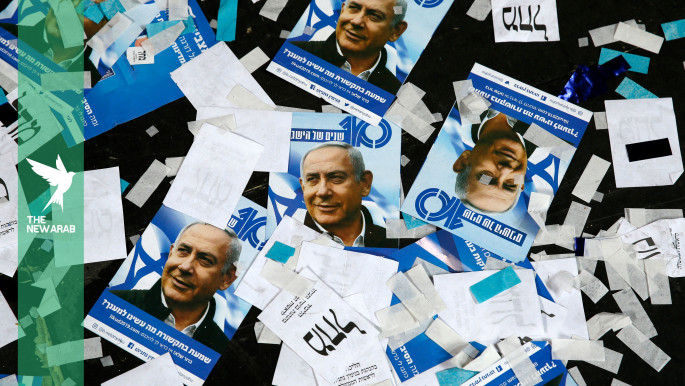
Ramallah, West Bank – Israel’s 27 October election is shaping up as a pivotal test of whether the country’s fractured political system can produce a stable majority.
Palestinian parties, no longer confined to the political margins, could prove decisive in determining the next prime minister if neither of the competing blocs secures enough seats to govern alone.
The election has largely become a contest between Prime Minister Benjamin Netanyahu’s alliance – centred on Likud and supported by the far-right parties of Itamar Ben-Gvir and Bezalel Smotrich, as well as the ultra-Orthodox Shas and United Torah Judaism – and a fractured opposition led by Gadi Eisenkot’s Yashar, which also includes the joint Bennett-Lapid list Together, Yair Golan’s Democrats, and Avigdor Lieberman’s Yisrael Beiteinu.
An early July Channel 12 poll projected the opposition bloc at 68 seats, with Yashar drawing level with Likud at 23 seats and Eisenkot narrowly ahead of Netanyahu as the preferred candidate for prime minister. Yet despite those numbers, neither bloc is assured of the 61-seat majority needed to form a government.
With the two Jewish-led camps running close enough that a handful of seats could decide who governs, the roughly two million Palestinian citizens of Israel once again hold the power to tip the balance, yet the war has left the country less willing than at any point in years to let them use it.
Analysts say that the question facing the country on 27 October is therefore not simply whether Palestinian votes are needed to assemble a majority, which they may well be, but whether an Israeli political system reshaped by the language of security is prepared to treat the Palestinian minority as a full partner in power rather than a convenience to be summoned at the ballot box and set aside once the government is formed.
A taboo, briefly broken
Palestinian parties have voted in the Knesset since the state’s founding, but their presence in successive governments has been almost non-existent. The sole exception was the unprecedented step taken in 2021 by Mansour Abbas, leader of the United Arab List, when he chose to join the coalition of Naftali Bennett and Yair Lapid, ending 12 consecutive years of rule by Netanyahu and breaking one of the most enduring taboos in Israeli politics.
That step followed an earlier moment of promise. When the Joint List brought the main Palestinian factions together under a single banner in 2015, turnout rose sharply, and by the 2020 election the alliance held 15 seats, making it the third-largest bloc in the Knesset.
But the coalition fractured over strategy, and Abbas broke away to pursue what he called “influence from within,” arguing that decades in opposition had won little for Palestinian citizens on the issues that mattered most to them, from organised crime to housing and municipal budgets.
In government, his party extracted commitments once thought unthinkable, including billions of shekels for Palestinian local authorities, plans to combat crime, and investment in infrastructure and housing. Abbas has defended the experiment ever since as proof that politics is cumulative, and that breaking the psychological barrier to Palestinian participation was itself a strategic gain.
His critics counter that most of the promised programmes were never completed, that the government soon fell, and Netanyahu returned, and that joining a coalition led by a figure of the settler right conceded national principles for little lasting change.
The war redraws the boundaries
Mohammad Darawshe, a researcher at the Givat Haviva Centre, told The New Arab that the central debate in Israeli politics right now is whether Palestinian parties should be allowed to participate in governing coalitions.
“Polls suggest uniting the Arab parties into a single list could measurably raise turnout in Arab society and hand them between 15 and 16 seats, enough to make them the third-largest force in parliament,” he explained.
“Yet that electoral achievement would not automatically open the doors of the governing coalition, because the central obstacle lies in the refusal of broad segments of the right, and even some centrist parties, to accept Arabs as partners in power.”
That reading overlaps with the analysis offered by Amal Jamal, a professor of political science at Tel Aviv University, who believes the war has “redrawn the boundaries of Arab political participation inside Israel”.
Before 7 October, she argues, there was a possibility of parliamentary cooperation despite ideological differences between the parties. Today, the political discourse revolves around notions of security, loyalty, and belonging, concepts that have made the very idea of including Palestinian parties in a government intensely sensitive for most Israeli parties.
“As a result of rising nationalist and religious rhetoric and the widening space occupied by parties that categorically reject any cooperation with them, Arab parties now confront a lower political ceiling than existed before the war,” she told The New Arab.
For the writer and analyst Antoine Shalhat, what has unfolded since 7 October is less an electoral shift than a return to an older pattern in the relationship between the state and its Palestinian citizens.
“The sharper the security crises, the more the space for civic debate contracts, and the more Arab citizens are redefined through the lens of security rather than as a national minority entitled to equal rights,” he tells The New Arab.
That dynamic, he adds, makes any future government warier of Palestinian parties even when it genuinely needs their votes, because the cost of such cooperation has risen far above what it was before the war.
The current political landscape has created a dilemma for the opposition, according to Jamal. While it recognises that forming a government may require the backing of Palestinian parties, it also fears that publicly acknowledging that reality would provide the right with a potent electoral message.
Esmat Mansour, an analyst specialising in Israeli affairs, sees that contradiction as the essence of the current crisis in Israeli politics. He sees that the question inside the Israeli parties is no longer whether they need Palestinian lawmakers, but “how to benefit from their votes without paying a political price before Jewish public opinion”.
“That tension,” he suggests, “may push the opposition to seek indirect forms of cooperation, such as outside support or parliamentary understandings, rather than formally bringing the Arab parties into the coalition.”
Israeli affairs researcher Mohanad Mustafa agrees, adding that Israeli society has been shifting rightward since the war began, both in electoral direction and public discourse.
“That shift has made the idea of partnership with the Arab parties harder even for parties once willing to cooperate with them,” he said, adding that this helps explain why talk of repeating the Bennett-Lapid experiment has faded, “even as parliamentary conditions may recreate the need for it”.
The opposition leader, Lapid, has grown more cautious in his statements, according to Mustafa, avoiding any clear pledge about the shape of his relationship with Palestinian parties after the election.
While Benny Gantz, who is trying to draw voters from the centre and the moderate right, keeps his rhetoric within limits that give his rivals no opening to accuse him of depending on Palestinian lawmakers to form a government.
Polling by the Moshe Dayan Centre paints a different picture within Palestinian society. Most Palestinian citizens see political participation as a way to improve daily life by tackling organised crime and investing in housing, infrastructure, education, and local authorities.
The surveys also suggest that reunifying the Palestinian parties could restore turnout to 2020 levels, when the Joint List won 15 seats and became the Knesset’s third-largest bloc.
Kingmakers without a throne
That external pressure has reopened an old argument inside Palestinian society itself, where leaders remain divided over methods.
Ayman Odeh, leader of the Democratic Front for Peace and Equality, told The New Arab that the divisions of recent years have cost seats and demoralised voters who feel their ballots lose value with each round. Restoring unity, in his view, is “the precondition for rebuilding trust and returning Arabs to a position of strength in parliament”.
Ahmad Tibi, leader of the Arab Movement for Change, does not oppose cooperation in principle but insists Palestinian parties will not serve as a “free safety net” for any coalition.
“Any future understanding,” he told The New Arab, “must rest on clear, written commitments, including efforts to combat crime in Arab towns, higher budgets for local authorities, and the repeal of policies that entrench discrimination in planning, housing and public services.”
Sami Abu Shehadeh, leader of the National Democratic Assembly, takes a harder line, warning that a fixation on joining Israeli governments reduces the Palestinian political project to administrative matters and abandons its national dimension.
“Continued division will only depress turnout further and hand Israeli parties an easier path to sidelining the Arab vote,” he said.
Given the circumstances, Mansour argues that the October election may amount to “an indirect referendum on the standing of Arab citizens within the Israeli political system”.
“Either the Arab parties succeed in establishing themselves as a negotiating partner that cannot be bypassed, or the cycle simply repeats itself, and Arabs are once again excluded from government after giving their votes,” he said.
Aseel Mafarjeh is a Palestinian journalist based in the West Bank
This story was produced in collaboration with Egab
Edited by Charlie Hoyle