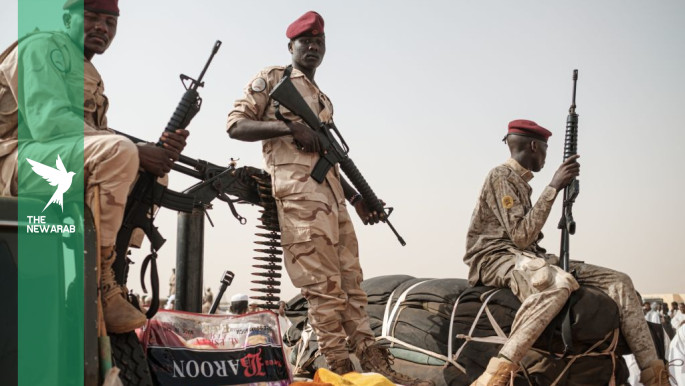
The two sides in Sudan’s war, the army and the Rapid Support Forces (RSF), are using the charge of collaboration to silence voices opposed to the continuation of the war, as well as political opponents and activists. [Getty]
The charge of collaborating with the other side in the conflict, with the threat of death sentences, is now part of a long list of abuses committed by both parties to the war in Sudan.
Amid worsening crises that includes displacement, refuge, dwindling food supplies, and the spread of hunger and disease that millions have endured throughout the years of conflict, the two sides in Sudan’s ongoing war, the army and the Rapid Support Forces (RSF), are using the charge of collaboration to silence voices opposed to the continuation of the war, as well as political opponents, and community activists and volunteers providing aid to the poor and displaced.
Each side has imposed harsh punishments for collaboration with the other.
The RSF resorts to enforced disappearance and summary execution of some of those they accuse of collaborating with the army, while the Sudanese army uses “sham trials” that hand down prison sentences of up to 20 years and, in some cases, death by hanging and summary executions.
The charge of collaboration does not require strong evidence to support or prove it, and it has become the most common accusation in Sudan today.
Those accused are usually subjected to multiple human rights abuses before being brought before sham trials that often sentence them to life imprisonment or death, while some have been summarily executed.
Legal experts describe the trials as unlawful and their rulings as arbitrary and capricious.
Among those accused of collaboration and summarily executed was Nour Mousa, 67, who worked as a livestock herder in the village of Al Ghabsha, near the town of Um Rawaba in North Kordofan.
When his village came under the control of the RSF between August 2023 and January 2025, Mousa decided to remain in his home.
When the Sudanese army recaptured the area, it summarily executed him along with dozens of residents on charges of collaborating with the enemy.
His brother, Ahmed Mousa, told The New Arab, “We could not flee because we did not know where to go, and we had very limited financial means, so we decided to stay in our home.
“But that alone was enough for us to be accused of collaborating with the RSF, which had seized the area by force of arms. When the army entered the area, they found my brother outside the house and asked him why he had stayed,” Mousa said. “Before he could explain his situation, they shot him dead, accusing him of being a collaborator. The RSF killed three of my cousins while they controlled the area. We were all subjected to horrific abuses by both sides in the conflict, each accusing us of collaborating with the other.”
After the RSF seized Singa, the capital of Sennar state, in July 2024, lawyer Abu Bakr Mansour decided to remain in his home.
When the army recaptured the city in November of the same year, he was arrested on charges of collaborating with the RSF and brought before the Singa General Court, which sentenced him to 20 years in prison and fined him 10 million Sudanese pounds (about $3,000).
When his defence team appealed the ruling, the Court of Appeal dropped some of the charges and returned the case to the General Court to hear additional evidence.
However, the court heard no further evidence and instead sentenced him to death in the absence of the defence team. The Supreme Court upheld the death sentence.
The Emergency Lawyers, a legal group, said in a statement: “Multiple testimonies confirmed that Abu Bakr Mansour remained inside the city during the RSF’s control of it and that he volunteered to provide humanitarian assistance, including distributing medicine to patients. No activity on his part amounted to collaboration with the RSF. However, the court ignored all the supporting testimony, constituting a fundamental breach of defence guarantees.”
The emergency lawyers described the ruling as “a violation of the Court of Appeal’s decision and an infringement of fair trial guarantees enshrined in the transitional constitution and international conventions.
It also highlights the clear politicisation of justice institutions and the interference of security agencies in the judiciary’s work, undermining its independence and threatening the rule of law. The security agencies arrested one member of Mansour’s defence team, lawyer Abu Bakr Al Mahi, and prevented him from carrying out his legal duties or communicating freely with his client.”
In another case, Neama Ali, the mother of three children and the wife of a soldier in the Sudanese army, was arrested at her home in Al Kalakla, south of the capital Khartoum, on charges of collaborating with the RSF.
She has spent more than seven months in the cells of the Security Cell, a shadowy security body established after the war that is not subject to judicial authority.
“My sister has not been brought to trial. Ironically, her husband was killed while serving at the Babanusa garrison, known as the 22nd Brigade, in Kordofan, when the RSF captured it in December 2025,” her brother, Hamdan Ali, told TNA. “We fear she may be forcibly disappeared or subjected to a trial that takes no account of the circumstances of her children, who have lost their father while their mother has remained in prison all this time.”
In 2025, the Shendi Court in the River Nile state sentenced Neama’s second brother, Nader Ali, 41, to 20 years in prison on charges of collaborating with the RSF, even though he is a person with disabilities.
The reason was that he had remained for several months in Khartoum while it was under the RSF’s control before leaving for the River Nile state, where he was arrested.
“My brother and sister were accused of collaboration because our family comes from western Sudan, where most RSF members originate, as well as because they remained in areas under its control,” Hamdan Ali said.
Writer Khalid Bahiri, 75, was arrested from his home in Wad Madani, the capital of Al Jazirah state, a few days after the army regained control of the city in January 2025.
He was forcibly disappeared for three months before his family learned where he was being held. He was then brought before a court that his defence team described as “farcical”.
On 13 January, the Wad Madani General Court convicted him and sentenced him to life imprisonment on charges of collaborating with the RSF.
His son, Mohammed Bahiri, said to TNA, “My father decided to stay in the city after the RSF took control of it. He repaired water stations after they stopped operating and established volunteer initiatives to help stranded people who were unable to flee by providing food, drinking water and medical services to residents.”
“His work was not secret. Before the war, he was a community activist and took part in many charitable initiatives for the poor and needy. He was sentenced to life imprisonment despite suffering from kidney failure,” Bahiri added.
Pharmacist Ahmed Abdullah Khidr was known in his area of the northern state for providing medicines free of charge to residents and displaced people. He also ran, with others, a community kitchen offering free meals.
Last June, a court sentenced him to 25 months in prison on charges of “insulting the martyrs of the war”.
According to a member of his family, who requested anonymity for security reasons, the court ordered his imprisonment because he told some soldiers that “those killed in this war are not martyrs”.
Lawyer Rehab Mubarak described the trials of civilians on charges of collaborating with the RSF as attempts at intimidation aimed at silencing voices calling for an end to the war.
“Women and children have been tried on charges of collaborating with the RSF. These trials are taking place in different areas under tight security conditions. There are no precise figures on the number of those convicted, but they number in the thousands,” Mubarak said.
Sami Abdel Halim Saeed, deputy head of the African Network of Constitutional Lawyers, told TNA, “Most of the trials taking place today, including those of people labelled as collaborators, lack the basic principles of a fair trial, and some are subject to political influence. Justice institutions have become part of the machinery of war.
“Under unjust legal classifications, these courts issue rulings that can be regarded as political purges of opponents or those who do not align with the authorities. Some people are being tried simply because they do not publicly support the army,” he noted.
“By following the facts and events, we have learnt that many women and elderly people remained trapped in areas controlled by the RSF. They became surrounded by abuses, torture and criminalisation, forcing them to devise various ways to make survival possible, including not opposing or confronting the RSF,” Saeed added.
“Those who succeeded survived, while those who failed were summarily executed. As a matter of law and ethics, it is unacceptable to prosecute victims on charges of collaborating with the enemy.”
Nafisa Hajar, deputy head of the Darfur Bar Association, said the danger of these trials lies in the death sentences that may be carried out following the re-establishment of the Constitutional Court.
She told TNA, “After the Constitutional Court, whose mandate expired in 2018, was reconstituted, citizens sentenced to death face grave danger because it is the highest court of appeal. Cases can be referred to it at any moment; death sentences can be confirmed and then carried out.
“We have documented the names of more than 2,000 people who had been tried by the end of last year, but the real number is certainly higher,” Hajar added.
Article translated from Arabic by Afrah Almatwari. To read the original, click here.