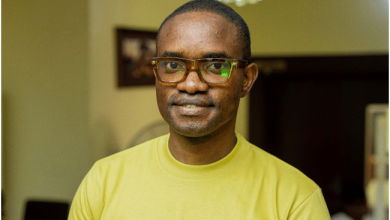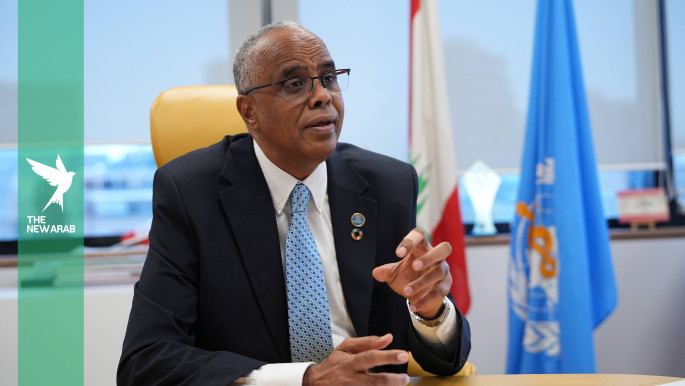
Dr Abdinasir Abubakar led the World Health Organization’s response to Lebanon’s successive crises, from the cholera outbreak to Israel’s war on the country [TNA/Mohamad Salman]
Standing beside the windows of the World Health Organization’s (WHO) office in Beirut, Dr Abdinasir Abubakar gestures towards the skyline stretching beyond the Lebanese capital.
“This is where I was on 8 April,” he recalls, the day Israel announced it had struck more than 100 targets across Lebanon in just 10 minutes during one of the war’s most intensive waves of indiscriminate bombardment.
From the fourth floor, he watched Israeli warplanes strike Beirut as smoke billowed across the city. He remained rooted to the spot as explosions echoed through the capital, despite the risk that shattered glass could come crashing through the office.
“I stood here without moving,” he says. “I remained frozen.”
Months later, he admits the experience left its mark. Like many Lebanese who lived through the war, he sought psychological support after witnessing the intense bombardment.
It was one of many moments that shaped his final years leading the WHO mission in Lebanon.
The Somali-born physician became a refugee after civil war broke out in his homeland in the early 1990s, an experience that inspired him to study public health at Johns Hopkins University and shaped a career responding to humanitarian crises across Africa and the Middle East, from cholera outbreaks and meningitis to the Covid-19 pandemic.
Since arriving in Lebanon in 2022, he has overseen the WHO’s response to successive emergencies, from Lebanon’s first cholera outbreak in three decades to Israel’s latest war on Lebanon, which placed unprecedented pressure on hospitals, ambulances and frontline medical workers.
The war, which escalated dramatically in March, killed thousands of people, displaced more than a million at its peak and left Lebanon’s already fragile health system struggling to cope.
Hundreds of attacks affected healthcare facilities and personnel, while repeated waves of casualties stretched hospitals well beyond their normal capacity.
Throughout the conflict, WHO worked alongside Lebanon’s Ministry of Public Health to coordinate emergency medical supplies, disease surveillance, trauma care and support for hospitals across the country. Yet Abubakar says the organisation’s greatest concern extends beyond the immediate casualties.
Repeated attacks on healthcare, he argues, risk weakening an entire health system at the very moment civilians need it most.
Below is an edited transcript of The New Arab‘s conversation with Dr Abdinasir Abubakar.
How would you describe Lebanon’s health situation today?
From WHO’s perspective, Lebanon continues to face a complex and fragile humanitarian and public health situation, where reduced intensity of hostilities in some areas coexists with significant and ongoing health consequences.
WHO welcomes continued efforts towards peace and stability and continues to call for sustained dialogue among all parties, full respect for international humanitarian law, and the protection of healthcare, health workers, patients and essential services at all times.
The health system remains under severe strain. Since 2 March, more than 4,300 people have been killed and over 12,000 injured, placing sustained pressure on emergency departments, trauma services, rehabilitation and the continuity of essential healthcare.
The humanitarian situation also remains significant. Around 30,000 people remain in collective shelters, while more than 412,000 people are still internally displaced across the country. Although more than 741,000 people have returned to their areas of origin, many of those returns remain temporary because of insecurity, damaged housing and limited access to healthcare and other essential services.
WHO is particularly concerned about the indirect health consequences of the conflict. Damage to infrastructure, disruptions to water, electricity and telecommunications, and the presence of unexploded ordnance continue to limit access to healthcare while increasing the risk of disease outbreaks, interruptions to chronic disease management, reduced maternal and child health services, and growing mental health and psychosocial needs.
Our priority is to support the Ministry of Public Health and our partners to maintain essential health services, strengthen disease surveillance and emergency preparedness, ensure continuity of care for vulnerable populations, support early recovery, and continue advocating for the protection of healthcare and sustained investment in Lebanon’s health system.
WHO has said its response to the current crisis did not begin on 2 March, but was built on years of investment in Lebanon’s health system. Can you explain what you mean?
The response we see today did not begin with this crisis. It is the result of years of partnership between the Ministry of Public Health, WHO, donors, other UN agencies and national partners to strengthen Lebanon’s health system and improve its readiness for emergencies.
WHO’s approach has always been that preparedness is built before a crisis occurs. Every emergency provides lessons that help identify gaps, strengthen capacities and improve readiness for the next one. This continuous cycle of preparedness, response, recovery and learning has enabled Lebanon’s health system to respond more effectively despite facing successive crises.
Over the years, WHO has worked with the Ministry of Public Health to strengthen emergency coordination, disease surveillance, laboratory systems, frontline health workers and hospitals. We have also supported the procurement of essential medicines, trauma supplies and emergency medical kits, while expanding the Ministry’s central medical warehouse so it could accommodate the unprecedented volume of humanitarian medical aid received during the conflict.
During the war, we also expanded support for the hospitalisation of people injured in the conflict, regardless of nationality or status, ensuring access to lifesaving treatment when the health system was under extraordinary pressure.
These long-term investments have enabled the health system to continue functioning despite unprecedented challenges. While it remains under immense strain, they have strengthened national capacity, improved coordination and allowed Lebanon to respond more rapidly and effectively to successive emergencies.
At the same time, every crisis reminds us that preparedness is not a one-time achievement but an ongoing investment if countries are to remain resilient in the face of future shocks.
Did WHO establish a dedicated team to respond to the crisis? And how was the response coordinated with other UN agencies?
Yes. WHO activated its Incident Management Support Team (IMST), its standard emergency response mechanism, to coordinate and scale up the health response in Lebanon.
The team brought together technical, operational and coordination functions under a single structure, allowing WHO to rapidly shift from routine operations to supporting the Ministry of Public Health and health sector partners during the emergency.
Working closely with the ministry, WHO focused on maintaining essential health services, coordinating the health sector, supporting disease surveillance and information systems, facilitating emergency medical response, and ensuring continuity of care across hospitals, primary healthcare centres and emergency medical services.
At the wider UN level, coordination was led by the UN Resident Coordinator to ensure a unified humanitarian response. WHO worked alongside other UN agencies to avoid duplication, coordinate health interventions and support cross-sector humanitarian efforts.
Together with the Lebanese government and UN partners, WHO also helped develop the Flash Appeal, ensuring urgent health priorities – including trauma care, disease surveillance, mental health support, continuity of essential services and the protection of healthcare facilities and workers -were reflected in the emergency response.
Overall, WHO’s response was fully integrated into both the Ministry of Public Health’s national coordination structure and the wider UN humanitarian system to ensure an efficient and coordinated response throughout the crisis.
If the military escalation were to resume, what would WHO do differently?
If the conflict were to escalate again, WHO would respond through the same emergency coordination framework, working closely with the Ministry of Public Health and UN partners.
Our immediate priorities would remain the same: supporting trauma care, emergency services, disease surveillance, essential medicines and the continuity of healthcare.
One area we would place even greater emphasis on is protecting and supporting Lebanon’s health workforce, which has been the backbone of the country’s health system throughout successive crises.
Over the past six years, health workers have continued providing care through the economic collapse, the Covid-19 pandemic, the Beirut port explosion, repeated conflict and large-scale displacement. Their commitment has been essential to keeping the health system functioning despite extraordinary pressure.
In any renewed escalation, WHO would therefore prioritise the safety, wellbeing and retention of health workers, while also strengthening surge capacity to ensure the health system can continue providing care to everyone who needs it.
Lebanese health workers, ambulances and hospitals repeatedly came under attack during the war. What impact has this had?
The impact has been devastating. Since 2 March, WHO has documented 211 attacks on healthcare, resulting in the deaths of 135 health workers and injuries to another 406, including paramedics and emergency medical teams who are often the first to respond in mass casualty situations.
These attacks have also affected ambulances, hospitals and primary healthcare centres, reducing emergency response capacity and delaying access to care in affected areas.
On 21 May, the World Health Assembly adopted a resolution on the protection of healthcare in Lebanon, calling for full respect for international humanitarian law, the protection of health workers, patients, ambulances and health facilities, and uninterrupted access to essential health services. The resolution also stressed the need for accountability and stronger protections for healthcare in conflict.
Despite that commitment, attacks have continued. Since the resolution was adopted, WHO has documented a further 41 attacks that caused 22 deaths and 143 injuries, as well as additional damage to health infrastructure and emergency services.
These attacks not only result in the tragic loss of health workers and first responders, but also have wider consequences for the health system. They reduce emergency response capacity, disrupt referral pathways and weaken access to lifesaving care for the people who need it most.
Under international humanitarian law, healthcare facilities, ambulances and health workers are protected and must never be targeted. Continued attacks further undermine the resilience of Lebanon’s health system and exacerbate humanitarian needs at a time of exceptionally high demand for trauma care, emergency services and essential healthcare.
Should these attacks be considered war crimes under international humanitarian law?
WHO’s mandate is not to make legal determinations or classify specific incidents as war crimes. Our role is to document the public health impact of attacks on healthcare, support the continuity of essential health services, and advocate for the protection of health systems, health workers and patients.
What we can say is that, under international humanitarian law, health facilities, health workers, ambulances and patients are protected and must never be targeted or obstructed. Respect for these protections is essential to ensure lifesaving health services can continue, particularly during armed conflict.
The repeated attacks on Lebanon’s health sector have had serious system-wide consequences, reducing emergency response capacity, disrupting referral pathways, damaging health infrastructure and limiting access to essential care for affected communities.
You have described the recent escalation as following a “deadly pattern” and said the past few months have been among Lebanon’s deadliest since October 2023. What did you mean by that?
When I used those terms, I was referring to the scale, intensity and cumulative impact of repeated mass casualty events on Lebanon’s health system.
Since 2 March, more than 4,300 people have been killed and over 12,000 injured, including hundreds of women and children. These figures illustrate both the heavy civilian toll and the sustained pressure placed on emergency departments, trauma services and rehabilitation care.
One of the clearest examples was 8 April, one of the deadliest days of the escalation, when at least 357 people were killed and more than 1,165 injured. Hospitals across Beirut, Mount Lebanon and other affected areas were suddenly overwhelmed with trauma cases, forcing many to operate beyond their normal surge capacity.
At the same time, hospitals were continuing to care for large displaced populations, including patients requiring cancer treatment, dialysis and other essential services. Managing these needs alongside repeated mass casualty events placed enormous strain on healthcare workers, hospital capacity, medical supplies and referral systems.
When I describe this as a “deadly pattern”, I mean these recurring cycles of high-intensity attacks followed by sudden surges in casualties, while the health system is already under chronic pressure. It is precisely why protecting healthcare, strengthening surge capacity and ensuring continuity of care remain so critical.
WHO Director-General Tedros Adhanom Ghebreyesus has repeatedly spoken out about attacks on healthcare in Lebanon, at times explicitly identifying Israel as responsible. How do you explain that, given WHO’s usual emphasis on neutrality?
WHO’s work is guided by the principles of neutrality, independence and impartiality. Our role is to document the public health impact of attacks on healthcare, advocate for the protection of health workers, patients and health facilities, and support the continuity of essential health services. Determining legal responsibility rests with the appropriate investigative and judicial bodies.
At the same time, WHO’s leadership has consistently spoken out when the human toll on healthcare has become especially severe. The aim is to draw attention to the devastating impact that repeated attacks have on health workers, emergency responders and the communities they serve.
One particularly tragic example was the death of a 16-year-old volunteer who was assisting emergency medical teams treating injured civilians. It illustrates the extreme risks faced not only by healthcare workers but also by volunteers supporting emergency response efforts.
Our priority remains the protection of healthcare, health workers, volunteers and patients, and ensuring uninterrupted access to lifesaving services for everyone.
What is the health situation in the towns and villages that displaced people are now returning to?
The situation remains fragile. Many families returning to their communities are facing multiple, overlapping health risks.
Access to healthcare remains uneven because of damaged infrastructure, poor road conditions and disruptions to electricity and telecommunications, all of which affect referrals and emergency response. At the same time, unexploded ordnance continues to pose a serious threat to people’s safety and limits access to homes and essential services.
We are also concerned about interruptions to treatment for people living with chronic illnesses such as diabetes, cardiovascular disease, cancer and hypertension, while access to maternal, child and reproductive healthcare remains limited in some areas.
Mental health and psychosocial needs are also increasing as communities continue to cope with displacement, insecurity, loss and uncertainty.
Overall, health services in many return areas remain under strain. While WHO continues to work closely with the Ministry of Public Health and partners to strengthen services, further recovery will depend on restoring infrastructure, improving access to healthcare and clearing unexploded ordnance.
How would you assess Lebanon’s health system before the war, during the conflict and today? What are its greatest needs going forward?
Lebanon’s health system has shown remarkable resilience and adaptability, but it remains under significant strain and will require sustained support to recover.
Before the war, the country had strong hospital and primary healthcare networks and a highly skilled workforce. At the same time, the system was already facing structural challenges, including financial pressures, unequal access to care and reliance on external support in areas such as medicines, disease surveillance and emergency preparedness.
During the conflict, the health system was repeatedly tested by mass casualty events, large-scale displacement, damage to infrastructure and shortages of essential supplies. Despite these challenges, it continued to function because of the close coordination between the Ministry of Public Health, health partners and frontline healthcare workers.
Today, the system remains operational but fragile. Access to healthcare is uneven in some areas, while hospitals continue to face pressure from chronic disease care, rehabilitation needs and growing demand for mental health services. Workforce fatigue, staff retention and limited funding also remain major concerns.
Looking ahead, WHO sees three priorities. The first is supporting and protecting Lebanon’s health workforce, including through staff retention, safety and psychosocial support. The second is ensuring continuity of essential services, particularly for chronic diseases, maternal and child health, mental healthcare and rehabilitation. The third is sustained investment in strengthening the health system through primary healthcare, disease surveillance, emergency preparedness and the restoration of damaged infrastructure.
Lebanon’s health system has repeatedly demonstrated its resilience, but resilience alone is not enough. Its long-term recovery will depend on sustained investment, continued stability and protecting the healthcare workers who remain its greatest asset.