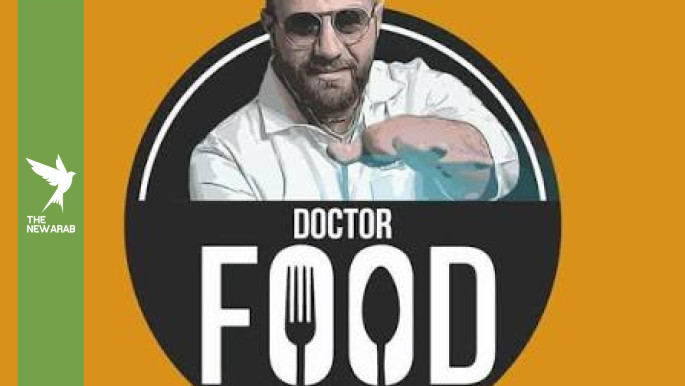
Despite the ruling issued against him in March, “Dr Food” has continued his activity on social media, particularly Facebook, where he has around four million followers. [Getty]
Social media and Lebanon’s media landscape were abuzz last Thursday, 16 July, after news emerged that Criminal Court President Judge Elie El Helou issued a ruling in absentia against content creator George Hanna Dib, known as “Dr Food”, along with several other individuals, regarding a drug smuggling and trafficking case.
According to the text of the ruling, the contents of which were leaked last Thursday, the court convicted the defendants under Article 125 of the Narcotics Law, in conjunction with Article 150 relating to the manufacture of narcotic substances.
It sentenced them to life with hard labour, imposed financial fines and stripped them of their civil and political rights.
A Lebanese judicial source told The New Arab that “the ruling was issued in absentia in March and is not new, but its contents circulated recently,” further noting that “the ruling does not concern Dib alone but also several associates of different nationalities and is an extension of an earlier indictment”.
“Dib is in hiding, and for this reason the ruling was issued against him in absentia,” considering that “the role of the judiciary ends once the ruling is issued, and it remains in force in its in absentia form until he is arrested, while responsibility for carrying out the arrest lies with the security agencies,” the judicial source added.
As news of the ruling spread quickly, with an entertainment page called Sharbelita the first to publish it, “Dr Food” appeared in a video posted to the Story feature on his official Facebook page, accusing the page of damaging his reputation and being paid $500 to spread the news.
Dib also accused Lebanese television channel MTV of receiving $250 to publish the news, stressing that he was “committed before the Lebanese judiciary and that a fully integrated team of lawyers is following every case related to his company”.
“We are certain of our innocence and have submitted proof of that, and we are present in the market,” Dib said.
At the same time, he continued posting advertisements on his page.
Despite the ruling issued against him in March, “Dr Food” has continued his activity on social media, particularly Facebook, where he has around four million followers.
He personally visits restaurants across different parts of Lebanon to review food and post videos from his tours, raising questions over why he has not yet been arrested and why his company’s products continue to be sold on the market.
In February 2025, Ziad Al-Daghidi, the investigating judge in Mount Lebanon, charged Dib, his commercial company “Doctor Food World Wide”, and 10 others with “manufacturing drugs from cannabis resin, packaging them within the company’s biscuit products, and shipping them from Lebanon abroad via Turkey, exploiting the company’s name and global reputation to promote and traffic drugs”.
The “Dr Food” case began in 2023, when 16 pieces of cannabis resin in the form of rectangular blocks, wrapped in nylon and placed inside chocolate boxes bearing the “Dr Food” trademark, along with chocolate bars carrying the same brand, were found inside the luggage of defendant Abdel Karim Al-Sammak as he prepared to travel to Turkey through Beirut’s Rafik Hariri International Airport.
According to the indictment, the contents of which were leaked at the time, “the documented evidence and information proved that Dib, in his personal capacity and in his capacity as chairman of the board and general manager of Doctor Food World Wide SAL, exploited his fame and influence on social media to promote his wafer products carrying the Doctor Food trademark in Lebanon and abroad”.
It added that “he contracted defendant Mohsen Diab, who owns a biscuit manufacturing factory, to produce wafer bars while simultaneously manufacturing bars of pure cannabis resin and packaging them inside the same wrappers and boxes.”
The indictment added that they “placed three bars containing sticks of cannabis resin inside each box instead of wafer bars, so that they matched them in size and packaging and could not be distinguished from them”.
It said they then “transported them to the Airport Road area, in cooperation with defendants Mohammad Al-Qaddour, Ahmad Al-Youssef, Kamal Ramadan, Obada Al-Omari, Omar Al-Aneid and Abdel Karim Al-Sammak, before shipping them in small quantities to Turkey and then onwards in transit to several countries, where the drug pieces were separated and sold for large sums.”
The indictment concluded that the defendants’ actions constituted the felonies set out in Articles 125 and 150 of the Narcotics Law, in conjunction with Article 13 of the same law, offences punishable by life with hard labour.
It referred all of them to the Criminal Court in Mount Lebanon for trial.
Article translated from Arabic by Afrah Almatwari. To read the original, click here.