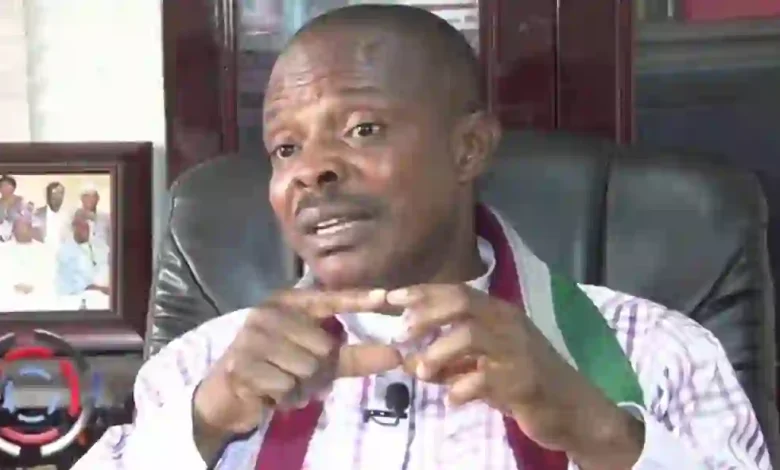
The President of the Nigeria Labour Congress (NLC), Joe Ajaero, has said the “age of prosperity” announced by President Bola Tinubu has not improved the lives of Nigerian workers. He also accused the federal government of failing to consult organised labour on policies that affect them.
Speaking on the “Mic On” Podcast, hosted by Seun Okinbaloye, Ajaero said higher costs of petrol, food, transport and housing have eroded workers’ purchasing power. He added that a lower inflation rate does not mean Nigerians are paying less for goods and services.
In his Independence Day broadcast on October 1, Tinubu said Nigeria had moved past the phase of emergency economic reforms into an “age of prosperity”. He said the “emergency treatment is over” and that the foundation of the economy had been repaired. Invoking the biblical story of the Israelites crossing the Red Sea, he said Nigeria had “passed through its own Red Sea” and should not look back.
Ajaero said the government had repeatedly cited falling inflation and other indicators as proof of progress, while ordinary Nigerians were still bearing the cost of earlier price increases.
“Prosperity is not (currently) with the Nigerian worker,” he said, though he added that he remained hopeful the promise could eventually be fulfilled.
Subsidy removal and the N70,000 wage
Ajaero challenged the administration to show where workers were feeling the gains of the reforms, pointing to the removal of the petrol subsidy and the resulting rise in pump prices.
He said labour accepted the N70,000 minimum wage partly because the government promised to cushion the effects of subsidy removal through cheaper Compressed Natural Gas (CNG) transport, vehicle conversion kits, cash transfers and other interventions. According to him, many of those promises were either not delivered at the required scale or brought little relief.
He recalled that during the wage talks, Tinubu indicated he could pay as much as N250,000 but was constrained by the implications for states and the private sector. Ajaero said labour deliberately avoided demanding a very high figure because raising nominal wages without addressing inflation and the exchange rate would not improve workers’ welfare.
“We either peg the new minimum wage based on cost of living index or on inflation,” he said, adding that future reviews should automatically reflect changes in the cost of food, housing and other necessities.
He warned that even a N500,000 minimum wage would be inadequate if living costs keep rising. “If I get N500,000 minimum wage, and I can’t pay my house rent, of what use?” he asked.
The core problem, he said, is the falling value of the naira and persistent rises in the prices of goods and services, not just the size of salaries.
To illustrate, Ajaero used the price of garri. If it rises from N20 to N30 and then to N32, he said, the smaller second increase does not mean the price has fallen. He rejected the idea that Nigerians were getting relief simply because inflation was slowing.
“The whole increase is a value on the consumer,” he said.
He also criticised the implementation of the N70,000 wage in some states, saying poorly handled consequential adjustments left workers worse off than expected. He noted that N70,000 is the minimum for the lowest grade level and step in the public service, not necessarily what every worker earns.
Petrol price and local refining
Ajaero said Nigeria’s status as an oil producer should shield its citizens from global price shocks through expanded domestic refining and guaranteed crude supply to local refineries.
He said petrol could sell for about N500 per litre if Nigerian crude were supplied to local refineries instead of forcing them to buy at international prices. “If you refine locally, you can even get N400,” he said.
He questioned the logic of exporting crude and importing refined products, citing the Dangote refinery and other private refineries, which he said cannot offer cheaper products if they buy crude at international rates.
Ajaero added that higher crude prices following geopolitical disruptions should bring Nigeria extra revenue to fund relief measures. He noted that the budget benchmark is about $70 per barrel, well below current international prices.
He also faulted the slow rollout of CNG infrastructure, saying a small number of CNG buses spread across the six geopolitical zones cannot change the transport situation in a country this large.
“If you give me a CNG bus and I can’t get any CNG station to fuel it, I will still be buying the same PMS that the price is still going high and high,” he said.
“This government doesn’t engage”
The NLC president accused the federal government of poor engagement with organised labour, saying this was fuelling tension. He said labour wrote to the President and at one point planned industrial action after getting no response, until some governors intervened and talks resumed.
“The government, this government, doesn’t engage,” he said.
He said some workers were still waiting for wage awards and other benefits meant to ease the immediate impact of rising living costs, and warned that the pressure could lead to wider industrial action if the government does not respond.
Ajaero said Nigeria’s problems predate the Tinubu administration but have reached a point that demands urgent intervention. He cited the decline in public transport, healthcare, roads, power supply and social safety nets, and called for more attention to pensioners and retirees.
He noted that each worker supports several non-working dependants, so improving workers’ welfare would have a wider economic impact. “Every worker takes care of at least six or five people who are not working,” he said.
Organised labour, he said, is not opposed to reforms but wants to be consulted on how they are implemented and what their consequences are.
2027 elections
On the 2027 polls, Ajaero said the NLC has not endorsed any presidential candidate or party. He said the union would engage candidates and present a workers’ charter of demands, and any candidate whose programme matches it could earn labour’s consideration.
Tinubu, Atiku, Obi “wrong” on subsidy
Ajaero also faulted the positions of Tinubu, former Vice President Atiku Abubakar and former Anambra State governor Peter Obi on the fuel subsidy. He noted that the three held similar views on subsidy removal ahead of the 2023 election.
“Peter Obi, Atiku and Asiwaju (Tinubu), they all have the same position and they have shown that they are market people from the far right,” he said.
He drew a distinction between the three and the Accord Party’s Gbenga Olawepo-Hashim and the Social Democratic Party (SDP) candidate, Adewole Adebayo, whose economic ideas he said deserve attention.
“I have looked at Gbenga-Hashim’s position and I think he’s an expert to an extent. I also looked at Adebayo. I may listen to them,” he said.
Ajaero said the question is no longer whether the subsidy should be removed, but how workers and other Nigerians should be protected from high energy costs.
Atiku demands details of N11.2tn NNPC claims
Meanwhile, Atiku, presidential candidate of the African Democratic Congress (ADC), has demanded a full account of the N11.2 trillion recorded by the Nigerian National Petroleum Company Limited (NNPC) as receivables from the Federation.
In a statement by his Director of Strategic Communication, Phrank Shaibu, Atiku called on the government to publish the contracts, payments and results tied to the spending, particularly on protecting oil and gas assets.
“Nigerians deserve to know how much of this enormous claim went to guarding pipelines, who received the money and what protection it bought,” he said.
He said NNPC’s 2024 accounts showed about N17.5 trillion in various claims on the Federation, including petrol under-recovery and other receivables linked to advances and asset protection, while its 2025 accounts show about N11.2 trillion in other receivables.
Atiku noted that the Ministry of Defence received about N3.1 trillion in 2025, less than a third of the NNPC figure. He acknowledged the two belong to different accounting categories but said oil-sector sums under Tinubu dwarf what is allocated to defending the country.
He also questioned whether firms linked to supporters of Tinubu’s re-election had benefited from government contracts. He cited Tantita Security Services, whose founder is Tompolo, over pipeline surveillance, and a company associated with the Chagoury family over the Lagos-Calabar Coastal Highway, which he said was awarded without open tender.
Atiku asked the government to disclose the contracts, payments and procurement processes, and to state whether any contractor had given financial or material support to Tinubu’s 2027 campaign.
“Tinubu’s government says it used restricted bidding. Then show us the invitations. Show us the competing bids. Show us the evaluation. Show us the contract,” he said.
He also referred to footage of the Minister of Works greeting a Chagoury as “my chairman”, saying a minister’s chairman should be the Nigerian people.
“The roads are bad. The economy is bad. There is no light. There is no safety. Families are hungry. Yet Tinubu calls this progress,” he said.
Atiku, Amaechi: We will bring back fuel subsidy
Over the weekend, Atiku and his running mate, Rotimi Amaechi, stopped at an NNPC filling station in Guzape, Abuja, where they were drawn into a conversation about petrol prices.
Amaechi, who was driving, told those present that an Atiku administration would lower petrol prices by reducing production costs.
Pressed on his subsidy pledge, Atiku replied in Hausa: “Zan dawo da tallafi insha Allah,” meaning, “I will bring back the fuel subsidy, by God’s grace.”
His remarks came less than two weeks after the presidency asked him to explain the legal, fiscal and practical basis of his proposed production subsidy on locally refined petrol. The State House argued that the Petroleum Industry Act (PIA) provides for market-determined prices unless statutory conditions for intervention are met.
Falana, ASCAB demand immediate cut in petrol price
Human rights lawyer Femi Falana (SAN) and the Alliance on Surviving Covid-19 and Beyond (ASCAB) have also urged the federal government to cut petrol prices without delay.
In a statement, ASCAB said disrupted crude supplies through the Strait of Hormuz, following the war between the United States and Iran, had pushed international prices above $100 per barrel. It said this made it more urgent for Nigeria to rely on its own crude and refining capacity rather than imported pricing benchmarks.
The group cited a presentation by US-based petroleum expert Prof. Izielen Agbon at its seminar on the state of the nation. Agbon questioned the basis of Nigeria’s fuel pricing, saying it made little sense for Nigerians to pay more for petrol than consumers in Texas.
ASCAB noted that G7 countries had announced plans to release 100 million barrels of diesel and crude from emergency reserves to ease prices, while other countries had introduced measures to cushion energy costs.
It lamented that Nigeria was not benefiting enough from its refining capacity, and accused the NNPC of fraud over its December 2024 claim that crude processing had begun at the Port Harcourt and Warri refineries.
While acknowledging efforts to revive the refineries, ASCAB urged the government to direct the 450,000 barrels per day of equity crude originally earmarked for the four refineries to domestic refining, so that petroleum products can be sold to Nigerians at affordable prices. It said this would give consumers immediate relief and reduce exposure to global price shocks.
READ ALSO: