Toyyibat Qasim
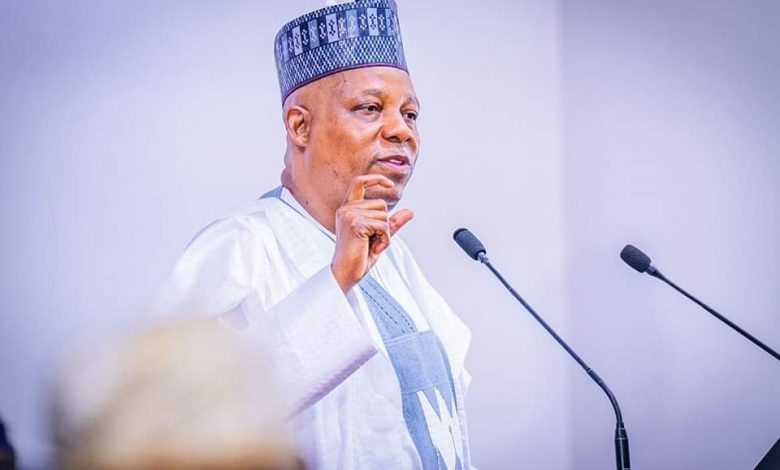
Nigeria will require an estimated $410 billion in additional investment by 2060 to achieve its net-zero emissions pathway, Vice-President Kashim Shettima has said.
Shettima said the massive financing requirement presented both a challenge and a major investment opportunity for domestic and international investors willing to participate in Nigeria’s transition to a low-carbon economy.
The Vice-President spoke on Tuesday at the second edition of the Decarbonising Infrastructure in Nigeria (DIN) Summit held at the United Nations House in Abuja.
He was represented at the summit, organised by his office in collaboration with the National Council on Climate Change and the United Nations Industrial Development Organisation, by his Deputy Chief of Staff, Ibrahim Hadejia.
The summit was themed, “De-risking Green Infrastructure Investment in Nigeria: Enabling Policy, Project Readiness and Risk-Sharing Solutions.”
Shettima said the government alone could not provide the enormous capital required to finance Nigeria’s long-term energy transition and infrastructure development.
He therefore called for stronger collaboration among government, private investors, development finance institutions, domestic financial institutions and institutional investors.
“Our energy transition plan estimates that Nigeria will require about $410 billion in additional investment above business-as-usual through 2060 to achieve our net-zero pathway,” he said.
“That is a significant financing requirement. But it also tells us something else: there is a very large investment opportunity ahead of us.”
The Vice-President said the central challenge was increasingly shifting from the formulation of climate policies to translating those policies into bankable projects capable of attracting financing.
According to him, investors require predictable policies, credible revenue models, adequate technical preparation and clearly defined risk-sharing arrangements before committing funds to major green infrastructure projects.
“We need the private sector. We need development finance institutions. We need domestic financial institutions and institutional investors. And, perhaps most importantly, we need projects that are properly prepared and capable of attracting that capital,” Shettima said.
He said Nigeria’s Nationally Determined Contribution 3.0 recognised the need to build a stronger pipeline of investment-ready projects, increase private-sector participation and improve access to climate finance.
The funding challenge was further highlighted by the United Nations Industrial Development Organisation’s Sub-Regional Representative in Nigeria and ECOWAS, Philbert Johnson.
Johnson said Nigeria’s physical infrastructure investment requirements were estimated at about $3 trillion by 2050, while tracked climate finance inflows remained significantly below the country’s needs.
According to him, Nigeria attracted an average of only $2.5 billion annually in tracked climate finance in 2021 and 2022, against an estimated annual requirement of $29.7 billion.
This, he said, translated into an estimated $27.2 billion annual financing gap.
Johnson identified policy and regulatory uncertainty, fragmented approval processes, unclear institutional responsibilities and inadequate revenue or offtake arrangements as major obstacles to financing green infrastructure projects.
“These projects sit at very different stages of maturity, from concepts which require feasibility work to projects ready to seek finance,” he said.