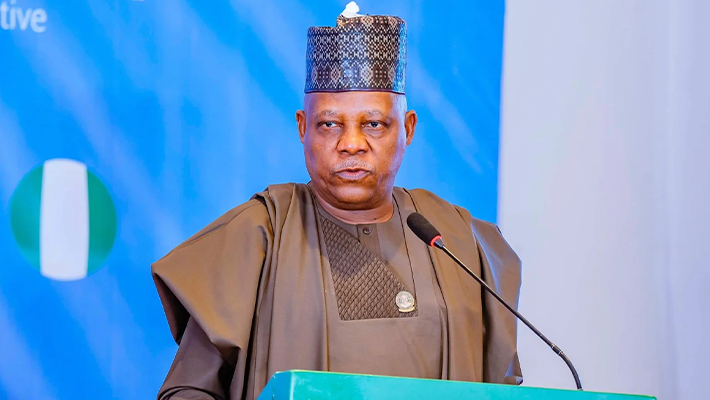
Shettima, who launched the NCMMP 2026–2036 during the National Capital Market Conference 2026, in Abuja, described the market as the bridge between citizens’ savings and Nigeria’s investment needs.
Minister of Finance and Coordinating Minister of the Economy, Mr. Taiwo Oyedele, said at the occasion that Nigeria should target a $1 trillion capital market within the next 10 years, stressing that a strong capital market is a recipe for the country’s envisioned $1 trillion economy.
Equally speaking at the conference, British High Commissioner to Nigeria, Pete Vowles, represented by Head of Green Growth and Private Sector Development at the British High Commission, Paul Healey, said Nigeria was now well positioned to tap the potential of the capital market.
Welcoming quests and stakeholders to the conference, Director-General of Securities and Exchange Commission (SEC), Dr. Emomotimi Agama, attributed the current advances at the Nigerian capital market to President Bola Tinubu’s reform agenda.
Relatedly, Deutsche Bank AG on Monday included Nigeria in its frontier foreign exchange monitor, indicating rising investor appetite for the naira amid prospects of further appreciation against the US dollar.
Shettima, who was represented by Deputy Chief of Staff in his office, Senator Ibrahim Hassan Hadeja, stated that the capital market was no longer merely a marketplace for investors, but it had become a strategic pillar of national economic policy and a critical instrument for Nigeria’s development aspirations.
He recalled that when the current administration assumed office in May 2023, the All-Share Index of the Nigerian Exchange stood at over 55,000 points.
He stated, “Today, it stands above 247,000. In just over three years, the index has more than quadrupled. The value of listed equities has grown from about N30 trillion to over N160 trillion. In January this year, equity market capitalisation crossed N100 trillion for the first time in our history. Add our bond market, and the total value of the market now exceeds N221 trillion.
“This is not only a naira story. Measured in US dollars, after we unified the exchange rate and let the naira find its true value, the Nigerian market ranked third out of 92 markets in the world by August this year, returning about 65 per cent.
“Global investors who once asked whether they could get their money out of Nigeria are now asking how much more they can put in. Behind those figures are real Nigerians: Pensioners whose retirement savings have grown, young investors opening their first accounts on their phones, and companies that have raised capital at home instead of borrowing abroad.”
The vice president tied the market’s growth to reforms undertaken by the federal government, including the removal of petrol subsidy, the unification of the foreign exchange market, tax reforms, bank recapitalisation, and the enactment of the Investments and Securities Act 2025.
He said despite the short-term costs of the reforms, they had helped to strengthen investor confidence by improving the policy framework and regulatory environment.
Shettima said the Nigerian Capital Market Master Plan 2026–2036 would place the capital market at the centre of infrastructure financing, enabling governments at the federal and subnational levels to fund long-term projects through domestic savings rather than rely excessively on short-term or foreign borrowing.
He added that the plan would also strengthen the bond market for subnational governments, broaden retail participation through technology and investor education, and provide opportunities for businesses in agriculture, solid minerals, and other sectors to raise capital locally.
The vice president, who chairs the National Economic Council (NEC), expressed a desire to work with state governors to encourage responsible use of the capital market through properly structured bonds, credible project pipelines, and greater transparency. He added that access to capital market financing could promote fiscal discipline and strengthen accountability in public spending.
While urging the market operators and regulators to sustain the momentum, he warned that policy reversals could undermine investor confidence and erode gains recorded in recent years.
Shettima stated that the success of the 10-year NCMMP 2.0 would depend on consistent policies, effective regulation, and the ability of market participants to protect investors, while expanding investment opportunities across the country.
In his welcome address, Agama said the giant strides and gains by the capital market did not come by chance. He said they were the fruits of the reforms spearheaded by Tinubu, citing the unified exchange rate, the end of fuel subsidy, and far-reaching tax reforms.