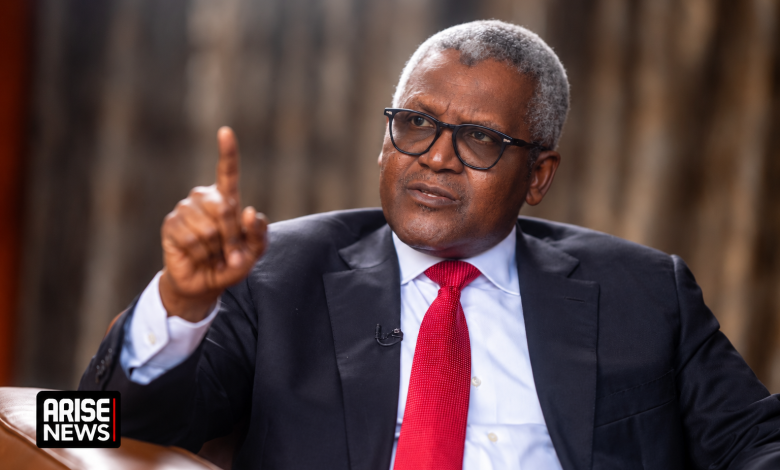
President of Dangote Group, Alhaji Aliko Dangote, on Thursday said the country risks remaining trapped in poverty unless it abandons its heavy dependence on trading and imports in favour of manufacturing and domestic production.
He stressed that no country had achieved lasting prosperity by selling what others produce.
Dangote spoke at the 25th Annual Conference of Women in Management, Business and Public Service (WIMBIZ), in Lagos.
He said the country’s continued celebration of trading at the expense of industrial production was undermining job creation, wealth generation and economic self-reliance, while policy inconsistency and inadequate electricity supply had made manufacturing increasingly difficult for local entrepreneurs.
Aftica’s richest man, in a keynote address titled, ‘The Geography of Opportunity: Why the World Needs What Africa Has’, further challenged Nigerian businesses, particularly women entrepreneurs, to move beyond conventional trading into production, processing and other value-adding activities, insisting that Africa’s enormous natural and demographic advantages would remain largely untapped without deliberate investment in industrial capacity.
He recalled his transition from trading to manufacturing, adding that the decision was driven by the realisation that the country’s business environment, particularly unreliable policies and poor power supply, had made industrial ventures difficult to sustain.
He explained that a retreat by his group challenged its management to abandon dependence on import licences and embrace backward integration by producing locally what it had previously imported.
That strategic shift, he said, laid the foundation for the group’s expansion into cement manufacturing and other industrial activities, demonstrating how domestic production could reduce import dependence and improve competitiveness.
Dangote cited the group’s cement operations as evidence of the benefits of industrial investment, noting that Dangote Cement had developed a robotic manufacturing plant and achieved production costs below $2.40, which he said were lower than those of Reliance Industries in India.
He also recounted the challenges surrounding the construction of the Dangote Refinery, which he said was initially dismissed by many international players as unrealistic.
According to him, some global contractors declined to undertake the project, while financial institutions were reluctant to support what they considered an excessively ambitious investment.
Rather than abandon the project, Dangote said the group assumed the role of its own engineering, procurement and construction contractor, taking responsibility for delivering the facility.
He disclosed that the refinery’s initial design capacity of 300,000 barrels per day was subsequently expanded to 650,000 barrels and eventually 700,000 barrels per day.
The industrialist further revealed that the group continued servicing $720 million in loan obligations every six months during the COVID-19 pandemic without securing repayment extensions, despite interest rates rising to as high as 40 per cent.
He described the experience as a lesson in the importance of understanding an investment, taking calculated risks and remaining committed to long-term objectives despite opposition and uncertainty.
Dangote said Africa could not afford to approach its economic future with limited ambition, particularly as the continent prepares for a major demographic transformation.
He noted that one in every four people globally would be African by 2050, yet the continent currently accounts for less than three cents of every dollar of global output.
He attributed the disconnect to inadequate planning, capital flight and the failure to convert Africa’s natural resource advantages into productive industrial capacity.