Enugu Generates N355bn From Non-Tax Sources As Mbah Credits Asset Recovery, Technology

Data published by StatiSense on its verified X handle, and quoting the National Bureau of Statistics (NBS), showed that tax revenue accounted for only N51.52 billion, or 12.67 per cent, of the state’s total IGR of N406.7 billion during the year.
The figures highlight the extent to which Enugu’s revenue expansion has relied on sources outside conventional taxation, amid Governor Peter Mbah’s insistence that his administration’s fiscal reforms and mobilisation of dormant public assets, rather than increased tax rates, are driving the state’s rising earnings.
The development comes after the NBS ranked Enugu among the leading states in IGR growth, behind only Lagos and Rivers, reinforcing the state’s position as one of the stronger performers in subnational revenue generation.
While Enugu recorded the lowest tax contribution to IGR, Abia State topped the tax-dependence ranking, with taxes accounting for 100 per cent of its N70.41 billion revenue.
The FCT also recorded a 100 per cent tax-to-IGR ratio, with its N356.34 billion IGR entirely attributed to tax revenue in the figures cited.
Bayelsa, Rivers and Sokoto followed with tax contributions of 99.39 per cent, 96.72 per cent and 92.44 per cent, respectively.
Other states with relatively low tax dependence included Kwara, where taxes represented 38.42 per cent of IGR; Katsina, 39.93 per cent; Osun, 41.53 per cent; and Ogun, 44.10 per cent.
Mbah cites asset recovery, revenue reforms
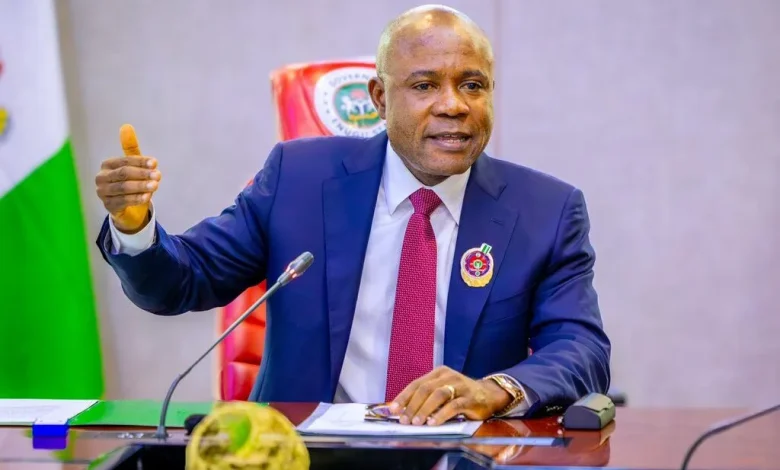
Speaking at a recent town hall meeting in Enugu, Mbah rejected claims that his administration had increased the tax burden on residents, arguing that the perception was being fuelled by political opponents and interests affected by changes to the state’s revenue collection system.
He attributed the growth in IGR to the introduction of technology to curb revenue leakages, the elimination of cash collections on behalf of the state government, and the recovery and commercialisation of previously underperforming public assets.
According to the governor, the administration had expanded the state’s revenue base by restoring dormant assets to productive use and developing new revenue-generating ventures.
Among the facilities he cited were Hotel Presidential, Enugu United Palm Products Limited, Nigergas, Nike Lake and the International Conference Centre, which he said had been recovered, completed, rehabilitated or repositioned to generate income.
Mbah also identified Enugu Air as part of the state’s emerging revenue-generating assets, noting that the administration’s strategy was focused on expanding the state’s economic base rather than placing additional levies on residents and businesses.
The governor said, “This is one falsehood that has been so peddled that it’s even beginning to take a semblance of a truth,” dismissing allegations of overtaxation.
Mbah said the scale of IGR growth had prompted some critics to assume that residents must have been subjected to higher taxes to account for the increase.
“But that’s far from the truth,” he added. The governor further explained that his administration had prioritised the closure of revenue leakages and the activation of assets that previously contributed little or nothing to the state’s finances.
“First of all, we plugged all the leakages. We ensured that nobody makes payments in cash on behalf of the state government,” he said.
He added that the government had also consolidated charges for certain services to reduce multiple collections and ease the burden on residents and businesses.