“Was El-Rufai’s Family Lawfully Denied Access?” — Court Reviews CCTV Footage, Reserves Judgment In ₦10bn Suit Against ICPC

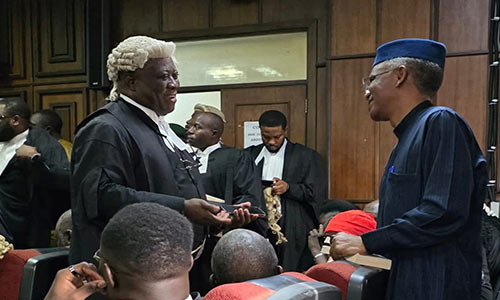
The Federal High Court in Abuja has fixed December 8 for judgment in the ₦10 billion fundamental rights suit filed by former Kaduna State Governor Nasir el-Rufai against the Independent Corrupt Practices and Other Related Offences Commission.
Justice Chigozie Onah fixed the date on Wednesday after parties in the suit adopted their processes and presented arguments for and against the application.
The suit, marked FHC/ABJ/CS/1852/2026 and filed on August 13, arose from el-Rufai’s allegation that the ICPC repeatedly prevented his wife, Aichatou Asabe, and his son, Abba el-Rufai, from visiting him while he was in detention and from bringing him food, medication and other necessities.
The former governor contended that the alleged denial of access violated his rights to dignity and private and family life as guaranteed under Sections 34 and 37 of the 1999 Constitution, as amended, and Articles 5 and 18 of the African Charter on Human and Peoples’ Rights.
He is seeking nine reliefs, including a declaration that his fundamental rights under Part IV of the Constitution remained enforceable despite his detention.
El-Rufai joined the ICPC Chairman, Musa Aliyu, and the Attorney-General of the Federation and Minister of Justice, Lateef Fagbemi, SAN, as the second and third respondents respectively.
During Wednesday’s proceedings, Justice Onah ordered the playback of closed-circuit television footage from cameras installed at the ICPC office as part of the evidence before the court.
The footage included an incident on July 7 showing Asabe arriving at the premises at about 2:37 p.m. with an officer to deliver food to el-Rufai.
Footage relating to an earlier incident on July 4 was also played before the court.
Counsel to el-Rufai, Ubong Akpan, argued that the footage did not establish that either the former governor’s wife or son breached any security protocol that would justify denying them access.
After the footage was played, the parties adopted their respective processes.
Akpan urged the court to determine whether the respondents had placed sufficient material before it to justify the decision to deny el-Rufai’s wife access to him.
He argued that any restriction placed on family access to a detainee must be supported by a clear and verifiable justification.
According to him, the alleged denial of access violated applicable legal standards, including principles contained in the Nelson Mandela Rules.
When the judge asked whether the Mandela Rules were directly enforceable in Nigeria, Akpan responded that they provided internationally recognised standards guiding the conduct of law enforcement agencies.
Counsel to the ICPC, Yetunde Mosunmola, however, urged the court to dismiss the suit.
She argued that the CCTV footage showed that Asabe had breached the commission’s security protocol on two occasions.
Mosunmola alleged that Asabe was smuggled into the ICPC premises on July 4 with the assistance of some officers on duty.
She told the court that the officers involved were subjected to disciplinary action and that one of them had been dismissed.
The ICPC maintained that any restriction imposed on access to el-Rufai was based on security considerations rather than an attempt to violate his fundamental rights.
After hearing arguments from the parties and reviewing the CCTV footage, Justice Onah adjourned the case until December 8 for judgment.
Post Title: “Was El-Rufai’s Family Lawfully Denied Access?” — Court Reviews CCTV Footage, Reserves Judgment In ₦10bn Suit Against ICPC By Papers Nigeria.