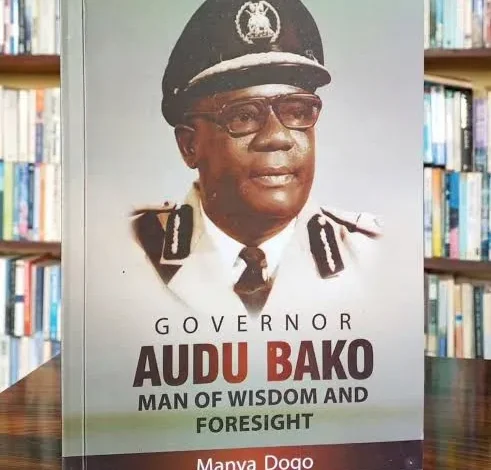
Eighty-nine-year-old retired Commissioner of Police Manya Dogo recently made public a book, “Governor Audu Bako: The Man of Wisdom and Foresight”, detailing the life and times of Audu Bako, the Commissioner of Police who served as the Military Governor of old Kano State from 1967 to 1975. CP Dogo wrote from an authoritative position, having served as Bako’s Orderly throughout his years as Military Governor.
The 155-page book has ten chapters, with a foreword by General Yakubu Gowon, Nigeria’s Head of State from 1966 to 1975, and under whose administration Bako served as a member of the Supreme Military Council. Gowon paid glowing tribute to his subordinate, praising him for (among other stellar qualities) sound leadership, and his employment of 300 Nigerians from the Eastern region, toward fulfilling Federal Government objectives of Reconciliation, Rehabilitation and Reintegration.
The author dedicated the book to the children and grandchildren of Governor Audu Bako, and also collected solemn tributes from all the former and serving Governors of Kano State from 1999 to date (including the present Governor of Jigawa State).
To enrich the work even further, the book, apart from its 155 written pages, contains 22 pages of photographs of the author and his boss in the line of duty and at official functions, including a picture of their children at the Government House. There are also photographs of Governor Audu Bako with General Yakubu Gowon and his wife, Victoria Gowon. Most striking is the portrait of Audu Bako’s parents, Dije and Bako, with his father in colonial police ceremonial uniform sporting his Regimental Sergeant Major’s insignia, and his mother dressed after the fashion of their era.
The author had worked under Audu Bako as an Orderly in the police before he was appointed Military Governor. They moved together to Government House Kano, where events narrated in the book, and beyond, transpired. True to Dogo’s chosen title, he classically analyzed Audu Bako’s wisdom, foresight and other leadership attributes which will be discussed in this blurb.
The tone of the book is a mix of solemnity and emotion. It is narrated from the lens of a faithful subordinate who served with devotion, sincerity and unalloyed dedication, along with deep admiration for the statecraft exhibited by his principal. The author seems to have held back on much of the betrayal and injustice suffered by his principal, especially after his exit from office and the circumstances leading to his demise in 1980. Still, he delved into a few of these distasteful episodes in detail. In summary, he is of the view that his principal was grossly unappreciated and poorly treated. The author only recently got the internal push to document his account, having been in two minds about the book for over four decades. He started writing in 1980, finally finishing after about 45 years of work (and over 50 years after the coup which ended the administrations of Gowon and Bako).
The author praised his benefactor for accommodating him and for the immense trust he reposed in him despite their religious and cultural differences. He narrated how his principal always adjusted their schedules to allow him to attend his Sunday worship. He described him as a man who embraced all, irrespective of religious and ethnic backgrounds. Governor Bako, he said, could travel without his ADC or Personal Assistant, but not without his Orderly, as the Governor once replied to his wife that Dogo was always available at every hour he needed him.
In Chapter One, the book details the family background of Governor Audu Bako, beginning with his father, Mallam Yakubu Ibrahim Bako, whose journey took him from Argungu to Sokoto, then to Zungeru, and finally to what is now known as Kaduna town, from the late 1800s to the early 1900s.
Yakubu, who was the father of Audu Bako, was born in 1878 to Ibrahim and Sa’adatu, in the then Augie village of Argungu District in present Kebbi State. Yakubu was given the moniker Bako (meaning “visitor” in Hausa) because he was born in the night when everyone was asleep, with the whole village waking up to the happy news of a new-born son. That name stuck more than his given name and stayed with him throughout his lifetime.
Dogo explains that Bako’s birth was about seventy-four years after the 1804 Usman Dan Fodiyo jihad which established the Sokoto Caliphate, and that even then the power struggles had not ceased, evidenced by the expedition launched by Sultan Abdulrahman against Kabawa when Mallam Bako was around 12 years old.
Bako, whose parents Ibrahim and Sa’adatu gave him a sound Islamic education befitting of the period, along with good cultural exposure, grew to be an honest, smart and dependable young man. At 18, he started working as a guide to British colonialists who were exploring the Sudan at the time, shuttling between Argungu and other areas in the region. From there he moved to Zungeru and then to Kaduna with the colonial officials. It was in Kaduna that the colonialists advised him to join the police in 1903. In Kaduna, as a police officer, he engaged in remarkable personal development which saw him promoted to the rank of Police Sergeant, Regimental Sergeant Major in 1915, and Major Inspector until his retirement in 1938. He was the first Nigerian instructor who undertook the training of police officers in the Northern Nigerian region.
Bako is also said to have played a role in the naming of Kaduna town. CP Dogo got this piece of history from late Hajiya Maryam Kurundu, Bako’s first daughter, who recounts: “He was in the company of white colonial officials with Lord Lugard in the lead, intrigued by the abundance of crocodiles in the river. They asked him what the Hausa word for crocodile was. He replied ‘Kadunan na’, the plural for Kada in the Sokoto Hausa dialect.” This encounter further informed the colonialists’ decision to name the river Kaduna. Dogo’s account tallies with the work of Dr. Yusuf Nadabo, particularly his 922-page book titled ‘’Tarin Garin Kaduna’’, first published in 1988, which I had the opportunity to read in 2015. In any case, the river itself lies barely four or five minutes’ drive from Mallam Bako’s residence at No. 4 Ahmadu Bello Way.
After his retirement from the police, the colonial government appointed Bako to preside over the Kaduna Mixed Court which served the three major ethnic groups of Hausa, Igbo and Yoruba. Being versed in both civil and Islamic law, he gave a good account of himself. Impressed with this development, the Emir of Zazzau, Alhaji Ja’afaru Isyaku, turbaned him the Sarkin Sabon Garin Kaduna in 1945. While Mallam Bako was making progress in active police service and in his post-service life, his son Audu Bako, who is the subject of the book, was also making progress in school prior to his own joining the police, which will be the next focus. But before then, his father Mallam Bako died in 1967 at the age of 89, a few months after the death of his wife Hajiya Dije (Audu’s own mother) at what is now known as Barau Dikko Teaching Hospital, Kaduna, then known as Nursing Home.
Audu Bako was born in 1924 while his father was serving at the police training school. He was originally named Abdu in their native Sokoto Hausa dialect. Their neighbors who were not conversant with the Sokoto strain of Hausa, instead pronounced his name as Audu. This eventually usurped the original Abdu as his known name. Growing up in the then small Kaduna Town, Audu was friends with the famous Yusufu Dantsoho of blessed memory. Audu acquired both Islamic and western education and after elementary school he proceeded to Zaria for his middle school and graduated in 1942, the very year he joined the police.
I will be brief on Chapters Two, Three, Four, Five and subsequent chapters because most of the issues discussed, especially his achievements as Military Governor and other legacies, have been narrated in the following books: “The Kano State of Audu Bako” by Suleiman Haruna in 1996 and “Kano State Under the Administration of Audu Bako 1967 to 1975” by Aisha Ni’ima Shehu in 2020. These accounts all documented Audu Bako’s strides which the author of the book under review recognized and cited in several chapters.
In Chapter Two, the author narrates how he came in contact with his principal in Kaduna after the 15th January 1966 coup while he was on duty at Government House Kaduna. During this episode, he escaped being killed by the mutinous soldiers, but his colleague, identified as Sergeant Yohanna Garkawa, was not so lucky as he was shot dead. After the sad event, he returned to his duty post at the same beat, and it was from this post that he and three other constables were invited for an interview at the Police Headquarters in Kaduna, after the countercoup of July 1966. He was selected as an Orderly to an Assistant Commissioner of Police, who turned out to be Audu Bako, the son of the famous Mallam Bako. From 1942, Audu progressed steadily in the force and was recognized for other national assignments, especially his commendable involvement with the Federal Government’s unsuccessful moves to persuade the secessionists to abandon their pursuits.
In Chapter Three, the author reeled out his principal’s journey in the police and his notable achievements. After his enlistment and basic training, he went to the United Kingdom at the Metropolitan Police Training School, Forensic Science College, Senior Officers Course at Ryton on Dunsmore, the Metropolitan No. 4 District Directing Staff Course, and Police Officers Course at the Department of Advanced Studies, all in the United Kingdom between 1942 and 1967.
Chapter Four narrates other activities which followed the July 1966 coup leading to the creation of 12 states, abolition of the four regions, and Audu Bako’s appointment as Military Governor of Kano State. The news was broken to him by the author and Audu Bako’s children, as he was on leave working on his farm when it was announced. Similarly, his appointment dredged up centuries-old history, as his Argungu kinsmen were so elated that they promptly dubbed him the avenger, drawing from an old account of how Sokoto triumphed over Argungu with the assistance of Kano. What began as a light joke nevertheless had roots in history and identity, but it was handled with maturity by all concerned. The Emir of Kano at the time of this quiet drama, Alhaji Ado Bayero, a former ambassador and police officer who was also Audu Bako’s cadet at the Police College, Kaduna, handled the situation with utmost care, and nothing untoward came of it. The author also mentions the names of the top officials who served under the governor on pages 42 and 43, as well as the reorganization of the civil service and other measures that strengthened it for greater efficiency and service delivery.
In Chapter Five, he outlines achievements recorded in agriculture, livestock development, and construction of over 20 dams, notably Bagauda and Tiga. He recalled giant strides in the health sector, the establishment of a health supply chain management system, health centers and dispensaries, employment of qualified doctors, reforms in the education sector, trade and industry, works, roads, transportation, land and survey, forestry. He extensively discussed the Kano State Five Year Development Plan and many other successes achieved.
Chapter Six unravels the secrets behind the breakthrough of his principal. The author describes the appointment as God’s design, because Audu Bako was a grandson of Kano, his mother hailing from Mariri Quarters, located to the east of old Kano City on the road to Maiduguri. It was there, the author explained, Audu Bako took his first steps as a toddler and grew to the age of circumcision before he was returned to his father in Kaduna to begin Qur’anic and western education. Even after that, providence brought him to Kano as an Assistant Commissioner of Police to take charge of Kano Metropolitan Area, a development that acquainted him with the town and gave him a deep understanding of the dynamics and complexities that later helped him to navigate issues as a Military Governor.
He highlighted several attributes that were the secrets of Governor Bako’s success: surprise visits to project sites at night, meetings with ordinary citizens, and separate confidential communication with Permanent Secretaries, Directors and others to check if the reports of these engagements tallied with the submissions of the Commissioners. His anti-corruption approach was preventive, introducing restrictive mechanisms rather than waiting for public funds to be embezzled. He created an open-door policy for appointees to exhibit their confidence. Security, law and order were of paramount importance to him as he consistently cross-checked the veracity of all security reports and ensured immediate action. He invested in human intelligence networks, even disguising himself in public to collect intelligence. He was meticulous, the author added, taking pictures with a camera and making diary entries daily.