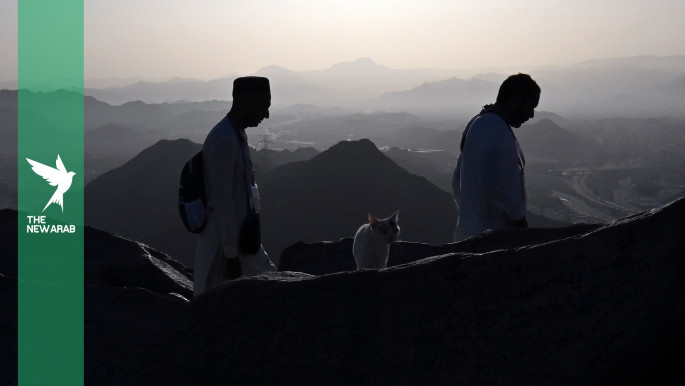
Amona Mukhtar has been saving for this journey for years. The 43-year-old Sudanese housewife, displaced by her country’s civil war and carrying the community’s hope alongside her own, was among 900 pilgrims accepted from Sudan’s Northern State for Hajj this year, which will take place from 25 May.
Her husband and brother pooled their savings to cover costs that have nearly doubled over the past year, to roughly 19 million Sudanese pounds, or around $31,600.
Neighbours contributed what they could, following a local tradition of collective giving that has taken on new urgency since the war stopped salaries, closed businesses, and emptied households.
“Most people this year don’t have the money for Hajj,” she told The New Arab. “The community decided that every person would give what they could to cover the pilgrims’ costs, because nobody has that kind of money anymore.”
Her story opens a window onto a Hajj season shaped less by religious ritual than by geopolitics. The US-Israel war on Iran, and the fear of its resumption, is reconfiguring who gets to travel, how they get there, and at what price.
Grounded by war
The most visible disruption is in the skies. Iraq’s Hajj and Umrah Authority has formally adopted overland transport for this year’s season, citing military and security uncertainties across regional airspace.
Sami al-Massoudi, head of the authority, said the switch was partly driven by soaring airfare costs but also by the risk of conditions changing mid-transit.
“Relying on air travel amid unclear conflict developments could produce airspace challenges and cost Iraqis the chance to perform Hajj entirely,” he said.
In Iraqi Kurdistan, officials are still assessing options. Karwan Stwany, spokesperson for the region’s General Directorate of Hajj and Umrah, said the decision would depend on “field developments in the region and their expected impact on aviation.”
The region has already been directly affected: according to Reza Barjizadeh, a US-based political analyst specialising in international affairs, Kurdistan has sustained missile and drone strikes during the ongoing conflict.
The rerouting of Kurdish and Iraqi pilgrims to land routes, he said, “reflects a precautionary operational approach, not panic.”
That distinction matters. For many pilgrims, an overland journey through the desert represents not just inconvenience but the full weight of a region at war pressed into their travel itinerary.
Iran’s reduced quota
Among the most closely watched developments is the sharp reduction in Iran’s Hajj quota.
This year, Iranian pilgrims will number around 30,000, down from 90,000 last year. The decline is a direct consequence of the US-Israel war and the uncertainty surrounding any resumption of hostilities.
There had been talk of cancelling Iran’s pilgrimage entirely; the reduced allocation is the compromise.
Ali Reza Rashidan, head of Iran’s Hajj committee, confirmed he held discussions with Saudi Arabia’s Ministry of Hajj and Umrah to secure necessary arrangements.
The Iranian ambassador to Riyadh, Ali Reza Enayati, subsequently announced that the first group of Iranian pilgrims had reached Saudi soil, with a second contingent expected shortly.
The diplomatic management of Iranian pilgrims has always been a sensitive subject, but this year carries particular weight.
Yassine al-Tamimi, a Yemeni political analyst, warned that renewed conflict could unravel Saudi-Iranian understandings around pilgrimage conduct.
“The greater danger,” he said, “is that Iranian pilgrims might be used to ignite conflict if other pilgrims from Iraq or Lebanon are mobilised to disrupt the sanctity of Hajj.”
Barjizadeh was more sceptical of deliberate interference.
“Any disruptions are more likely to be the result of escalation or miscalculation than intentional targeting,” he said, noting that “both the United States and Israel have strong incentives to avoid politicising the Hajj season.”
Iraq has taken a practical role in managing the flow. The country’s Interior Minister, Lieutenant General Abdul Amir al-Shamari, announced that Iraqi authorities would escort Iranian pilgrims through border crossings as part of overland convoys, coordinating with both Tehran and Riyadh to ensure safe passage.
The route runs from Karbala through the Arar border crossing under an intensive security plan involving Basra police.
Tightened controls, steeper costs
Saudi Arabia has introduced what amounts to the most rigorous entry management framework in recent memory.
At the centre is the “Nusuk” card, now mandatory for all pilgrims, carried at every stage from arrival to departure.
The card is required before visas are issued, and its rollout this year has extended to Morocco and Yemen, among other countries.
Officials in the industry describe a system designed to shut out a persistent black market.
Osama al-Hajouri, of a Yemeni land transport company, noted that Yemeni pilgrims registered through the Nusuk app partly to combat unofficial convoys run by smugglers charging cut-rate fares.
“Sometimes Yemenis cross borders informally,” he said, “and are then smuggled from inside the kingdom itself.”
The stakes for non-compliance are high. Saudi authorities have announced fines of up to 50,000 riyals (around $13,330) and six months’ imprisonment for those who overstay visas, and fines of 100,000 riyals ($26,660) for pilgrims who enter Mecca without authorisation. Five Egyptian residents were arrested just days ago after entering the holy city without permits.
Visa costs have climbed alongside the enforcement architecture.
A Hajj visa now runs to 2,300 Saudi riyals (around $613), up 300 riyals from last year. Premium “courtesy visas” — issued outside national quotas through royal court connections — have reached $1,300, with full packages touching $5,300.
Renewal of regular tourism visas has been suspended entirely to protect the integrity of the pilgrimage, a measure that has caught ordinary visitors in its sweep.
Proxy costs, human weight
All of this filters down to people like Amona, and to the families pooling small sums in northern Sudan to send someone to Mecca on their behalf.
Dr Heba al-Bishbishy, professor of political science at Cairo University, believes that despite everything, this season may draw larger numbers than recent years.
“Religious rituals intensify among Muslims during conflict,” she said. “People will not allow America and Israel to affect the performance of the most important Islamic religious rite.”
She added that umrah attendance could rise sharply once the pilgrimage season ends.
In her quiet preparation, attending training sessions, completing vaccinations against yellow fever, influenza, and meningitis, Amona carries her own small prayer inside a much larger one.
She wants to stand on the plain of Arafat. She wants peace in Sudan. And she still cannot entirely believe, she says, that she is actually going.
“Every time I sit with myself, I think: is it really possible that I’m going to Hajj?”
Shimaa Elyoussef is a freelance Egyptian journalist
This piece is published in collaboration with Egab