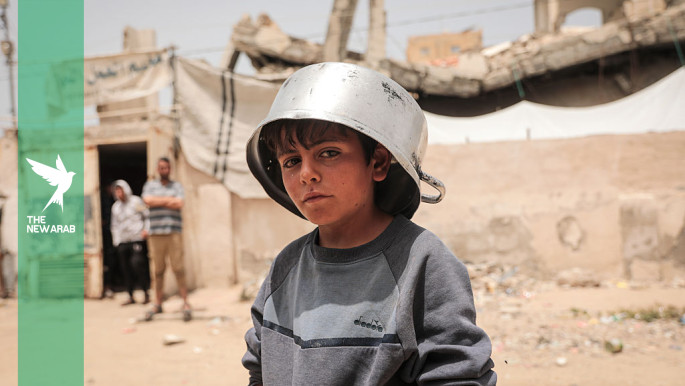
Displaced Palestinians, including many children, wait in long queues to receive hot meals distributed by a charitable organisation in Gaza City, Gaza, Palestine, on 18 May 2026. [Getty]
A deepening food crisis in the Gaza Strip is raising concerns among humanitarian agencies and residents as several major aid programmes scale back operations amid supply shortages, funding gaps, and ongoing access restrictions, according to aid workers and local sources.
In western Gaza City, a displaced mother of four, Majdolin Ezzat, said her family’s daily meals have become increasingly limited as access to food continues to shrink.
“Sometimes we eat only bread and tea for days,” she told The New Arab. “The children ask for fruit and meat, but these things have become a dream, especially after World Central Kitchen stopped distributing free meals for us.”
“Everyone is afraid of tomorrow,” she added, as she described life in a classroom-turned-shelter where her family now lives and said she had just gathered an empty cooking pot.
Inside the crowded shelter, there is no sense of routine left. Meals are uncertain, aid is shrinking, and hunger has become part of daily life for thousands of families across the enclave.
The World Central Kitchen (WCK), one of the major organisations providing hot meals across displacement sites in Gaza, has recently reduced parts of its operations.
The organisation has cited shortages of supplies, restrictions on the entry of food and fuel, and heightened security risks as key reasons behind the decision.
Before the reduction, WCK had been delivering hundreds of thousands of meals daily across various parts of Gaza, according to aid workers familiar with its operations.
Its scaled-back activity has raised concerns among displaced families who relied heavily on cooked meal distributions as their primary source of nutrition.
The reduction comes as United Nations agencies continue to warn of deteriorating food security conditions in Gaza.
In repeated alerts issued between December 2025 and April 2026, the Food and Agriculture Organisation (FAO), UNICEF, the World Food Programme (WFP), and the World Health Organisation (WHO) said approximately 1.6 million people in Gaza were at immediate risk of famine, citing collapsing humanitarian funding and declining aid flows.
Aid agencies say the situation has not significantly improved in recent months. According to humanitarian monitoring data, restrictions on the entry of supplies, including food, fuel, and medical items, have continued to affect delivery operations across the territory, even following the declared ceasefire in late 2025.
Israeli restrictions on the entry of humanitarian supplies have continued even after the declared ceasefire, with aid agencies and local officials saying tighter controls on crossings have further slowed the flow of food, fuel, and medical goods into the enclave.
Meanwhile, the Israeli army is continuing to attack the strip. Palestinian health authorities in Gaza also said that Israeli forces have killed at least 880 Palestinians since the fragile ceasefire came into effect.
According to the latest Integrated Food Security Phase Classification (IPC) data, nearly 77 per cent of Gaza’s population is now experiencing acute food insecurity.
Aid entering Gaza has dropped by 37 per cent compared to the period immediately following the October 2025 ceasefire. UN figures show more than 167,600 tonnes of aid entered during the first three months after the truce, before falling to less than 105,000 tonnes between January and April this year. Only 10 per cent of the required humanitarian funding has been secured.
Shrinking lifelines
In northern Gaza City, 47-year-old Umm Mohammed Hamdan told The New Arab that her family now depends mainly on rice and some bread, fearing that even these limited supplies could soon disappear as WCK operations scale back.
“We are afraid even this will end,” she said, referring to the small amounts of food they manage to secure.
Recalling earlier phases of hunger during the Israeli genocidal war, she said the situation today feels even more severe and uncertain than before.
“During the worst days, we had almost nothing and waited long hours for food aid,” she added. “Now we are trying to stretch whatever little we find, but it is never enough.”
Displaced more than four times since the war began, she said her youngest child has lost significant weight due to the lack of milk and nutritious food.
“My children sleep hungry. We survive on whatever we can find, but it is never guaranteed,” she said.
Across Gaza, aid workers say that the shrinking budgets and restrictions on movement are paralysing humanitarian operations.
Alaa al-Qudra, a Palestinian aid worker with a local organisation partnering with international food programmes, told TNA that the agencies are operating under extreme constraints.
“Some organisations have merged programmes or reduced beneficiaries because funding is no longer enough,” he said, adding that access restrictions are worsening shortages.
“There are serious difficulties in moving aid trucks and distributing supplies,” he said. “Flour, oil, and basic food items are constantly missing from the market.”
The impact is particularly visible in overcrowded shelters and displacement camps, where families rely almost entirely on humanitarian assistance.
In Deir al-Balah, 33-year-old Samer Abu Warda waits for hours outside food distribution centres in the hope of securing a single meal for his family of seven.
“People crowd because there is never enough. We often return with nothing,” he said.
He added that even hot meal programmes, once a crucial lifeline, are now being reduced or shut down, saying, “Free kitchens are closing because they don’t have supplies or funding.”
World Central Kitchen’s decision to scale back operations has further reduced the availability of cooked meals, leaving gaps that other overstretched organisations are struggling to fill.
Spreading hunger
Humanitarian agencies warn that the crisis is no longer limited to food sovereignty alone.
Mustafa Ibrahim, a Gaza-based political analyst, described the situation as a “compound collapse” affecting all aspects of life.
“This is no longer just hunger,” he told TNA. “What we are seeing is the breakdown of the entire system of survival in Gaza. Water networks are barely functioning, electricity is almost nonexistent for long hours, healthcare is overwhelmed, and housing conditions are deteriorating with every new wave of displacement.”
He said that the combined pressure of these crises is leaving civilians with no viable coping mechanisms.
“Families who depend entirely on aid are now left without alternatives,” he added. “When food distributions shrink, and services collapse at the same time, people are pushed into a situation where even basic survival decisions become impossible.”