
Most conversations about healthcare in Nigeria focus on what people can see — hospitals, doctors, equipment, and access. But another part of the system plays an equally important role, even though it is less visible.
Every hospital visit triggers a series of decisions behind the scenes. Eligibility has to be confirmed. Treatments must be approved. Claims are submitted, reviewed, and eventually paid. For years, many of these steps have depended on manual processes, which often lead to delays, inconsistencies, and limited visibility into how the system functions.
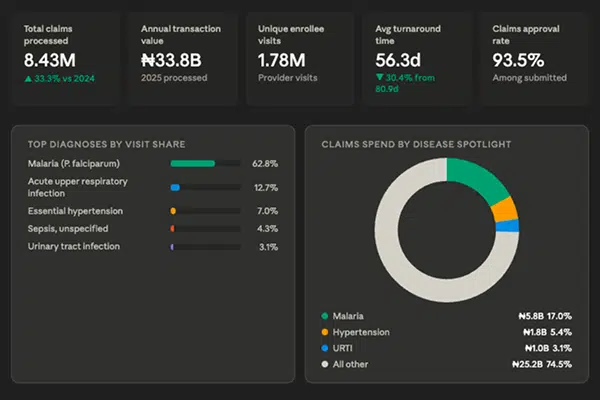
Using anonymised data from over 8.4 million claims processed across its platform, Medismarts provides a clearer view of what is happening within Nigeria’s healthcare system. The data shows not just how care is delivered, but how it is financed, approved, and sustained.
Between 2024 and 2025, total claims processed increased from 6.32 million to 8.43 million, a 33.3% rise in activity within one year. At the same time, the average time to process claims dropped from 80.9 days to 56.3 days. This means that even as more people used the system, the system became faster.
That combination points to something important. It suggests that improvements are not just happening at the surface level but also within the structure of how healthcare decisions are made.
What the data reveals about care, cost, and coordination
When healthcare data is viewed at scale, patterns emerge.
Malaria remains the most common diagnosis, accounting for over 60% of recorded cases. Upper respiratory infections follow, while hypertension continues to appear as a growing concern. Among children between 0 and 5 years old, malaria alone accounts for more than 400,000 cases in a single year.
These outcomes are not new, but the level of clarity is. Instead of relying on scattered reports, the system now provides consistent data on what people are being treated for, how often, and at what cost. This kind of visibility makes it easier to understand where pressure exists within the system and where attention is needed.
The data also shows changes in how claims are processed. In 2025, about 26.5% of approvals on the Medicloud platform were handled automatically, accounting for over ₦9.2 billion in claims. While human review still plays a role, this level of automation reduces delays and ensures that decisions are applied more consistently.

Victoria Fakiya – Senior Writer
Techpoint Digest
Stop struggling to find your tech career path
Discover in-demand tech skills and build a standout portfolio in this FREE 5-day email course
Financial flows are also becoming more structured. In 2025, over ₦33.8 billion in healthcare transactions were processed through the platform. Faster approvals and payments mean that healthcare providers can operate with more stability, which directly affects how quickly and effectively they can deliver care.
Another important insight is how healthcare activity is distributed. The top 10 hospitals account for ₦2.3 billion in claims, while the remaining providers account for over ₦31 billion. This shows that healthcare delivery in Nigeria is widely distributed rather than concentrated in a few large institutions. Any system designed to support healthcare at scale must reflect that reality.
Taken together, these patterns show that healthcare is beyond clinical care. It is coordination, how information moves, how decisions are made, and how payments are handled. As these processes become more structured, the system becomes easier to understand and manage.
What to watch in the coming year
The next phase of this evolution will be shaped by how these systems continue to grow and connect. As more providers, HMOs, and patients operate within shared digital environments, the volume of usable data will increase, and the picture of the healthcare system will become even clearer.
One area to watch is the expansion of automated decision systems. As more claims are processed through structured workflows, turnaround times are likely to improve further, and variability in approvals is likely to continue to decrease. This could make healthcare financing more predictable for both providers and insurers.
Another important shift will be in how data is used beyond operations. With clearer insights into disease patterns, regional trends, and treatment costs, there is an opportunity to support better planning at both the institutional and policy levels.
There is also the question of coordination. As digital systems continue to grow, the ability for different platforms to work together will become more important. Systems that can share data securely and operate within common standards will be better positioned to support long-term improvements in healthcare delivery.
What is becoming clear is that healthcare in Nigeria is no longer defined only by physical infrastructure. It is increasingly shaped by the systems that manage decisions, data, and financial flows behind the scenes.
As these systems continue to evolve, they will play a larger role in determining how accessible, efficient, and reliable healthcare becomes for millions of people.
About the Author
Obinna Osuji is a health-tech entrepreneur and Co-Founder of Medismarts, where he leads the development of AI-powered healthcare infrastructure solutions for HMOs and healthcare providers across Nigeria. His work focuses on healthcare automation, digital claims systems, and improving operational efficiency within the healthcare ecosystem.