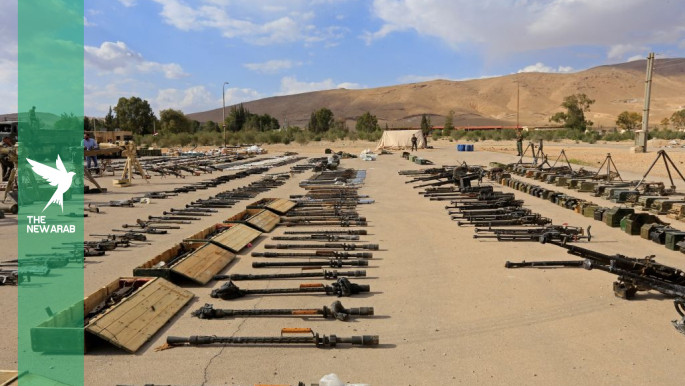
Iraqi security forces arrested two suspects over an alleged network smuggling advanced weapons through Syria to Hezbollah in Lebanon [Getty]
Iraqi security forces have arrested two suspects as part of an investigation into an alleged weapons smuggling network that transported arms from Iraq through Syria to Lebanon for Hezbollah, Iraqi sources told The New Arab.
The arrests came during an ongoing security operation overseen directly by Iraqi Prime Minister Ali al-Zaidi, following Syria’s announcement last week that it had intercepted a shipment of advanced weapons allegedly destined for Hezbollah.
According to Iraqi sources in Baghdad, security forces in the western province of Anbar, working alongside intelligence and investigative agencies, arrested two suspects identified as Saleh Mohammed Saleh and Hadi Sallal al-Jabri.
The sources said investigators were using surveillance footage and confessions to identify additional suspects connected to the network.
Security sources told The New Arab that the two men were not members of Iraqi armed factions but acted as intermediaries willing to facilitate smuggling operations for any party in exchange for payment, without political affiliation.
However, Iraqi sources said the seized shipment was not an isolated case, alleging that several previous consignments had successfully crossed into Syria before being transferred to Lebanon. They claimed the operations involved employees at Iraq’s western border crossing with Syria in Anbar province, as well as Syrian facilitators who allegedly helped move the weapons onward to Hezbollah.
Last week, Syria’s Interior Ministry announced it had foiled an attempt to smuggle what it described as a shipment of advanced weapons across the Iraqi-Syrian border, alleging that the cargo was bound for Hezbollah in Lebanon. Hezbollah denied the accusation.
Syria’s General Authority for Border Crossings and Customs said customs officers at the al-Tanf (al-Waleed) border crossing discovered a large cache of weapons concealed inside an oil tanker travelling from Iraq to the Syrian city of Baniyas.
According to the Syrian Interior Ministry, the shipment included long-range missiles, anti-tank guided missiles and drones. The ministry said preliminary investigations indicated the weapons were intended to transit Syrian territory before reaching Hezbollah in Lebanon, adding that Syria would not allow its territory to be used as a corridor for arms smuggling or activities threatening Syria or neighbouring countries.
In response, the Iraqi government announced the formation of a high-level committee, ordered by Prime Minister Ali al-Zaidi in his capacity as commander-in-chief of the armed forces, to investigate the incident, describing it as a matter of national security.
Iraq’s Security Media Cell said Baghdad would coordinate with Syrian authorities to establish the full circumstances surrounding the operation and hold any negligent officials accountable in order to safeguard the shared border.
A senior Iraqi officer in Anbar, speaking to The New Arab on condition of anonymity, blamed the influence of Iraqi armed factions at border crossings and corruption for allowing previous weapons shipments to pass undetected.
He said investigators believed earlier consignments had crossed into Syria and reached Lebanon without being discovered, alongside large sums of US dollars.
“The investigation is now focused on uncovering the wider network extending to Baghdad, including parties involved in organising and loading oil tankers,” the officer said.
He alleged that pressure exerted by Iraqi factions on border staff often prevented the inspection of specific vehicles, adding that a breakdown in coordination among collaborators on the Syrian side, allegedly linked to financial payments, may have contributed to the latest shipment being uncovered.
“The seized weapons were not the first shipment. According to the investigation, previous consignments successfully crossed and reached their destination,” he added.
The New Arab contacted four sources close to Iran-aligned Iraqi factions. Three of them confirmed that sending weapons to Hezbollah formed part of what they described as the “military support” provided to the Lebanese group.
One source said the supply routes had never ceased despite the change of government in Syria.
“The Iraqi factions have also provided Hezbollah with financial support on numerous occasions,” the source said. “Hezbollah represents the real will to resist the Israeli occupation, and the least that can be offered to fighters in southern Lebanon is money and weapons.”
Iraqi security expert Sarmad al-Bayati, however, said the Iraqi state had no official connection to any weapons transfers to Hezbollah.
“Iraq seeks strong relations with Syria, and the types of weapons reportedly seized by Syrian authorities are not registered with the Iraqi state,” al-Bayati told The New Arab.
“If the seized shipment did indeed originate from Iraq, then it came from actors operating outside the authority of the Iraqi government.”
Iraq and Syria share three main border crossings: Rabia (al-Yarubiyah), al-Qaim (Abu Kamal) and al-Waleed (al-Tanf). All have gradually resumed operations since the fall of Bashar al-Assad’s government in late 2024 as part of efforts to expand economic cooperation between the two countries.
Baghdad has also announced plans to expand exports through Syria to include crude oil, transporting fuel overland to Baniyas for onward export as part of the government’s strategy to diversify export routes away from the Gulf.
On 6 July, Iraqi and Syrian officials held what they described as their first joint border meeting to strengthen field coordination, intelligence sharing and border security between the two countries.