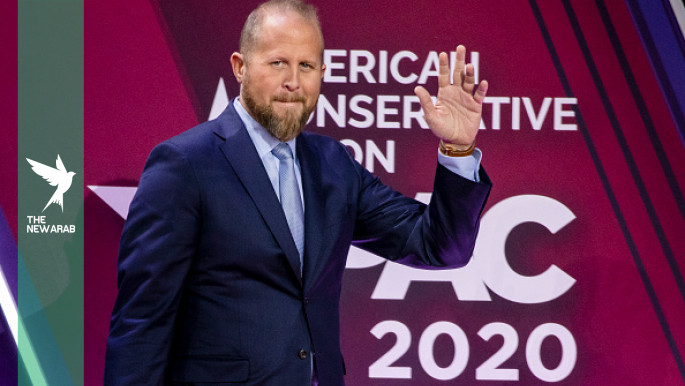
Brad Parscale has been contracted to rehabilitate Israel’s fractured image in the US [Getty]]
Israel has turned to AI-generated text messages, influencer outreach and conservative media partnerships in an effort to reverse a sharp decline in American public support for the country, according to an investigation in the US media.
The report by the Wall Street Journal said the Israeli government had signed a contract worth more than $45 million with Brad Parscale, a longtime adviser to US President Donald Trump, to run a campaign aimed at reshaping public opinion in the US.
The effort reportedly includes millions of AI-generated text messages, targeted digital advertising and content designed to influence responses from AI chatbots such as ChatGPT and Claude.
The campaign comes as polling shows support for Israel has continued to erode in the US amid its genocidal war in Gaza, as well as its joint war on Iran with the Trump administration.
According to a Pew Research Center survey cited by the Journal, 60 percent of American adults now hold an unfavourable view of Israel.
The AI text campaign reportedly sends messages from fictional individuals using names such as “Emma”, “Sarah” and “John” under the banner “Friends for Peace”, asking recipients for their views on Israel and US foreign policy before steering conversations towards pro-Israel messaging.
The outlet said millions of such texts had been sent to American mobile phones in recent months.
“The existential threat to Israel is misinformation, from any side,” Parscale told the newspaper, while denying any effort to undermine US negotiations with Iran.
According to the report, the contract with Parscale forms part of a broader expansion of Israel’s public diplomacy efforts.
Foreign Minister Gideon Sa’ar previously announced a 2026 budget of more than $700 million to strengthen Israel’s global messaging and “shape consciousness”, while the country has retained at least six firms to work on influence efforts in the US over the past year.
The report also claimed that Israel’s campaign extends beyond AI-generated messages.
It includes advertising on conservative media networks, outreach to evangelical Christians, work with social media influencers and the creation of websites intended to appear prominently in responses generated by AI chatbots.
One such website, Allyvia.org, was reportedly built by Parscale’s team as part of an effort to improve the information retrieved by AI systems when users ask questions about Israel. The report said one objective was to identify the public’s biggest concerns about Israel and feed that information back to the Israeli government.
The campaign has also drawn criticism from within Trump’s political coalition. Vice President JD Vance accused Israeli officials of “manipulating and trying to change American public opinion to keep the war going on indefinitely” during an appearance on Joe Rogan’s podcast, according to the Journal.
Steve Bannon, Trump’s former chief strategist, also questioned the arrangement, asking: “How is the second-biggest conservative talk network run by a registered foreign agent?”
Salem Media, where Parscale serves as chief strategy officer, said its hosts were not paid to promote specific views on Israel and that advertising purchases did not influence editorial content.
The WSJ said some recipients of the AI messages had become suspicious after discovering that “Friends for Peace” did not appear to exist as a registered organisation. Artist Beth Surdut told the newspaper she eventually concluded she was speaking to artificial intelligence.
“I said to it, ‘I don’t think you’re a real person’ – and it tried to talk me into thinking it was a real person,” she said.