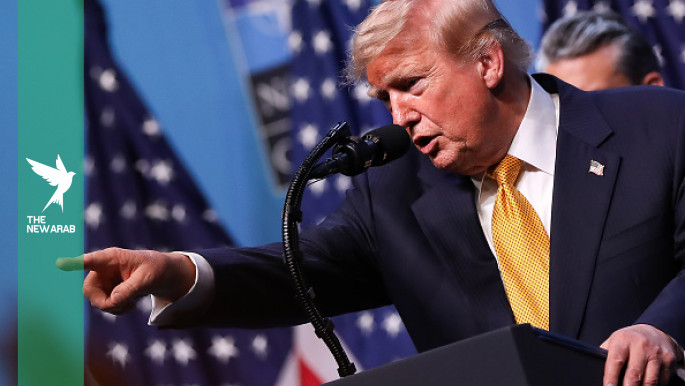
Since returning to office in 2025, US President Donald Trump has been taking steps to tilt the 2026 midterms in the Republicans’ favour.
This entails the unprecedented steps of mid-decade redistricting, legislation to restrict voting access, suggesting sending federal agents to polling stations, trying to relitigate the results of the 2020 election, plans to hold a midterm convention, and “joking” about running for a third term.
These moves, though widely criticised, are nonetheless taking place under a president whose party controls both chambers of Congress and has appointed the majority of Supreme Court justices. He appears determined to keep this control, regardless appearance.
Trump tries to prevent a repeat of history
Traditionally, midterms are something of a referendum on presidents and are often seen as a check on executive power.
It is common for the opposition party to do well in the midterms, as was the case during the presidency of Barack Obama and during Trump’s first term with the 2018 “blue wave” that ushered in progressive first-time US Congress members Alexandria Ocasio-Cortez, Ilhan Omar and Rashida Tlaib.
This November, according to polls, Democrats, including a number of outspoken progressives, are expected to sweep the 2026 midterms. This could lead to a third impeachment for Trump and other key checks on his power.
Redistricting
In the US, congressional districts are typically redrawn every 10 years following the results of the census at the turn of the decade, ideally a non-partisan process meant to reflect population shifts in different districts.
Over the past year and a half, Trump has led a redistricting overhaul in red states that has eliminated majority-Black congressional districts across the South and pushed some veteran lawmakers into retirement.
“When redistricting is conducted fairly, it accurately reflects population changes and our diverse communities, and is used by legislators to equitably allocate representation in Congress and state legislatures,” according to an explainer on the website of the American Civil Liberties Union.
It goes on to say, “When politicians use redistricting to manipulate the outcome of elections, however, it’s called gerrymandering—a practice that undermines democracy and stifles the voice of voters. Voters should be picking their politicians. Not the other way around.”
The SAVE America Act
The bill, whose full name is the Safeguard American Voter Eligibility Act, requires proof of US citizenship, which could include a passport, a birth certificate, a state identification card, a birth certificate, a naturalisation certificate, or a Native American ID card.
In-person verification would mean presenting one’s proof of citizenship to election officials. Voter ID would be required to vote in federal elections.
Anyone updating their voting registration would need to comply with these new regulations. The bill could potentially make voter registration more difficult for women who have changed their last name after marriage, as the name on their ID would be different from that of their birth certificate.
Federal agents at voting sites
The Trump administration have not ruled out placing federal agents at election polling stations.
In a congressional confirmation hearing earlier this month, acting Attorney General Todd Blanch sidestepped questions about allowing federal agents, such as Immigration and Customs Enforcement (ICE), near polling stations to monitor voters. When asked by Senator Amy Klobuchar if he would follow the law and not allow armed federal agents to polling sites, he said he would follow the law, no matter what it was.
Federal and state laws strictly prohibit armed troops from patrolling election sites, a policy that dates back to the civil war, to prevent the intimidation of voters.
Republican midterm convention
In June, Trump announced on social media the first Republican midterm convention, which is planned to be held in Dallas in July.
Party conventions are traditionally for general election years.
Though the Democrats are not holding their own midterm convention, they are hoping this event will help differentiate their candidates from Trump’s picks.
However, such an event does not raise legal questions about election interference, it is located in Texas, the state where Trump began his sweeping redistricting campaign.
Relitigating the 2020 election
In July 2026, Trump is once again invoking the 2020 general election that he lost to Joe Biden.
In a speech earlier this month, Trump accused China of interfering with the 2020 election.
He also attacked the election system itself. Multiple investigations have not found foreign or domestic interference.
A third term?
Trump has repeatedly suggested running for a third term, so much so that there is a Wikipedia page dedicated to the topic. When he has done so, it has been in the tone of a joke, often waiting to hear his audience’s reaction.
“Maybe we do one more term. Should we do one more?” Trump said at an event in Texas in February, eliciting cheers from the crowd. “Well, we’re entitled to it because they cheated like hell in the second one. We would actually be entitled to it.”
Under the 22nd Amendment of the constitution, presidents are constitutionally prohibited from holding office for a third term (though one of his allies, Andy Ogles of Tennessee, has suggested revising the amendment).
This law would normally be a comforting fact for democracy advocates.
However, Trump’s repeated suggestions of staying for a third term, along with her determination to rewrite election laws, have raised alarms.
This is in addition to a growing collection of projects designed to remake the capital in Trump’s image, structures that some have suggested are not typical of leaders who intend to leave.