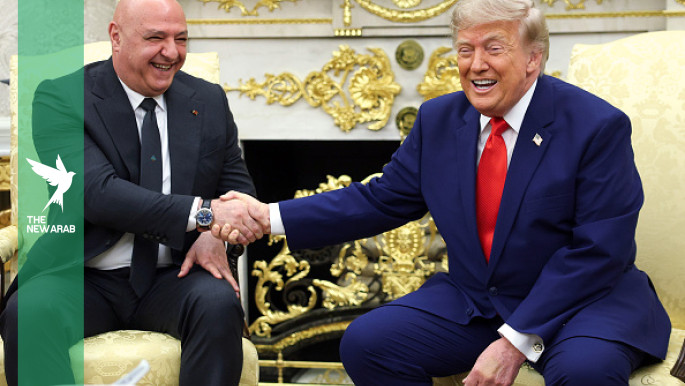
Despite warm words from Donald Trump, Joseph Aoun returned to Beirut without a US pledge to compel Israel’s withdrawal from southern Lebanon. [Getty]
Lebanese President Joseph Aoun left Washington without securing a clear US commitment or timetable for Israel’s withdrawal from southern Lebanon, despite receiving broad pledges of political, economic and military support from President Donald Trump.
The most tangible outcome of Tuesday’s White House meeting was an agreement to resume direct flights between Lebanon and the United States for the first time in more than four decades.
But the talks produced no binding pledge requiring Israel to withdraw from occupied Lebanese territory, even as Israeli forces continued attacks and military operations across southern Lebanon.
Trump publicly spoke of an Israeli “redeployment” rather than a full withdrawal and again linked US support for Lebanon to Hezbollah’s disarmament and the state’s ability to establish exclusive control over weapons.
He also suggested Syria could play a role in confronting Hezbollah and said he would be willing to speak to the group if Aoun requested it.
Official Lebanese sources told The New Arab that Aoun rejected any Syrian intervention during the closed-door talks, insisting Lebanon wanted relations with Damascus based on mutual respect for sovereignty, non-interference in internal affairs and cooperation on border security.
The sources added that Trump told Aoun that Israel should ultimately withdraw from all Lebanese territory and expressed readiness to support Lebanon’s economic recovery, provided Beirut implemented reforms and strengthened state authority over weapons.
However, no public timetable, enforcement mechanism or formal US guarantee was announced.
The absence of a concrete commitment came as Israel continued carrying out airstrikes, demolitions and excavation work across southern Lebanon, raising fresh questions over whether Washington is willing to pressure its ally to implement the June framework agreement.
Israeli forces also opened fire near Lebanese army units as they deployed in one of the first designated “pilot zones” under the trilateral agreement signed by Lebanon, Israel and the United States on 26 June.
The initiative aims to gradually transfer security responsibility to the Lebanese Armed Forces while Israel carries out a phased withdrawal.
However, local officials previously told TNA that none of the first three pilot-zone villages—Froun, Srifa and Zawtar al-Gharbiya—weren’t under Israeli occupation before the rollout, prompting criticism that the initiative risks becoming a symbolic test of the Lebanese army, as Israeli forces continue operating in surrounding areas.
Aoun travelled to Washington hoping to get greater US pressure on Israel to withdraw from southern Lebanon, as well as secure the release of Lebanese prisoners, support reconstruction and provide economic assistance.
Aoun says disarmament hinges on ending Israeli occupation
Speaking during his visit, the Lebanese president said Hezbollah’s disarmament was achievable only if the conditions that had long justified the group’s armed presence were addressed.
He argued that the process must begin with ending Israel’s occupation of Lebanese territory, continue with giving the Lebanese army full operational control backed by immediate and unconditional support, and conclude with state-led reconstruction and meaningful economic opportunities.
“A political path without an economic path is a state that cannot compete,” Aoun said, warning that the Lebanese state would struggle to replace alternative power structures unless it could deliver security and economic stability.
Despite Aoun’s emphasis on strengthening the army, Israeli military activity has continued to complicate its deployment across the south.
Expert says Hezbollah remains central to any deal
Adam Chamseddine, senior policy adviser at the Alternative Policy Institute, told TNA that Hezbollah would continue publicly rejecting direct negotiations with Israel and the practical steps associated with the framework agreement.
However, he said an armed confrontation between the Lebanese army and Hezbollah in the “pilot zones” remained unlikely.
“The seizure or destruction of infrastructure and underground facilities in these areas would introduce a different set of challenges and raise questions about how Hezbollah would respond,” Chamseddine said.
“Such a scenario is unlikely to unfold without prior talks between the party and the LAF, though how such talks would take shape remains unclear,” he said.
He said Hezbollah’s communication with the presidency remained indirect and there was no indication the group was ready to soften its opposition to the direct negotiations track.
According to Chamseddine, Hezbollah remains the central actor that must ultimately be engaged if the framework is to advance without triggering an internal confrontation.
“Such a confrontation appears to be desired by Israel, and perhaps by some Lebanese actors as well,” he said.
Although Aoun pledged in his inaugural address that the Lebanese state would establish exclusive control over weapons, Chamseddine argued that the process had yet to begin in any meaningful way.
“As a result, it remains unrealistic in its current form,” he added. “Hezbollah wants to be part of the decision-making process, but this appears to be unacceptable to both the Americans and the Israelis.”