Alleged Coup Trial: Court to Rule on Statements, Videos as Defendants Challenge Evidence

Zainab Abioye
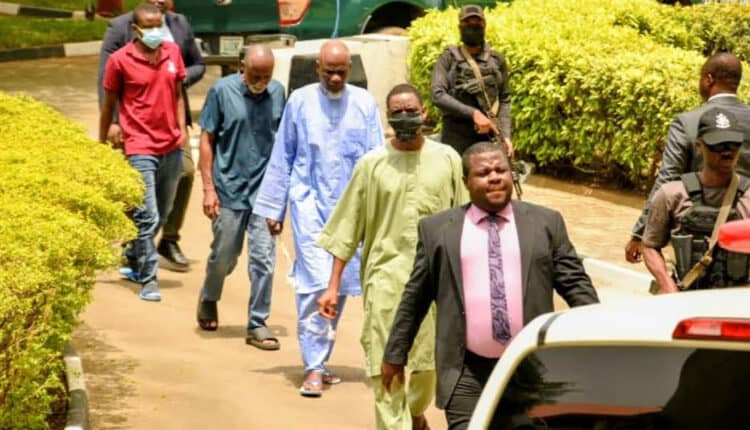
The Federal High Court sitting in Abuja has fixed December 7, 2026, for ruling on the admissibility of statements and video recordings the Federal Government seeks to tender in the ongoing trial of six persons accused of involvement in an alleged coup plot.
Justice Joyce Abdulmalik fixed the date on Wednesday after prosecution and defence counsel adopted their respective written addresses and presented arguments for and against the admissibility of the disputed evidence.
The proceedings arose from a trial-within-trial ordered by the court to determine whether the statements allegedly made by the defendants during investigations were obtained voluntarily.
The defendants had challenged the prosecution’s attempt to tender the statements and video recordings, arguing that the evidence was not voluntarily obtained.
The Federal Government, through the Office of the Attorney-General of the Federation, had on April 22 arraigned the six defendants on a 13-count charge in suit number FHC/ABJ/CR/206/2026.
The charge, filed on April 20 by the Director of Public Prosecutions of the Federation, Rotimi Oyedepo, SAN, contains allegations including treason, terrorism, failure to disclose security intelligence and money laundering linked to terrorism financing.
The defendants are retired Major-General Mohammed Gana, retired Navy Captain Erasmus Victor, Inspector Ahmed Ibrahim, Zekeri Umoru, Bukar Goni and Abdulkadir Sani, listed as the first to sixth defendants respectively.
Former Minister of State for Petroleum Resources, Timipre Sylva, was also alleged to be involved but is listed as being at large.
The trial-within-trial was ordered on May 11 after defence lawyers objected to the admissibility of statements and video recordings obtained during the investigation.
The objection came after the prosecution had called four witnesses.
The fourth prosecution witness, an army officer identified in court by the codename “AAA” for security reasons, had tendered video recordings of the defendants’ interrogations before the trial-within-trial commenced.
The prosecution subsequently closed its case in the trial-within-trial on June 23, while the defendants began presenting their defence on June 25.
Following the conclusion of the defence’s evidence, the court scheduled Wednesday’s proceedings for the adoption of written addresses by counsel.
With the addresses now adopted, Justice Abdulmalik fixed December 7 for her ruling.
During the proceedings, the court heard evidence concerning an alleged plan to compromise security arrangements around the Presidential Villa, Abuja.
The fourth defendant, Umoru, a Julius Berger Nigeria Plc employee attached to the Maintenance Department at the Presidential Villa, reportedly told investigators that discussions were held about shutting down electricity supply to the Villa as part of the alleged plot.
In video evidence played before the court, Umoru reportedly said he warned that such an action could immediately trigger an investigation and lead to the detention of workers on duty.
He further alleged that Col. Mohammed Ma’aji, whom he identified as an alleged mastermind of the plot, offered him money through the third defendant, Inspector Ahmed Ibrahim, to recruit between 18 and 19 people working within the Villa.
According to the account presented in court, the proposed recruits were to include soldiers, Department of State Services officials and Julius Berger personnel.