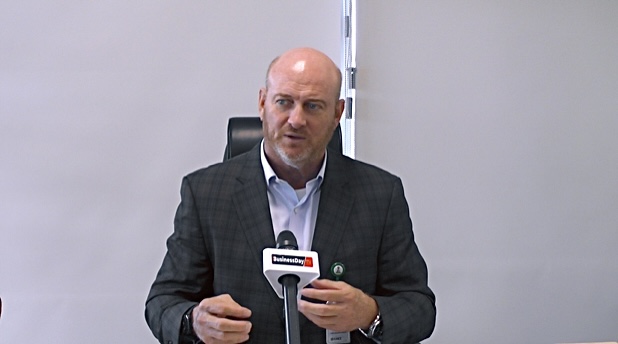
Brian Deaver, Chief Executive Officer of the African Medical Centre of Excellence (AMCE), Abuja
…As Aigbogun seeks shift in healthcare systems from resource allocation to tangible impact
Brian Deaver, the Chief Executive Officer of the African Medical Centre of Excellence (AMCE), has warned that Nigeria’s universal health coverage (UHC) ambition will remain out of reach unless the country fixes weak referral systems, accountability gaps and shortages of skilled healthcare workers.
Deaver said more funding alone cannot deliver universal healthcare, stressing the need for a connected system in which primary healthcare centres, diagnostic services, emergency care and specialist hospitals work seamlessly to ensure patients receive timely and quality treatment.
He spoke at the BusinessDay Health Conference 2026 in Abuja, under the theme, “Building Trust, Building Systems: Strengthening the Basic Health Care Provision Fund for Universal Health Coverage.”
He said universal health coverage was ultimately about “trust that healthcare will be available when it is needed”, irrespective of where a patient lives or their financial status.
“Trust is created when the entire circuit works, not merely when one component performs well,” Deaver said.
According to him, Nigeria’s high out-of-pocket healthcare spending means illness remains both a medical and financial burden for millions of households.
Citing World Health Organisation data, Deaver said out-of-pocket payments accounted for 71.9% of current healthcare expenditure in 2023, stressing that the Basic Health Care Provision Fund (BHCPF) must be assessed by the outcomes it delivers rather than merely the amount disbursed.
“The true test is whether a patient in a primary health setting can obtain an accurate and timely diagnosis, appropriate treatment and, when necessary, a seamless referral to a higher level of care,” he said.
Deaver likened Nigeria’s health system to an electrical grid, saying excellent hospitals would have limited impact if primary healthcare facilities, laboratories, pharmacies, emergency services, transport and referral systems remained disconnected.
“A brilliant hospital disconnected from the rest of the system is like a power station without a transmission line. Impressive, but unable to deliver its full value to people who desperately need it,” he said.
He identified transparency, functional referral protocols, outcome-based performance measurement, sustained investment in healthcare workers and digital systems as five priorities for strengthening UHC.
Deaver also disclosed that AMCE had registered more than 5,000 patients from over 20 countries and processed more than 40,000 diagnostic tests and investigations within nine months of receiving full licensure.
He said the centre’s experience demonstrated the demand for advanced healthcare closer to home, but stressed that specialised facilities alone could not build public confidence.
Frank Aigbogun, Publisher of BusinessDay Media Limited, in his welcome address, called for a robust system to drive accountability and build public trust in Nigeria healthcare system, without which he said investments may not yield tangible results.
According to him, while the Basic Health Care Provision Fund (BHCPF) remains a critical mechanism for supporting vulnerable populations, its success hinges entirely on operational transparency and administrative accountability.
He stressed that sustained healthcare financing alone will not deliver Universal Health Coverage (UHC) in Nigeria without robust systems to track funds.
“At its core, healthcare is about trust: trust that citizens will receive quality care, that public resources will reach those for whom they are intended, that health workers have the tools and support to do their jobs, and that the systems we build today will continue to work tomorrow.
“We need systems that track resources from allocation to impact, promote accountability at every level, equip health facilities to deliver quality services, and provide reliable data for decision-making. Most importantly, citizens must see tangible results from healthcare investments.
“Strengthening the BHCPF must therefore go hand in hand with transparency, accountability and measurable outcomes. Where citizens do not trust the system, access and confidence suffer; where providers cannot rely on funding mechanisms, implementation is weakened; and where impact cannot be demonstrated, investment and partnerships become more difficult,” he said.
Aigbogun who was represented by Oghenevwoke Ighure, managing director, BusinessDay media limited, noted that the private sector has an important role across healthcare delivery and financing, stressing that transforming Nigeria’s healthcare system cannot be achieved by government alone.
He stressed that the BHCPF presents an important opportunity for the development of the Nigerian healthcare sector, adding that”its success depends on building trust around the money and systems around the funding. For him, efforts must move beyond diagnosis towards solutions: identifying what works, and confronting what does not.
“Universal Health Coverage is ultimately about people the mother who should not have to choose between feeding her family and paying for healthcare, the child who deserves quality primary healthcare regardless of where they are born, and the healthcare worker who needs a functioning facility and the resources to save lives. Access to quality healthcare should rot be determined by income, geography or circumstance.
“At BusinessDay, we believe a healthier Nigeria is not only a social imperative but also an economic imperative. A healthy population is more productive, a stronger healthcare system creates jobs and investment, and affordable, quality healthcare strengthens the foundation for sustainable economic development.
“BusinessDay also believes that transforming Nigeria’s healthcare system cannot be achieved by government alone, The private sector has an important role across healthcare delivery, financing, technology, pharmaceuticals, insurance, diagnostics, Infrastructure, manufacturing and innovation.
He challenged stakeholders to build partnerships among government, business, development partners, healthcare professionals and communities and make those partnerships work at scale.