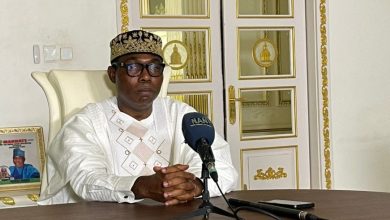
Kaduna State Governor, Uba Sani, has credited the late human rights lawyer and activist, Chief Gani Fawehinmi, with playing a decisive role in expanding Nigeria’s democratic space through his legal battles against restrictive electoral rules.
The governor spoke on Saturday in Kaduna at the public presentation of a book titled “Gani Fawehinmi and Uba Sani: A Tale of Mentor and Mentee,” authored by Mrs Basirat Fawehinmi Biobaku.
Sani recalled that Fawehinmi led the legal fight against tough conditions imposed by the Independent National Electoral Commission (INEC) on political associations seeking registration, at a time when many pro-democracy activists were becoming disillusioned. He said Fawehinmi refused to let that frustration curdle into despair, instead urging fellow activists to trust the judiciary and use democratic means to defend democracy itself.
According to Sani, Fawehinmi and former Kaduna governor Alhaji Balarabe Musa took the case to court, a legal battle that stretched more than two years before the Court of Appeal ruled in their favour in 2002. INEC’s appeal to the Supreme Court also failed, with the apex court affirming the judgment in January 2003 — a verdict Sani said cracked open Nigeria’s political space and cleared the way for more political parties to emerge.
“Democracy has a history, and every freedom has a cost,” the governor said, urging Nigerians to remember the people who fought for political plurality each time a new party registers.
Sani described Fawehinmi as more than a fighter for political freedom — a committed pan-Nigerian who believed in developing every part of the country regardless of region, ethnicity, religion or social class.
He also highlighted the lawyer’s investment in education, particularly through the Gani Fawehinmi Scholarship Foundation. Sani said he personally coordinated the foundation’s scholarship programme in Northern Nigeria and later persuaded Fawehinmi to launch a scheme for indigent university students across the region, given how severe educational deprivation was there at the time. The programme has since supported more than 1,000 students, many of whom are now doctors, lawyers, academics and engineers.
The governor recalled that at the scheme’s flag-off 26 years ago at Arewa House, Fawehinmi challenged Northern leaders to confront educational backwardness — a warning Sani said still rings true, given how many of the region’s present-day challenges trace back to underinvestment in human capital.
Calling Fawehinmi one of the most formidable Nigerians of his generation, Sani said he placed principle above comfort and justice above personal convenience, using the law as “an instrument of liberation” to defend ordinary citizens against arbitrary power.
Sani congratulated the book’s author for documenting a relationship he said spoke to courage, democratic struggle, social justice and the responsibility of one generation to prepare the next for service.
READ ALSO: