Nigeria’s maternal mortality crisis: What Ghana, Rwanda, others did differently


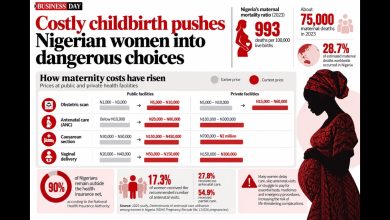
Nigeria’s maternal mortality ratio was estimated at 993 deaths per 100,000 live births in 2023, far above rates recorded in Ghana, Rwanda, Senegal and Ethiopia and exposing persistent gaps in the country’s ability to keep women alive through pregnancy and childbirth.
The country also recorded an estimated 75,000 maternal deaths that year, accounting for more than a quarter of the global total, according to international estimates cited in the data reviewed by BusinessDay.
At 993 deaths per 100,000 live births, Nigeria remains more than 14 times above the Sustainable Development Goal target of fewer than 70 by 2030.
BusinessDay’s analysis of the maternal mortality data, however, showed a wide gap between Nigeria and some African countries that have made faster progress in reducing maternal deaths.
Ghana recorded an estimated 234 maternal deaths per 100,000 live births in 2023, while Rwanda and Ethiopia recorded 195 each and Senegal about 237, compared with Nigeria’s 993.
This paper observed that Nigeria and these countries face many of the same causes of maternal deaths, including severe bleeding, hypertension, infections and obstructed labour.
The difference, experts said, is how effectively their health systems respond when complications occur.
Findings by BusinessDay showed that Nigeria has introduced successive maternal-health policies and programmes since the Safe Motherhood Initiative of the late 1980s, alongside primary healthcare reforms, health insurance schemes and donor-supported interventions.
It was, however, discovered that antenatal attendance alone cannot guarantee survival when facilities lack skilled personnel, blood, essential medicines, electricity, surgical capacity or functioning referral systems.
It was observed that institutional financial barriers compound those weaknesses.
According to the World Health Organisation (WHO), more than 70 percent of Nigeria’s current health expenditure comes from household out-of-pocket payments.
For low-income households, transport, consultations, laboratory tests, medicines, admission, blood, surgery and post-operative care can determine how quickly a pregnant woman receives treatment.
This creates what health experts described as the “three delays,” which include the delay in deciding to seek care, the delay in reaching a health facility and the delay in receiving appropriate treatment after arrival.
Nigeria’s national guideline on postpartum haemorrhage identified obstetric haemorrhage as a major cause of maternal deaths, with complications from severe bleeding accounting for about 42 percent of maternal deaths in the country.
It also identified delayed diagnosis, inadequate skills, poor supplies and the absence of safe blood and transfusion services as factors contributing to poor outcomes.
Bringing care closer
BusinessDay’s analysis found that Ghana’s experience illustrates one approach to reducing some of the distance and access barriers.
It was observed that Ghana’s Community-based Health Planning and Services programme, known as CHPS, was designed to take primary healthcare into underserved communities while involving residents in the delivery of care.
Ghana also introduced its National Health Insurance Scheme to reduce financial barriers to healthcare.
A WHO assessment of CHPS identified community engagement, financing, primary healthcare-oriented research, monitoring and political commitment among important elements of the programme.
Over the longer term, Ghana’s maternal mortality ratio fell from about 472 deaths per 100,000 live births in 2000 to 234 in 2023.
Skilled birth attendance reached 86 percent in 2022, according to WHO’s Ghana country strategy.
But Ghana’s experience also demonstrates the difficulty of maintaining programme quality during expansion.
A WHO review found that some of CHPS’s original community-engagement components had weakened or been overlooked as the programme grew.
BusinessDay observed that Rwanda offers another model, combining decentralised healthcare, community health workers and health insurance
Rwanda’s maternal mortality ratio declined from 870 deaths per 100,000 live births in 2000 to 195 in 2023, a reduction of about 78 percent.
The country’s Mutuelle de Santé community-based health insurance scheme was designed to reduce financial barriers to healthcare, while community health workers connect households, including those in rural communities, with formal health services.
For Nigeria, experts argued that the relevance lies less in adopting any one programme than in making the different parts of maternal care function together.
They noted that community health workers must be able to identify risks and connect women to functioning primary facilities.
According to them, these facilities need the staff and supplies to provide basic maternal care, while referral hospitals must be able to deliver emergency obstetric treatment.
They stressed that financial protection must ensure that inability to pay does not prevent women from reaching those services.
When operating theatre does not work
Senegal’s experience shows that the presence of a health facility does not necessarily mean emergency care is available.
In 2020, an audit by Senegal’s Directorate of Mother and Child Health found that 30 of 71 operating theatres assessed were non-functional. Seventeen were reportedly affected by shortages of trained personnel.
It was gathered that WHO and the Senegalese government subsequently supported the restoration of 10 operating theatres across 10 districts and trained doctors and paramedics in emergency care.
WHO revealed that the intervention was followed by hundreds of surgeries in the affected areas, alongside improvements in assisted deliveries and Caesarean sections and a decline in medical evacuations.
Senegal’s national maternal mortality ratio was estimated at about 237 deaths per 100,000 live births in 2023, compared with 392 in 2015.
The country also uses its Badiénou Gox programme, under which respected women in communities serve as links with the formal health system, encouraging women to recognise danger signs and seek care.
Learning from deaths
Ethiopia has also sought to strengthen the process of learning from maternal deaths.
The country introduced a national Maternal Death Surveillance and Response system in 2013 to identify maternal deaths, investigate contributing factors and use the findings to prevent similar deaths.
Its internationally comparable maternal mortality ratio declined from 870 deaths per 100,000 live births in 2000 to 195 in 2023.
Experts stressed that these approaches for Nigeria should determine whether each preventable death generates information capable of fixing the weakness that contributed to it
Nigeria targets high-burden areas
Findings by BusinessDay, however, showed that Nigeria has begun targeting some of the same weaknesses.
The federal government launched the Maternal Mortality Reduction Innovation Initiative (MAMII) in November 2024, targeting 172 local government areas across 33 states.
According to the Ministry of Health and Social Welfare, those LGAs represent about 20 percent of Nigeria’s LGAs but account for approximately 55 percent of maternal deaths.
MAMII aims to reduce maternal mortality by 30 percent and neonatal mortality by 20 percent in the targeted areas by 2028 and provide free, timely, and comprehensive care to about 2.9 million pregnant women.
The government reported in 2025 that maternal deaths had fallen by 17 percent in the targeted LGAs, while skilled birth attendance increased by 33 percent.
It also reported the recruitment of more than 15,000 community-based health workers, revitalisation of 435 facilities and about 4,000 free Caesarean sections in NHIA-empanelled facilities.
BusinessDay’s analysis showed that these government-reported figures will require sustained monitoring to determine whether the reported gains are maintained.
It was observed that the experiences of Nigeria’s peers suggest that there is no single intervention capable of solving the country’s maternal mortality problem.
Experts stressed that Nigeria needs to prioritise treatment for pregnant women in rural communities and provide facilities capable of receiving an emergency referral for people in hard-to-reach areas.
Imeh Johnson, a health expert, told BusinessDay that maternal deaths should trigger investigations into whether late presentation, referral failures, unavailable blood, absent skilled personnel, delayed surgery or inadequate equipment contributed to the outcome.
“For me, a maternal death should trigger more than statistics,” Johnson stressed.
This is the second part of BusinessDay’s series on Nigeria’s maternal health crisis. You can read the first part here and the second part here.