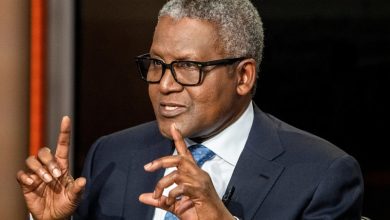
The Nigerian National Petroleum Company Limited (NNPC) Tuesday announced that it posted a 33 per cent increase in Profit After Tax (PAT) to N7.2 trillion in the financial year ended 2025, rising from N5.4 trillion in 2024.
According to the national oil company, this was despite a 24 per cent decline in its total revenue to N34.5 trillion. NNPC also declared a N5.8 trillion dividend and reported its strongest crude and condensate production in five years, averaging 1.77 million barrels per day.
The results, presented at the company’s headquarters in Abuja by the Group Chief Executive Officer, Bayo Ojulari, further showed a significant improvement in other key financial indicators, with Earnings Before Interest, Tax, Depreciation and Amortisation (EBITDA) rising 22 per cent to N18 trillion, while earnings per share increased 32 per cent to N35.9.
Besides, Operating cash flow grew 16 per cent to N12.8 trillion, while return on equity improved by 200 basis points to 16 per cent. The company’s board declared a dividend of N5.8 trillion, representing a 35 per cent increase over the previous year.
Speaking at the briefing, Ojulari attributed the stronger profit performance to improved operational efficiency and financial discipline, despite the pressures that affected revenue during the year. He said taxes, royalties and other remittances to the federal government rose 39 per cent to N22.3 trillion.
Ojulari said crude oil and condensate production averaged 1.77 million barrels per day, representing the company’s highest level in five years, while natural gas supply reached a three-year high of 7.2 billion standard cubic feet per day.
The improvement in production was also reflected in the company’s annual volumes, with oil and condensate production totalling 565.8 million barrels, up 5 per cent, while NNPC’s equity share increased 11 per cent to 223.7 million barrels.
In the same vein, natural gas production rose 9 per cent to 2,606.2 billion cubic feet, with NNPC’s equity share increasing 11 per cent to 1,154.9 billion cubic feet.
According to Ojulari, progress across the portfolio included completion of the AKK River Niger crossing and full completion of the 40-inch by 623-kilometre Ajaokuta-Kaduna-Kano mainline.
He explained that the NNPC also commissioned the ANOH-OB3 Custody Transfer Metering Station and advanced the 300MMscfd ANOH Gas Processing Plant to start-up readiness. It also acquired 500 CNG-powered trucks, and adopted a Technical Equity Partnership Model for its refinery reform.
Ojulari said the performance was the result of sustained attention to the company’s assets, infrastructure and execution, stressing that the stronger earnings would give NNPC greater capacity to invest and contribute to public revenue.
“Our 2025 performance shows what disciplined execution and a capable workforce can deliver. We are strengthening earnings, growing production and investing in the people and assets that will sustain value for our shareholders, communities and the Nigerian people,” he said.
He said NNPC was also strengthening its workforce through its Talent-to-Value programme, noting that more than 1,000 newly recruited professionals had completed a rigorous one-year internship and training programme and had been deployed across the company.
The company said it employed 1,023 full-time employees in 2025, while women now occupy 23 per cent of leadership positions, compared with a global industry average of 17 per cent.
Beyond its financial performance, NNPC announced that it recorded progress on several major infrastructure and operational projects during the year.
On the refineries, Ojulari said NNPC had made significant progress with prospective partners under its Technical Equity Partnership model.
He said the prospective partners had carried out a three-month intrusive, on-site due diligence exercise involving more than 30 senior technical personnel, with the objective of establishing a commercially viable and sustainable pathway for the refineries.
According to him, the new approach would require prospective partners to take equity stakes and share responsibility for the performance of the refineries, rather than simply executing rehabilitation contracts and leaving NNPC with the operational risks.