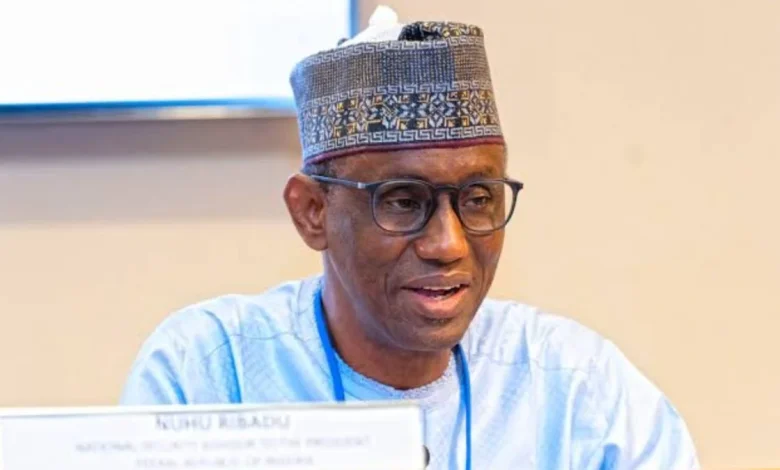
Otunba Segun Showunmi has written an open letter to the National Security Adviser, Nuhu Ribadu, urging him to establish clear boundaries for political conduct and ensure that individuals whose actions threaten national security are held accountable ahead of the 2027 general elections.
Showunmi, in the letter addressed to Ribadu, expressed concern over what he described as the growing toxicity of political conduct, reckless political communication and increasingly dangerous behaviour among politicians, their supporters and influential individuals.
Showunmi is a chieftain of the Peoples Democratic Party (PDP) in Ogun State, though he has recently been involved with President Bola Tinubu’s All Progressives Congress (APC) Presidential Campaign Council for the 2027 general elections
He warned that political competition, personal ambition and partisan disagreements should not be allowed to create additional threats to Nigeria’s stability, particularly at a time when the country is battling multiple security challenges.
“Enough is enough!” he declared.
According to him, there is a need to distinguish between legitimate political engagement and actions capable of threatening public peace, stressing that freedom of expression should not be used as an excuse to incite violence, promote ethnic or religious hostility or undermine national cohesion.
“There is a difference between robust political engagement and conduct that deliberately or recklessly threatens public peace. There is a difference between criticising government and deliberately inciting citizens against one another,” he stated.
Showunmi expressed concern over what he described as the normalisation of provocative statements, ethnic and religious insinuations, threats, inflammatory public performances and the manipulation of sensitive national issues for political advantage.
He argued that some politicians, party loyalists and influential supporters appeared to believe that their political positions or connections could shield them from the consequences of irresponsible statements and actions.
“That assumption must be firmly challenged. National security cannot be held hostage to political ambition,” he added.
Showunmi called on Ribadu to work with relevant security and law-enforcement agencies to establish and publicly communicate clear standards for political communication and behaviour as political activities intensify ahead of the 2027 elections.
He also urged security agencies to investigate credible evidence of criminal incitement, threats, intimidation and other unlawful conduct without considering the political status or influence of those involved.
According to him, serving and former public office holders, party leaders, political financiers, campaign spokespersons, social media influencers and ordinary supporters should all be subject to the same laws.
“There must be no sacred cows, no political exemptions and no selective enforcement,” he said.
Showunmi further called for a coordinated mechanism to respond to political misinformation and incitement, arguing that security institutions should be able to document incidents, verify information and correct false narratives before they escalate into violence.
He maintained that political parties and their leadership structures should also be held responsible for promoting responsible political engagement among their members and supporters.
Showunmi stressed that security agencies should not wait until inflammatory rhetoric results in violence before taking action, insisting that credible threats and organised intimidation should attract timely and lawful intervention.
“Prevention is always better than crisis management,” he stated.
He, however, clarified that his call was not intended to suppress opposition voices, silence critics of government or criminalise legitimate political disagreements.
Showunmi said democracy must accommodate dissent, criticism, protests and competing political views but should also protect the country from individuals who might exploit democratic freedoms to threaten national peace and stability.
“The government must be able to distinguish between legitimate political expression and conduct that crosses the threshold into criminality. That distinction must be made through established legal standards, credible evidence, due process and respect for fundamental rights,” he said.
He added that political actors also had a responsibility to protect the country’s security, arguing that national stability should not be left exclusively to soldiers, police officers, intelligence officers and other security operatives.
“The security of Nigeria is not a partisan project. It is a collective national responsibility,” he declared.
The letter was copied to President Bola Tinubu, Minister of Defence Christopher Musa, the Special Adviser to the President on Homeland Security, Adeyinka Famadewa, Inspector-General of Police Rilwan Tunji Disu, Director-General of the Department of State Services, Tosin Ajayi, and Minister of State for Defence Bello Matawalle.
Showunmi’s intervention comes amid growing political tension and allegations of intimidation and attacks involving supporters of different political interests ahead of the 2027 general elections.
Two days earlier, the National Youth Leader of the APC, Dr Dayo Israel, accused elements within the opposition, particularly supporters of the Obidient Movement, of orchestrating attacks and intimidation against supporters of President Tinubu.
Israel alleged that some Nigerians, particularly individuals in the creative industry, had become afraid to publicly identify with the President or express support for his administration because of the harassment they could face.
In a statement titled, “The Targeted Attack Against Tinubu Supporters Must End: We Will Not Be Intimidated,” the APC youth leader described the alleged incidents as a sustained campaign of hostility against Tinubu, First Lady Oluremi Tinubu and their supporters.
“What we are witnessing is no longer ordinary political disagreement. It is a deliberate, sustained campaign of targeted hate against President Bola Ahmed Tinubu, the First Lady, and every Nigerian who openly stands with him,” Israel said.
He claimed that comedians, entertainers, creative professionals, ordinary supporters and public officials had faced online attacks, threats and intimidation because of their political affiliations.
“Many in the creative industry have grown afraid to publicly identify with the President, not because they disagree with him, but because they know the personal cost of doing so. Families have been dragged into the fray. This is not politics. It is persecution,” he added.
Israel also cited the November 12 confrontation involving the Chairman of the Independent National Electoral Commission (INEC), Professor Joash Amupitan, in London.
Amupitan had spoken at Chatham House about preparations for the 2027 general elections before reportedly encountering Nigerian protesters who surrounded his vehicle, shouted insults and demanded his resignation.
The protesters reportedly accused INEC of favouring Tinubu and the APC, while questioning the commission’s handling of the preliminary voters’ register.
Israel alleged that some of the protesters were associated with the Peter Obi-led political movement, describing the incident as an attempt to intimidate an independent democratic institution.
He also referred to the reported disruption following Tinubu’s attendance at Juma’at prayers at the Shehu Shagari Central Mosque in Area 1, Garki, Abuja, on November 13.
The APC youth leader alleged that suspected opposition-sponsored thugs attempted to attack security operatives attached to the President’s convoy, with videos circulating online reportedly showing youths throwing stones and chanting rejection slogans.
However, Israel warned that further attacks against the President or his convoy would not be tolerated.
“Any further attack on the person or the convoy of His Excellency President Bola Ahmed Tinubu will not be condoned. Nigeria is a country governed by the rule of law, not the law of the mob,” he said.
The development also followed President Tinubu’s condemnation of rising incidents of violence at political gatherings on November 13.
The President urged politicians and their supporters to avoid violence as preparations for the 2027 elections intensify, directing security agencies to deal firmly with individuals involved in thuggery and other activities capable of disrupting public order.
“Every form of violence stands condemned. Violence should never have a place in our political campaigns as we move toward the 2027 general elections,” Tinubu said.
He also urged political leaders across party lines to take responsibility for the conduct of their supporters and avoid treating political opponents as enemies.
“As the leader of this country, I commit myself to a peaceful, free, and fair election, and I urge political leaders and supporters across party lines to conduct themselves responsibly,” he stated.
Tinubu added that Nigerians belonged to the same national community regardless of their political affiliations.
“I have said that being in different political parties or pursuing different ambitions does not make us enemies,” he said.
The President further declared that security agencies had been authorised to confront political thuggery and other anti-democratic activities, warning that his administration would not tolerate irresponsible conduct by politicians and their supporters.