Nigeria’s health per capita expenditure, less than cost of two bags of sachet water

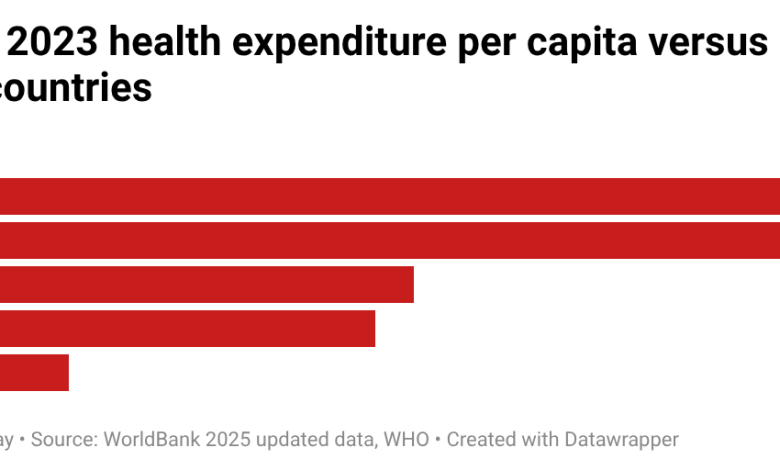
Nigeria’s health per capita spending has shrunk to the price of less than two bags of sachet water, exposing the fragility of a system struggling to meet basic needs, while increasing high rates of out-of-pocket spending.
Data from the 2026 federal budget shows that Nigeria’s N2.4 trillion health allocation for about 230 million persons translates to about N10,435 per person yearly, or roughly N869.6 monthly.
In everyday terms, that amount cannot buy more than two bags of sachet water at N500 each, highlighting how little is effectively set aside for individual health needs in a country of over 200 million people.
Experts say this level of spending is dangerously low and continues to drive a cycle of high out-of-pocket payments, worsening inequality, and mounting pressure on healthcare workers.
Read also: Why Nigeria’s health experts must leverage technology
Afekhide Omoti, professor of ophthalmology and newly elected president of the Nigerian Medical Association(NMA), shared similar concerns about the current conditions of the nation’s healthcare system.
“In some hospitals, doctors stay in rooms not fit for domestic animals. Yet we expect them to perform optimally,” he said.
He warned that poor welfare and harsh working environments are accelerating the exodus of medical professionals. “Our country is in crisis. There are no doctors. The few that are left are doing the work of almost ten doctors,” he added.
A population study by Wella Health involving 411 participants further exposes the human cost of weak health financing.
The study found that 86.4 percent of Nigerians pay for healthcare out of pocket, while 84.9 percent experience lasting financial, physical, or emotional strain after recovery.
“You’re one diagnosis away from being financially bankrupt,” said Segun Bello, a Lagos-based medical doctor and founder of Klinix Limited.
Experts note that chronic patients are the hardest hit. “While 70 percent of Nigerians pay out-of-pocket for health, chronic patients are affected the most as 89 percent of chronic patients bear the burden of healthcare alone because most insurance plans do not cover chronic cases like cancer” said Taofik Odukoya, founder of Vanguard Pharmacy.
Beyond low budgetary allocation, experts point to a persistent gap between what is approved and what is eventually released. “The gap between health allocations and actual releases has weakened the health system and limited access to essential health services,” noted Akinbode Oluwafemi of Corporate Accountability and Public Participation Africa(CAPPA).
For millions, the cost of staying alive is fast becoming unaffordable.
Africa and other countries
Rwanda’s health spending stood at about $76 per person annually, roughly $6.3 per month or N8,624, nearly ten times higher than Nigeria’s per capita allocation, according to CDC Africa data.
In Zambia, figures from Macrotrends show health spending at $74 per capita each year, translating to about $6.1 monthly or roughly N8,360.
Yet Nigeria is not an outlier in Africa’s low per capita health spending. More than 600 million people across Africa are unable to afford or obtain essential healthcare services.
With a high global disease burden the region continues to record the widest healthcare access gap globally, with rural communities and low income households bearing the greatest strain, according to African Business News.
“Out-of-pocket payments still dominate health financing in much of our region. In 31 member states, they account for more than a quarter of all health expenditure, in 11 countries, more than half, and in two countries, more than 70%,” noted Mohamed Janabi, WHO regional director for Africa.
“These financial pressures force families into impossible choices, between care and food, between medicines and school fees, between dignity and survival,” he added in a message marking Universal Health Coverage Day in December,2025.
There’s a huge funding gap as the World Health Organization (WHO) recommends a minimum of $249 per capita in public health spending to deliver basic services, yet between 2012 and 2020 only eight of 47 countries in the African region met that benchmark.
Way forward
The World Health Organization has recently called for stronger domestic financing for health systems across sub Saharan Africa, urging countries to raise their commitments beyond current levels in order to improve outcomes and expand access to care.
In Nigeria, experts have also argued that health spending must move beyond the longstanding benchmark of about 5 percent of the national budget if meaningful improvements are to be achieved.
“We must increase the nation’s health spending if we expect to see better health outcomes,” noted Taiwo Obindo, president of the Association of Psychiatrists in Nigeria(APN).
Beyond the size of the health budget, analysts stress that how resources are managed is equally critical. Strengthening transparency and improving efficiency in allocation are seen as key steps toward expanding access to essential primary healthcare services and reducing the heavy burden of out of pocket payments that many Nigerians currently face.
“Healthcare facilities should be structured in a way that there’s reduced reliance on the Federal government, this will enable proper and transparent management of resources, improve competition among healthcare facilities and boost better health outcomes,” noted Neto Ikpeme, a health economist.