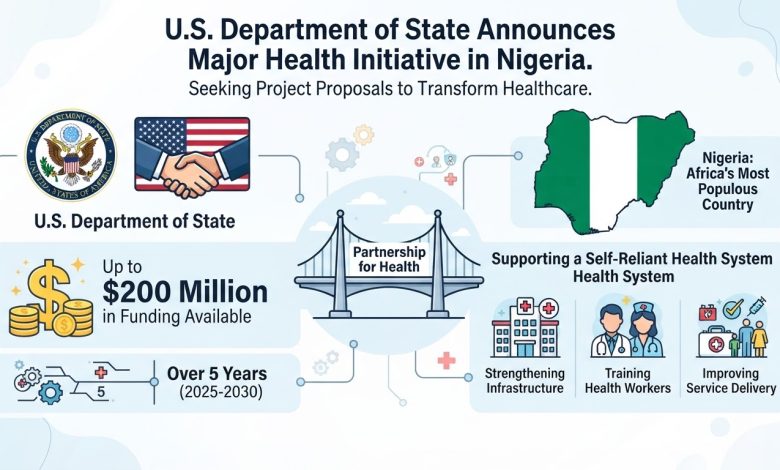
The United States Department of State is seeking project proposals for what could become one of its biggest health transformation efforts in Africa’s most populous country, offering up to $200 million in funding to support Nigeria’s move toward a more self-reliant health system over the next five years.
The funding opportunity, announced by the Bureau of Global Health Security and Diplomacy (GHSD), is part of the implementation of a Health Memorandum of Understanding (MOU) signed between the U.S. government and the Federal Republic of Nigeria in December 2025. The initiative, according to a document seen by BusinessDay, is expected to run through 2030 and could result in up to 20 awards, subject to funding availability.
Rather than financing individual disease programs in isolation, the U.S. wants organisations to propose projects that strengthen Nigeria’s health system as a whole while gradually transferring responsibility to Nigerian institutions.
Read also: Experts call for stronger partnerships to strengthen food safety in Africa
The approach aligns with the U.S. America First Global Health Strategy, which emphasises reducing long-term dependence on donor-funded programs and strengthening national health systems.
Donor dependence out of the window
The central message of the program is that Nigeria should increasingly own and finance its health services.
According to the document, projects should help build “sustainable, integrated, and accountable health services, systems, and institutions” while creating a “credible path to long-term Nigerian ownership, accountability, and financing.”
A solution to Nigeria’s fragmented health system
The proposal argues that many health services in Nigeria remain fragmented, with separate programs for HIV, tuberculosis, malaria, maternal and child health, immunization and disease surveillance.
Instead, applicants are encouraged to design integrated health services where patients can receive multiple types of care through a single system, particularly in faith-based and community health facilities.
The program specifically excludes government-run hospitals under one objective, focusing instead on strengthening faith-based and community-based providers while ensuring they remain connected to government health systems.
Expanding health insurance
One of the clearest priorities is expanding health insurance coverage.
The document says fewer than 20% of women and children currently have financial protection against healthcare costs in most Nigerian states.
Organisations are encouraged to work with the National Health Insurance Authority and state governments to increase enrollment, particularly for people living with HIV and tuberculosis, support premium payments, improve reimbursement systems for maternal and newborn care, strengthen claims verification, and help standardize benefits across state insurance agencies.
Stronger disease surveillance
Another major focus is preparing Nigeria to detect and respond to disease outbreaks more effectively.
The U.S. wants projects that strengthen the Nigeria Centre for Disease Control and Prevention (NCDC) and support integrated disease surveillance across all diseases rather than maintaining separate systems.
Suggested activities include strengthening Public Health Emergency Operations Centers, improving rapid response teams, conducting simulation exercises, improving specimen transport systems and expanding community-based disease surveillance.
Digital health takes center stage
The document also calls for a significant expansion of digital health systems.
Recipients would support the migration of U.S.-supported electronic medical records onto government-owned platforms across 4,000 health facilities.
The program also emphasises connecting major health information systems, improving interoperability, strengthening cybersecurity, protecting patient data and developing better tools for health planning and decision-making.
Supply chain weaknesses
The proposal identifies weaknesses in Nigeria’s supply chain for essential medicines and health commodities.
Read also: Tinubu’s ‘Iya Alakara’ joke revives debate over Remi’s business comments
Rather than directly buying or distributing medicines, funded projects would provide technical assistance to improve forecasting, warehouse management, logistics planning, workforce training and transition planning so government institutions gradually take over supply chain functions.
Laboratory systems are another priority.
Projects could support molecular diagnostics, genomic sequencing, laboratory quality systems, specimen transport networks, equipment maintenance and accreditation, with targets that include expanding testing capacity and improving turnaround times for diagnostic results.
Health infrastructure upgrade
Infrastructure upgrades are also included.
The U.S. wants support for improving reliable electricity and water supplies in at least 3,800 health facilities, alongside renovations, infection prevention measures and essential equipment.
The program also prioritises maternal and newborn care, including establishing intensive care units in selected Comprehensive Emergency Obstetric and Newborn Care facilities and upgrading at least 360 facilities with life-saving equipment.
Phasing out U.S.-funded salaries
Perhaps the most significant long-term change concerns health workforce financing.
Beginning in 2027, U.S. salary support for frontline health workers, including community health workers, nurses, doctors, midwives and pharmacy workers, would decline by 25% each year, with full transition to Government of Nigeria financing by the end of 2030.
At the same time, projects are expected to help government strengthen workforce planning, recruitment, retention, training and long-term financing.
Faith-Based organisations have a role
Faith-based organisations are expected to play a significant role in implementation.
The document encourages partnerships with Nigerian faith-based and community organizations but states that any religious activities must remain separate from U.S.-funded health services. Access to healthcare cannot depend on participation in religious activities or a person’s religious beliefs.
Focus on local leadership
Throughout the document, the emphasis is on building a health system that is integrated, coordinated and led by Nigerian institutions.
Applicants are encouraged to work closely with federal, state and local governments, community organizations and the private sector while ensuring strong accountability, transparent reporting and measurable results.
Interested organisations must first submit a Statement of Interest by July 31, 2026, as the first step in a two-stage application process. Successful concept notes may later be invited to submit full proposals for funding.