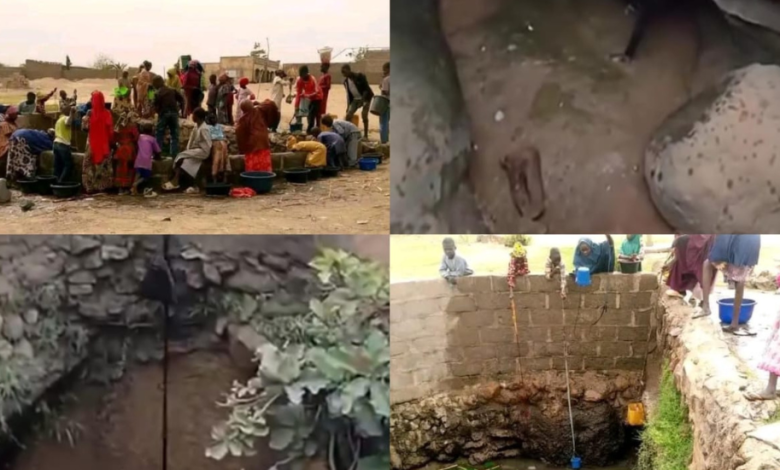
Residents of Kachi Ward in Dutse Local Government Area of Jigawa State are reportedly forced to descend into nearly dry wells in search of water, while others rely on open wells and ponds for their daily needs, exposing them to waterborne diseases such as cholera, among others.
The water crisis extends to other communities, including Gwaram, Rinyal, Facawa Matsango and other parts of Jigawa, where residents also face difficulties accessing water.
One of the affected residents, Kabiru Usman, lamented that residents depend on open wells and ponds for their daily water needs, putting them at risk of illnesses such as diarrhoea, cholera and guinea worm infection.
The situation highlights a troubling gap between government spending plans for water infrastructure and the delivery of basic services, as three state water agencies spent less than one-fifth of their combined N10bn capital budget in the first half of 2026.
An analysis of the Jigawa State Government’s second-quarter 2026 Budget Implementation Report by THE WHISTLER shows that the Jigawa State Water Board, Rural Water Supply and Sanitation Agency, and Small Town Water Supply Agency spent a combined N1.69bn between January and June, representing approximately 16.8 per cent of their capital allocation.
This left approximately N8.4bn unspent at the end of June, despite the critical need for reliable water supply across communities.
The unspent allocations come amid significant revenue inflows to the Jigawa State Government. Under Governor Umar Namadi, the state generated N13.2bn in the first half of the year, representing between January and June, 2026.
In addition to its internally generated revenue, Jigawa received N132.2bn as federal allocations between January and June, 2026. This leaves the Internally Generated Revenue and Federal allocations at N145.8bn between January and June, 2026. The state also posted an opening balance of N76bn according to details on official budget documents reviewed for this report.
The figures show that the state continued to receive substantial revenue inflows during the period when the three water agencies recorded low capital budget implementation. However, the revenue figures do not establish how much was available for water projects or whether the allocations were earmarked for the sector.
According to residents, there have been serious questions about the pace of water infrastructure delivery.
Investigation by THE WHISTLER also raises questions about whether budgeted projects are reaching residents who continue to depend on unsafe or unreliable sources.
The Rural Water Supply and Sanitation Agency, responsible for rural water facilities, boreholes and sanitation infrastructure, recorded particularly low capital budget performance.
Of its N4.16bn allocation for 2026, the agency spent only N507.1m by June, representing 12.2 per cent of its budget. Approximately N3.65bn remained unspent.
Several projects intended to improve access to water recorded no expenditure during the period.
The rehabilitation of 2,500 hand-pump boreholes, allocated N300m, recorded zero spending by June. Another N100m earmarked for rehabilitating 50 existing solar-powered boreholes also remained untouched.
Similarly, the construction of 30 solar-powered boreholes, with an approved budget of N500m, recorded no expenditure in the first half of the year.
The agency also recorded no spending on water facilities under outstanding 2025 constituency projects, despite an allocation of N716.17m.
Together, the four projects had N1.62bn budgeted for them, but none recorded expenditure by the end of June.
The rehabilitation of additional boreholes for existing water schemes performed better, with N247.58m spent from N601m, representing 41.2 per cent. The construction of new solar water supply schemes in urban towns recorded N113.31m in expenditure from N240m, or 47.2 per cent.
The Small Town Water Supply Agency also recorded low spending. It spent N319.2m of its N3.4bn capital budget, representing 12.6 per cent, leaving approximately N3.1bn unspent.
The Jigawa State Water Board recorded comparatively higher expenditure, spending N865m from its N2.5bn capital allocation. Its performance stood at 33.9 per cent, with about N1.68bn remaining unspent.
Although the Water Board recorded the highest spending performance among the three agencies, a substantial portion of its capital budget remained unused halfway through the year.
The second-quarter report showed that the agencies collectively spent N841m between April and June.
Experts who spoke to THE WHISTLER noted that the slow pace of spending is particularly concerning given the health risks associated with unsafe drinking water.
Usman Shehu, a private health expert, said contaminated water and poor sanitation could spread diseases such as cholera, diarrhoea, dysentery, typhoid and hepatitis A. He warned that inadequate water and sanitation services expose communities to preventable health risks.
The situation also raises concerns about Nigeria’s progress towards Sustainable Development Goal 6, which seeks to ensure universal access to safe and affordable drinking water by 2030. Safely managed drinking water must come from an improved source, be available when needed and be free from harmful contamination.
For residents of Kachi, Gwaram, Rinyal, Facawa and other communities facing water shortages, the concern is not simply how much the government allocates to the sector, but whether the money produces accessible and safe water.
With more than N8.4bn of the three agencies’ combined capital budget still unspent at the halfway point of 2026, the pace of project execution remains a critical question, particularly against the backdrop of the state’s revenue inflows.
The available budget and revenue figures provide a basis for seeking explanations from the agencies on procurement, project implementation and the reasons for delays.
As the year progresses, the key test will be whether the unspent allocations translate into completed water projects or remain largely on paper while residents continue to depend on open wells and ponds.
Efforts to reach the Jigawa State Commissioner for Information, Sagir Musa Ahmed, via calls and text messages were unsuccessful.