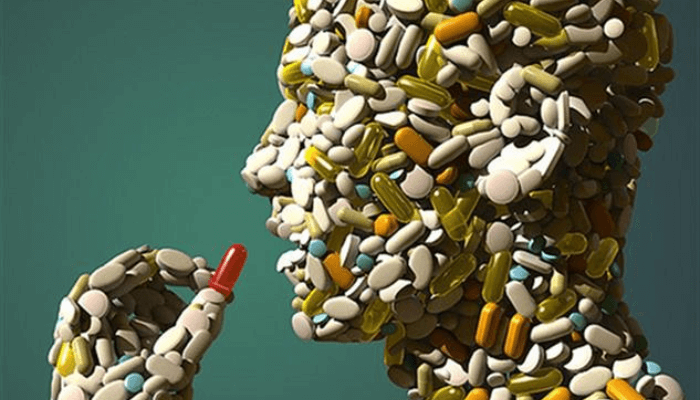
The high rates of self-medication in Nigeria have raised public health concerns among experts, who believe this behaviour is fuelling a $200bn global fake drugs market, according to the World Health Organisation (WHO).
The human cost of unlabelled medicine
On March 26 2026, Lagos resident Doris Osasogie, 33, noticed she could no longer move her legs. She initially dismissed the heaviness as minor discomfort, but her condition worsened over the following days. Her right leg became severely swollen, making it difficult to stand.
Osasogie was later rushed to hospital. After several medical tests, doctors could not immediately identify the cause beyond a possible link to medication she had been taking for two years, which appeared to have affected her blood circulation.
“I have been taking these blood tablets for the past two years,” she said, pointing to a small white container of unlabelled tablets. “I got it from a roadside vendor, and little did I know that it would put me in harm’s way.”
High prevalence across Nigerian demographics
Evidence shows that self-medication remains a major public health concern in Nigeria. Reports from the British Medical Journal indicate that individuals who self-medicate face up to a 95 percent risk of incorrect dosage or exposure to poor-quality drugs.
Read also: How insecurity is undermining Nigeria’s economic future
BusinessDay findings further show that 66.7 percent of Nigerians engage in self-medication, often visiting nearby pharmacies or patent medicine stores. In a survey of about 50 participants, 64 percent cited easy access, shorter waiting times, fewer bureaucratic procedures compared to hospitals, and lower costs as key reasons for the practice.
Pharmaceutical Society of Nigeria (PSN) former Nasarawa State chairman Agada Vincent has repeatedly warned Nigerians about the dangers. “We strongly denounce the growing practice of indiscriminate drug use without proper medical evaluation,” Vincent said.
Counterfeit drugs claim thousands of lives
Nigeria has a self-medication prevalence rate estimated between 52 percent and 92 percent. During a webinar marking the 2026 World Malaria Day, experts noted that about 95 percent of Nigerians self-diagnosing and treating malaria may not actually have the illness.
A recent study by the United Nations Office on Drugs and Crime reports that up to 500,000 people die annually from counterfeit drugs in sub-Saharan Africa. The report estimates as many as 267,000 deaths each year from substandard malaria drugs and up to 169,000 deaths from fake antibiotics used to treat pneumonia in children.
The WHO defines self-medication as the use of drugs to treat self-diagnosed conditions or symptoms, or the intermittent use of prescribed drugs for chronic illnesses. These include over-the-counter medicines, leftover prescription drugs, and herbal preparations.
Read also: Nigeria’s youth drug abuse crisis and the awakening of a Zombie Apocalypse
Countries such as Egypt, Thailand, and Indonesia have high rates of self-medication, with prevalence levels of 96 percent, 92 percent, and 75 percent respectively. A population-based study published on ScienceDirect found that El Salvador recorded the highest level among 12 Latin American countries at 79 percent.
In Africa, Togo recorded a prevalence of 34.2 percent during the study period. While self-medication can pose a serious health risk, the WHO also notes that correct self-medication based on well-informed decisions is critical to personal healthcare.
Strategies for primary healthcare integration
Integrating primary healthcare services with community-led pharmaceutical centres is critical to reducing self-medication. Business Day findings reveal that nearly 70 percent of Nigerians visit pharmacies as their first point of contact for healthcare.
Vanguard Pharmacy co-founder Kawthar Odukoya noted that expanding services such as rapid testing and vaccine administration through collaboration with primary healthcare centres (PHCs) is a key strategy.
“In-care rapid testing and vaccine administration in collaboration with PHCs have been critical in protecting our clients,” Odukoya said. Experts also emphasise leveraging technology for drug tracking to protect patients from exposure to fake medicines.